Colombia's new president may set the 2027 minimum wage alone. How high will he go?
Colombia's unions, business groups and government have until 15 December to agree the 2027 minimum wage. If not, the president sets it alone.
What happened
El Tiempo wrote in its editorial on that a deal on the 2027 minimum wage looks unlikely and that the government will probably set it by decree.
Colombia sets next year’s minimum wage every December. Under a law of 1996, unions, business groups and the government meet in a commission and have until to agree. If they cannot, they meet again before . If there is still no deal, the government sets the wage itself by . Each side votes by the view of most of its members, so a deal does not need every union.
The two sides start far apart. On Jaime Alberto Cabal, head of the traders’ group Fenalco, said the rise should not be more than 9%, and other business groups named 8.5 to 9.5%. Fabio Arias of the CUT union group asks for 38.5% because, he says, the country owes workers a historical debt. El Tiempo wrote on that the usual rule, inflation plus productivity, would give close to 8%.
The minimum wage is now 1,750,905 pesos a month. The government of Gustavo Petro raised it 23% for 2026, by decree, after the talks ended with no deal. Prices rose 6.29% in the year to September, against the central bank’s target of 3%. This time, without a deal, President Abelardo De La Espriella will set the figure. His finance minister, Miguel Gómez Martínez, said in July, before taking office, that the wage should grow as fast as productivity, and the president said when he took office that the minimum wage should not go down.
The talks on the wage itself have not started. The government plans to open them on instead of , and labour minister Natalia López said the date would be made official in the coming days.
Para la fijación del salario mínimo, la Comisión deberá decidir a más tardar el quince (15) de diciembre.
Law 278 of 1996, article 8, Senate of Colombia, in Spanish
Sources: El Tiempo (2, 3, 4, 5), Senate of Colombia, Infobae (2, 3)
The Pattern
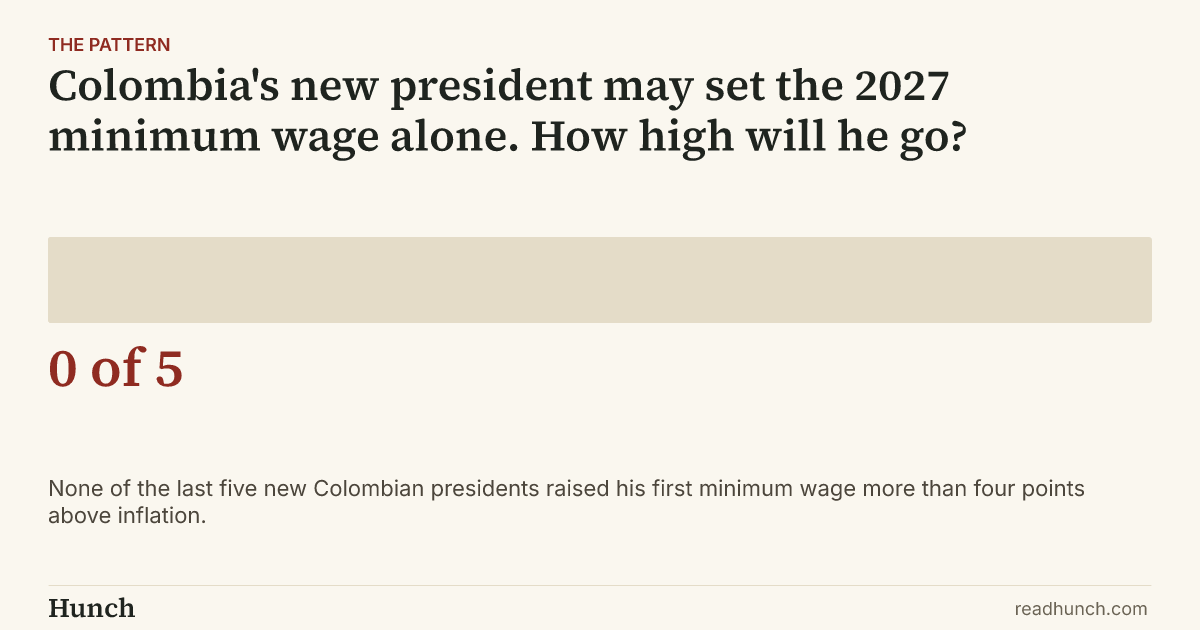
We looked for cases where a new Colombian president set a first minimum wage through the same commission of unions, business and government. We found five such years since 1998, one for each change of president. In three of them the government set the wage alone, and in two the sides agreed. (Government of Colombia; Government of Colombia; Government of Colombia; Ministry of Labour of Colombia; Government of Colombia)
Show the other 3 cases
The Read
Three of the last five new presidents, Andrés Pastrana, Álvaro Uribe and Juan Manuel Santos, set their first minimum wage alone. Only Gustavo Petro got a deal by , in 2022, and Iván Duque got one five days later. None of the five first wages beat inflation by more than three points. In 1998, when prices rose 16.70%, the rise fell 0.69 points short of inflation, and in 2022, when prices rose 13.12%, it beat inflation by 2.88 points. Analysts now expect inflation of 6.9% in December, so beating it by four points would need a rise above about 10.9%, more than any business group offers. An analysis in El Tiempo on said the government might still go above 10%, because 2027 is an election year.
There are reasons for doubt. All five years went through the same commission under the same law, and Colombia changed president only five times between 1996 and 2025. The last rise, 23% for 2026, was the largest above inflation in 40 years, according to Infobae, and it came by decree after no deal. The unions’ first figure, 38.5%, is far above the 12% and 20% they first asked for in 2018 and 2022. The labour side is also split this year: one part of the CGT union group joined the talks on its own, and in 2018 a deal was signed by most unions, not all.
Sources: Government of Colombia, DANE (2, 3, 4, 5), Infobae (2, 3), El Tiempo (2)
Disclaimer
Hunch works only from sources that are publicly available, and publishes on the basis of analysis of that material. We do not form an editorial opinion or take sides, we give a simpler and wider view of news that already exists. If information in a source we used was inaccurate, distorted, or later disputed but had already entered our analysis, Hunch accepts no liability for that. Predictions are not advice. Phase 1 markets use Hunch Points, not money.
Published by Hunch under the Editorial Code. Complaints and corrections: /contact/.