Colombia's president fast-tracks new taxes. Congress usually passes them late.
President Abelardo de la Espriella asked Colombia's Congress to fast-track his tax law. Even his own allies oppose the new taxes.
What happened
President Abelardo de la Espriella asked Congress on to treat his tax law as urgent, so that it can pass faster.
Colombia’s constitution ends this part of Congress’s year on . After that date, Congress meets only if the government asks it to, and then only on the government’s topics. A tax on a year’s income can only apply from the next period after the law starts. So a law must pass in 2026 for its taxes to work in 2027.
El primer periodo de sesiones comenzará el 20 de julio y terminará el 16 de diciembre
Constitution of Colombia, Article 138: the first session period starts on 20 July and ends on 16 December
On the government sent Congress a 106-article tax law. It names it the Economic Rescue Law, and it aims to close a budget gap of 2.2% of the economy, about 40 trillion pesos. The tax on coffee, sugar, flour and cooking oil would rise from 5% to 19% from , and the tax on company profits would fall from 35% to 31%. The government says seven of every ten pesos will come from cutting its own costs, while El País writes that the cuts give only 20% to 25% of the effect.
On the president asked for urgent treatment. Under Article 163 of the constitution, the law now goes before other business, and the money committees of both houses discuss it together in one first debate. After that, the Chamber of Representatives and the Senate each vote on it in a full session. Vice-President José Manuel Restrepo, who leads the defence of the law, warned that without progress by the end of 2026 Colombia would fail to pay its debts next year.
The parties backing the government hold 186 of the 286 seats in Congress. The largest of them is the Democratic Centre (Centro Democrático) of former president Álvaro Uribe. Its senator Honorio Henríquez, who leads the Senate, said he will not vote for any article that adds taxes: “Los colombianos no aguantan un impuesto más” (Colombians cannot take one more tax). Members of Salvación Nacional, the president’s own party, also oppose the higher tax on food.
Congress leaders have not given a date. Henríquez said the law must be reviewed “con calma, con detenimiento”, calmly and carefully. Carlos Meisel, a Democratic Centre senator on the money committees, said he could not give a date. El Tiempo reported that the committees must first finish a change to this year’s budget, and that an extra session after was not ruled out.
Sources: El Espectador, Senate of Colombia (2), Infobae, El Tiempo (2, 3, 4, 5, 6), El País (2)
The Pattern
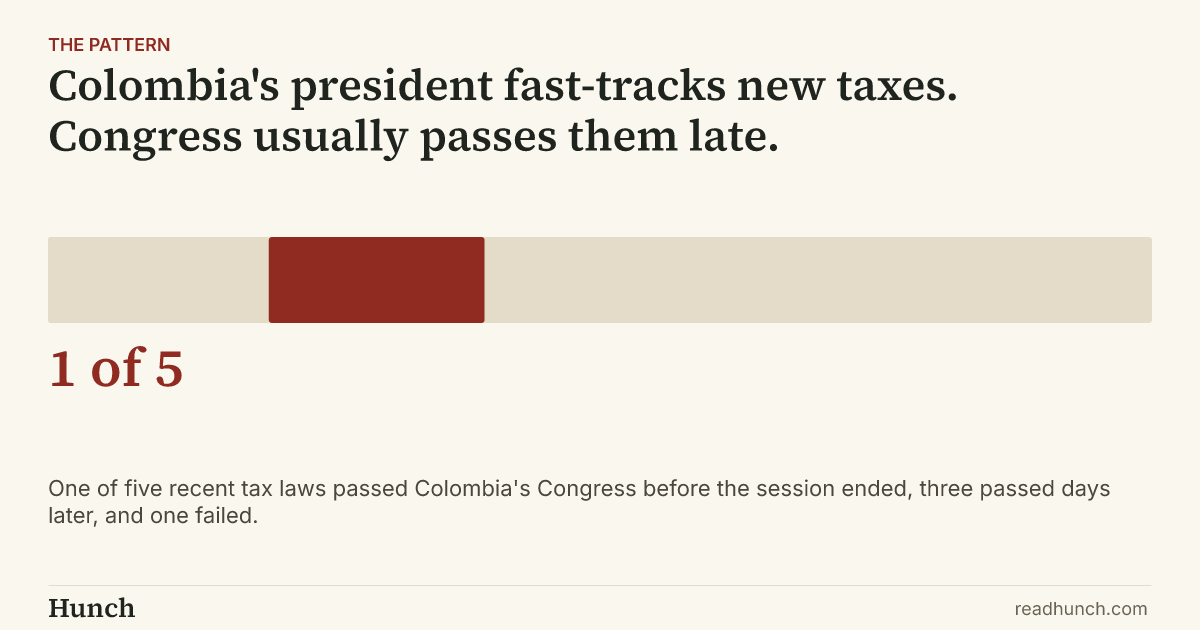
We looked for cases where Colombia’s government sent Congress a law to raise new taxes under the 1991 constitution, while the president’s parties were not in a minority and had not agreed the law with other parties in advance. We found five such laws from 2016 to 2025. One passed both houses before the session ended on . Three passed from three days to more than a week later, and one was rejected in a Senate committee.
Show the other 3 cases
The Read
The time is short. The one law of the five that passed before the session ended, in 2022, took 101 days from its start to the final text, and this law has 48 days, although the urgent treatment saves one round of votes. Congress leaders give no date, and an extra session after that date is not ruled out. Passing by looks more likely: four of the five laws passed before the year ended, and only the government can bring Congress back after . The taxes are harder. In the two passed laws where the figures are known, Congress kept between half and four fifths of the money the government asked for, and this time the Democratic Centre says it will back only the cuts.
There are reasons for doubt. Each time it was the same Congress deciding, and the 2018 and 2019 laws were the same law sent twice by the same government after a court ruling. Laws from 2006 to 2014 are left out because the dates of their final votes are not on open pages, and failed tax bills from before 2021 are not listed, so the past may look better for governments than it was. This year’s budget also had a majority in both houses, but it came out by decree after mistakes in the procedure. The government has offered parties no ministries, and Álvaro Uribe has told his lawmakers not to send the government names for public jobs.
Sources: DW (2), Swissinfo, El Tiempo (2, 3, 4, 5), Senate of Colombia, Portafolio, El Espectador (2)
Disclaimer
Hunch works only from sources that are publicly available, and publishes on the basis of analysis of that material. We do not form an editorial opinion or take sides, we give a simpler and wider view of news that already exists. If information in a source we used was inaccurate, distorted, or later disputed but had already entered our analysis, Hunch accepts no liability for that. Predictions are not advice. Phase 1 markets use Hunch Points, not money.
Published by Hunch under the Editorial Code. Complaints and corrections: /contact/.