Will MPs and peers ask to change the harm test in the conversion practices ban?
On 16 November Baroness Hilary Cass told MPs and peers she does not support the draft law to ban conversion practices as it is written.
What happened
asked at the Draft Conversion Practices Bill committee if she supported the bill’s current form, she said simply “no”.
In June the UK government published a draft law to ban conversion practices in England and Wales. These are acts meant to change or suppress a person’s sexual orientation or gender identity. Under the draft, an act is a crime only if it causes the person serious harm or serious distress, and the punishment is up to five years in prison or an unlimited fine.
serious harm to the individual’s physical or mental health, or serious alarm or distress to the individual which has a substantial adverse effect on their usual day-to-day activities
Draft Conversion Practices Bill, as quoted by BBC News, 16 November 2026
On Baroness Hilary Cass said “no” when the committee asked if she supports the draft as written. She led the 2024 review of NHS gender care for under-18s, and the government quoted her support in June. She says she gave that quote before reading the details. She says the harm wording could open therapists to complaints and even prosecution, and she told the committee that parents could be at risk too.
Others support the draft. A group of more than 25 health, counselling and psychotherapy organisations backs it, and so does the charity Stonewall. The bill has also drawn criticism from religious leaders and a former head of Britain’s rights watchdog, and there are calls to drop it. The government says the law will only cover acts that cause “real harm”, and that it will take all evidence put forward by the committee seriously.
The committee must report by . The Lords set this date on and the Commons agreed. The committee hears more witnesses on 19, 23 and . The report goes to the government, which in past reviews answered each recommendation in writing.
Sources: BBC, The Guardian, UK Parliament, UK Parliament (2), GOV.UK
The Pattern
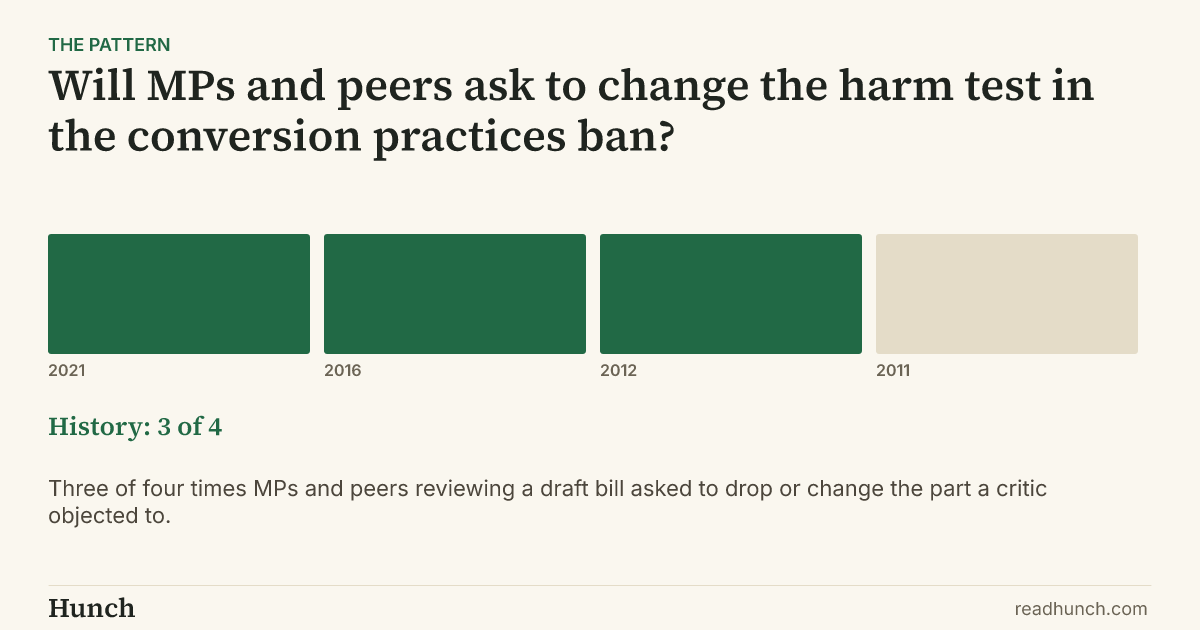
We looked for cases where a committee of MPs and peers reviewed a draft UK bill after a witness spoke out in public against one part of it. We found four such reports since 2011, on libel, Lords reform, internet records and online safety. The critics were newspapers, a church leader, phone companies and charities. None of them was an expert the government had quoted in support.
Show the other 2 cases
The Read
In three of the four past reviews, the committee asked to drop or change the part a critic objected to. In 2012 it asked to drop a clause on women bishops, and in 2021 a duty on harmful content. In 2016 it asked for clear rules on internet records. In 2011 it backed ending most jury trials for libel, against the editors, and said this served the bill’s core aim of cutting costs.
There are reasons for doubt. Committees of MPs and peers have reviewed 33 draft bills since 1999, and these four are the ones where we found a critic reported in the press before the report. In 2016 the phone companies mostly objected to the cost, and the committee asked for clearer rules, not lower costs. This time the harm wording decides what counts as a crime, and Olivia Bailey, who presented the draft as equalities minister in June, sits on the committee.
Sources: GOV.UK (2), GOV.UK, UK Government, UK Parliament (2), The Guardian (2)
Disclaimer
Hunch works only from sources that are publicly available, and publishes on the basis of analysis of that material. We do not form an editorial opinion or take sides, we give a simpler and wider view of news that already exists. If information in a source we used was inaccurate, distorted, or later disputed but had already entered our analysis, Hunch accepts no liability for that. Predictions are not advice. Phase 1 markets use Hunch Points, not money.
Published by Hunch under the Editorial Code. Complaints and corrections: /contact/.