UK defence ministers quit over 2.68% of GDP. Past walkouts did not change it.
Defence Secretary John Healey and Armed Forces Minister Al Carns resigned on 11 June. They said Downing Street refused to pay for defence.
What happened
Healey resigned with a letter accusing Starmer and the Treasury of being ‘unable, and unwilling, to commit the resources that the nation needs to defend the country at this time of rising threats.’
The new deal lifts defence spending only to 2.68% of GDP. GDP is the size of the whole economy. John Healey resigned as Defence Secretary over it on . In his letter to Keir Starmer he said the settlement agreed on the Monday fell well short of what defence needed.
Healey pointed to the conflict in the Middle East, Britain’s lead of the international mission in the Strait of Hormuz and more Russian activity. He said the plan “could make the country less safe”.
Armed Forces Minister Al Carns, a decorated former Royal Marine, resigned six hours later for the same reasons. He was the seventh minister to leave Starmer’s government in a month. Two days later Starmer named Dan Jarvis, a former soldier, as the new Defence Secretary.
The Ministry of Defence and the Treasury had disagreed for months over the Defence Investment Plan, the long-term plan for what the armed forces buy. It was already a year late.
The revolt spread. Within eleven days Starmer announced his own resignation during a wider crisis over the Labour leadership. The Defence Investment Plan is still unpublished. Whoever takes over inherits the 2.68% figure, and senior officers expect it to rise.
Sources: Al Jazeera, The Guardian, BBC
The Pattern
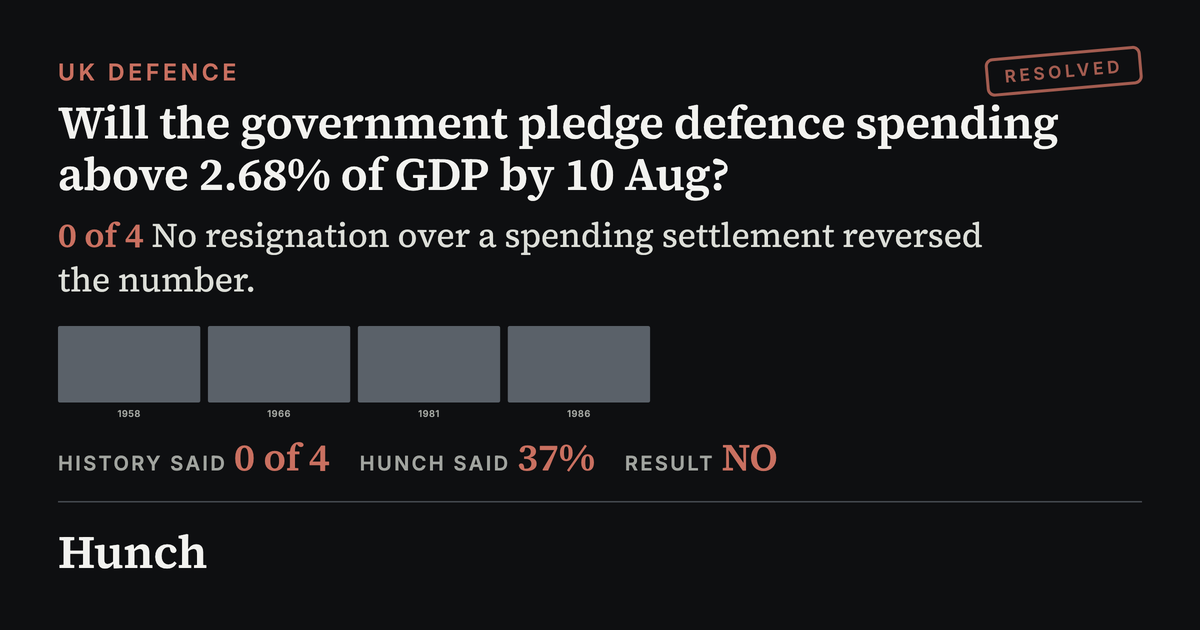
In four cases over seventy years, no settlement was reversed. We looked for British ministers who left office over a defence or spending settlement. Each time the resignation made the front pages and the number stayed. Keith Speed in 1981 was sacked rather than resigning. Michael Heseltine in 1986 left over a dispute about defence buying, with no spending number to reverse.
Show the other 2 cases
The Read
Some things point to the number rising. This time the resignations helped bring down the prime minister within eleven days, which did not happen in any earlier case. The new leadership, with Andy Burnham the clear favourite, needs an early and visible break from the Starmer settlement. Defence is an easy place for that. A new prime minister can promise more than 2.68% in a first-week speech without spending any money before the autumn Budget. Healey and Carns, both still MPs, would back that promise.
History and the calendar point the other way. None of the four earlier revolts changed the settlement, and the Treasury’s sums have not changed. A change of leader also takes up the weeks this market covers. Nominations close on , and a contested race would leave a caretaker government until , with no power to rewrite spending plans. A plan already a year late and owned by no one is most likely to stay unpublished. The record is small, and in 1982 a war partly reversed the cuts a year later.
Disclaimer
Hunch works only from sources that are publicly available, and publishes on the basis of analysis of that material. We do not form an editorial opinion or take sides, we give a simpler and wider view of news that already exists. If information in a source we used was inaccurate, distorted, or later disputed but had already entered our analysis, Hunch accepts no liability for that. Predictions are not advice. Phase 1 markets use Hunch Points, not money.
Published by Hunch under the Editorial Code. Complaints and corrections: /contact/.