Judges blocked Trump's deportations to other countries. Is the Supreme Court next?
A federal appeals court in Boston ruled that Donald Trump's government cannot send people to countries they have no tie to without a real hearing.
What happened
A three-judge panel of the First Circuit in Boston largely upheld a February ruling that the Department of Homeland Security policy of fast removals to countries migrants have no tie to is unlawful.
People must get a real chance to say they fear for their safety before the US sends them to a country that is not their own. A three-judge panel of the federal appeals court for the First Circuit, in Boston, ruled this on . It largely confirmed a February ruling that the Department of Homeland Security policy is unlawful.
Judge Seth Aframe wrote the ruling for the panel. The case is D.V.D. v. Department of Homeland Security, No. 26-1212. The panel did overturn one part of the lower ruling, on whether officials must first try countries the person is tied to.
The policy began in . It allowed removal on short notice if officials had a promise from the other country that the person would not be persecuted or tortured. More than 25,000 people have been sent to at least 29 other countries under it, most often Mexico.
The policy has kept running while the case went on. A district judge ruled it unlawful on . On the First Circuit lifted that block while it heard the appeal. The Department of Homeland Security did not comment on the new ruling.
Sources: Al Jazeera (2), Reuters
The Pattern
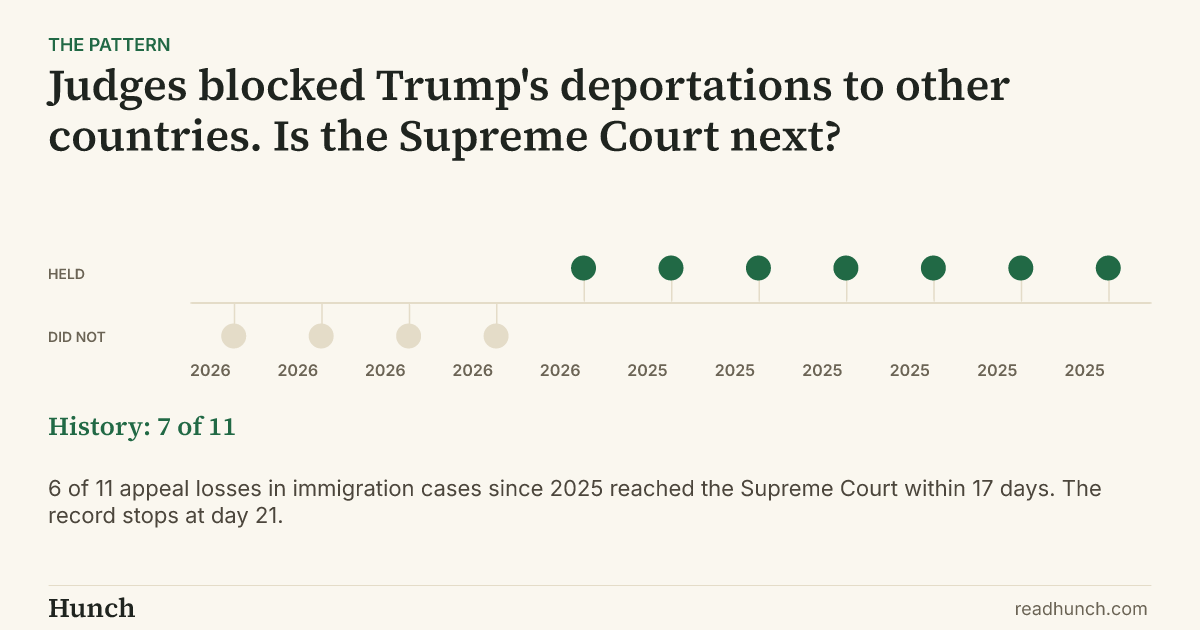
We looked at every ruling since where a US appeals court went against the Trump government on an immigration policy and kept it blocked for the whole country or a whole group. Did the government then ask the Supreme Court for an emergency pause? We found eleven rulings. One office decides every one of these requests, so the eleven are not fully separate. The two detention rulings came from one policy and one choice, so they count as one. Newest first.
Show the other 9 cases
The Read
The timing matters most. Since the government has lost eleven appeal rulings like this one. In seven it went to the Supreme Court within three weeks, on day 2, 3, 5, 6, 11, 13 and 21. No request in this record came later than day 21, so the answer will most likely come within the next six weeks.
The type of ruling matters too, and here it points against a quick request. When an appeals court refused to pause an order that was already stopping the government, a request followed every time, five out of five, always within thirteen days. When a court decided the appeal itself and the ruling had not yet taken effect, a request followed twice out of six, for Haiti in and Venezuela in . The detention rulings and the asylum ban went the slow, ordinary route and are still on it.
The Boston ruling is in the slower group. The policy has been running since the First Circuit lifted the first block on . The new ruling does not take effect until the court sends its formal order to the lower court, and under its rules that comes after the window to ask for a new hearing closes on . So the government loses nothing by waiting. This changes if that order comes early, or if the court ends its March pause. The government would then be where it was in the five cases that all brought a fast request.
Disclaimer
Hunch works only from sources that are publicly available, and publishes on the basis of analysis of that material. We do not form an editorial opinion or take sides, we give a simpler and wider view of news that already exists. If information in a source we used was inaccurate, distorted, or later disputed but had already entered our analysis, Hunch accepts no liability for that. Predictions are not advice. Phase 1 markets use Hunch Points, not money.
Published by Hunch under the Editorial Code. Complaints and corrections: /contact/.