England's doctors back a pay deal by 53%. Most past NHS deals kept a year of calm.
Resident doctors in England voted to accept the government's pay and jobs offer. This ends a dispute that brought 21 strike days since July 2025.
What happened
Resident doctors in England vote to accept the government’s offer, ending 21 days of strikes since .
The resident doctors’ dispute in England is formally over. Resident doctors were once called junior doctors. On their union, the British Medical Association (BMA), said members had voted to accept the government’s offer on pay and jobs. The vote was close: 53% of eligible members voted yes, on a 57% turnout, with 32,932 doctors voting.
The dispute brought 15 rounds of strikes and other industrial action since 2023. Each strike day cost the NHS roughly £50 million.
The deal gives an average pay rise of 6.6%, in full by . That puts resident doctors’ pay 35.2% higher on average than four years ago. It also adds up to 4,500 extra specialty training places over three years and pays back the fees for required Royal College exams and portfolios.
Locally employed doctors move to standard 2016 contract terms. Health and Social Care Secretary James Murray said the deal was a chance to draw a line under the disruption of the previous months.
The BMA committee sounded less final. Its leaders said the vote was not the end of the fight to restore pay. Once rising prices are counted, resident doctors are still paid nearly a fifth less than in 2008.
Nurses are also still in open disagreement with the government over their 3.3% pay award for 2026/27. So the wider question of NHS pay stays open through the summer.
The Pattern
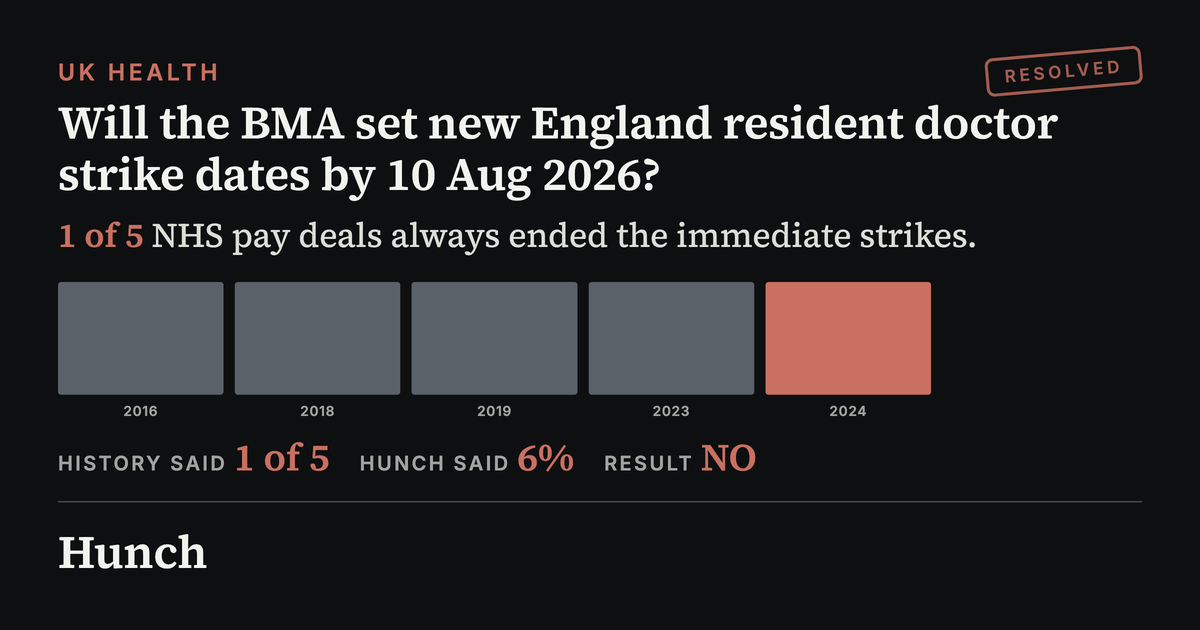
We looked at the major NHS pay disputes of the past ten years. Each one ended with a deal, or with a contract the government forced on staff. What changed from case to case was how long the calm lasted. The gap before the next fight ran from under twelve months to six years.
Show the other 3 cases
The Read
History points to calm, at least for a while. After four of the last five NHS pay settlements, no new strike dates came within a year. This deal also covers more than a pay rise. It changes the pay structure, adds training places and pays back exam fees, which answers much of what the committee asked for. Members have just voted to stop, and a lawful strike ballot takes weeks to run. That is why our forecast for new BMA strike dates before was 6%.
The weak point is the vote itself. A 53% yes on a 57% turnout means only about three in ten eligible doctors backed this deal, and the committee at once called it a step towards full pay restoration. The most recent case is also the closest one. In 2024 these same doctors signed a deal, and new strike dates came ten months later.
The nurses decide the wider question. Their dispute over the 3.3% award for 2026/27 is still open, and their union, the Royal College of Nursing (RCN), has warned it will step up action if talks this summer fail. It has no live vote for strikes yet.
Disclaimer
Hunch works only from sources that are publicly available, and publishes on the basis of analysis of that material. We do not form an editorial opinion or take sides, we give a simpler and wider view of news that already exists. If information in a source we used was inaccurate, distorted, or later disputed but had already entered our analysis, Hunch accepts no liability for that. Predictions are not advice. Phase 1 markets use Hunch Points, not money.
Published by Hunch under the Editorial Code. Complaints and corrections: /contact/.