Russia hits a train on Boris Johnson's route. UK sanctions or aid usually followed.
A Russian drone destroyed the engine of an empty Kyiv to Warsaw train at Yahodyn on 13 September, minutes after Boris Johnson had passed through.
What happened
A Russian jet-powered drone struck the locomotive of an evacuated Kyiv to Warsaw passenger train at Yahodyn, two kilometres from the Polish border, on the morning of , shortly after a separate train carrying Boris Johnson, the UK national security adviser Jonathan Powell and other European security advisers had passed through on the way back from the Yalta European Strategy conference in Kyiv.
Passengers had been ordered off the train fifteen minutes before the drone hit its engine, and nobody was hurt. The strike was part of a night attack of more than 450 drones and missiles across Ukraine. It killed at least six people and set off air raid warnings in Poland.
Boris Johnson’s train had passed along the same line minutes earlier. It carried him, Jonathan Powell and other European national security advisers, and it had left the station ahead of time. Ukraine’s state railway said this diplomatic train could well have been the target. Russia said it had hit railway infrastructure carrying military cargo from Europe.
Johnson called on allies to send Ukraine more air defences. He also asked for frozen Russian money held in London to be released to Ukraine.
Britain was already acting against Russia before the strike. On the Foreign Office summoned Russia’s chargé d’affaires, the diplomat standing in for its ambassador, over the drone at Leipzig airport. On the government promised Ukraine £100m of air defence for the winter.
On Sunday morning Powell told the Kyiv conference that Europe must accept a hard winter to keep up the pressure on Moscow. Donald Tusk chaired an emergency meeting in Warsaw and said Polish intelligence had expected attacks on the border crossings. No gov.uk statement on the train strike had appeared at the time of writing.
Sources: BBC, Guardian, Politico, Independent
The Pattern
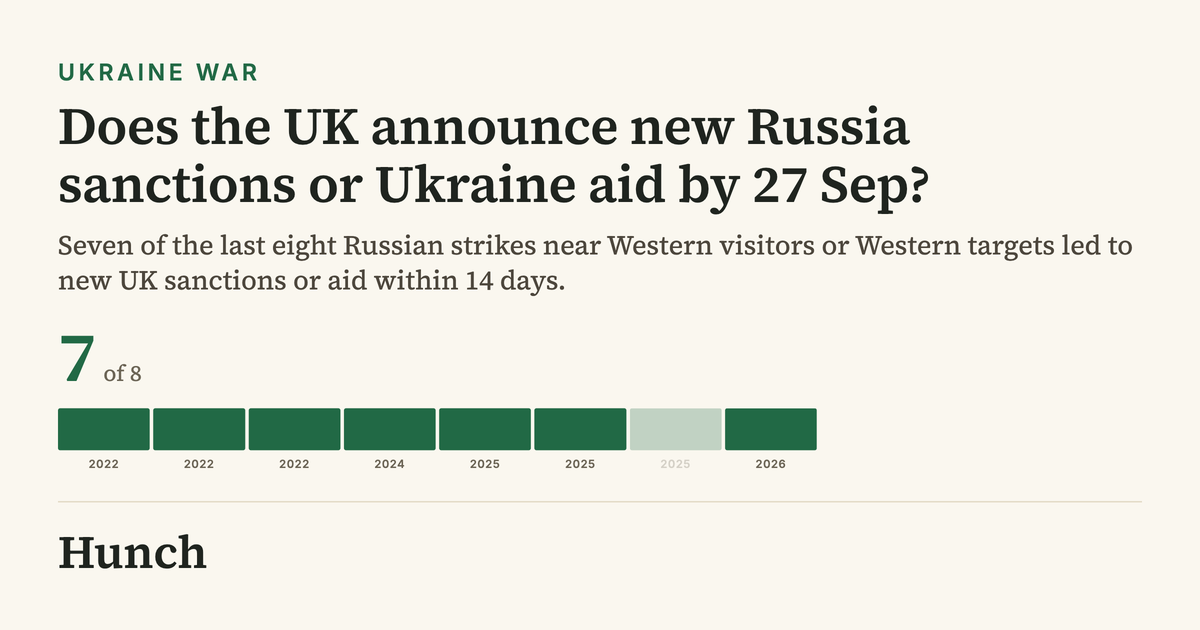
We looked at Russian strikes since 2022 that landed on or next to a Western delegation, a building of a Western country, or NATO territory. We found nine. For each we checked gov.uk to see whether the UK announced new sanctions on Russia or new military aid for Ukraine within 14 days. The eight most recent are shown here, newest first.
Show the other 6 cases
The Read
History points to a UK announcement within two weeks. Seven of the last eight strikes of this kind were followed by new sanctions or an aid package, six of them within six days. The closest case is the missile strike on the British Council in Kyiv in , which led to sanctions and £1bn of aid six days later. Our market still opens at 72%, below that record, because the government announced its latest aid on and no British people were hurt this time. Poland has asked for Article 4 talks, formal consultations among NATO members, only when Russian drones entered its own airspace, never for strikes inside Ukraine. So the Article 4 market sits low.
The main doubt is Sumy. In a strike came two days after a US envoy met Putin, and in the next 14 days the UK only paid a loan instalment that was already planned. There were no new sanctions and no new aid. The same could happen now. The aid may stand as the answer, and new sanctions may wait for the next minister’s visit to Kyiv.
Three players can act before . The UK government announces sanctions and aid on gov.uk. Poland can ask for Article 4 talks, and NATO’s North Atlantic Council can meet. The UK market fails if gov.uk shows nothing but statements to the OSCE and the UN by . The summons market fails if the Foreign Office treats its summons over Leipzig as enough.
Disclaimer
Hunch works only from sources that are publicly available, and publishes on the basis of analysis of that material. We do not form an editorial opinion or take sides, we give a simpler and wider view of news that already exists. If information in a source we used was inaccurate, distorted, or later disputed but had already entered our analysis, Hunch accepts no liability for that. Predictions are not advice. Phase 1 markets use Hunch Points, not money.
Published by Hunch under the Editorial Code. Complaints and corrections: /contact/.