Russia elects a parliament at war. Can Putin's party keep two-thirds of the seats?
Russia's first parliament election since it invaded Ukraine runs from 18 to 20 September. The only anti-war party was removed from the ballot.
What happened
Russia’s Supreme Court struck the anti-war Yabloko party from the September Duma ballot, upholding a suit from the pro-Kremlin Rodina party. Yabloko, polling around 3%, was the only registered party campaigning against the war.
Russians vote for the 450-seat State Duma, the lower house of parliament, from 18 to . It is the first parliamentary election since Russia’s full-scale invasion of Ukraine. Vladimir Putin’s decree setting the date was published in June.
Half the seats go to parties by their share of the party-list vote, and a party needs at least 5% to win any of them. The other half are won in single-seat districts. In 2021 this system gave United Russia 88% of the district seats, although it won less than half of the list vote.
Yabloko’s leader Nikolai Rybakov said the party would appeal the ban, and about a hundred supporters gathered outside the court. Some Yabloko candidates are still standing in single-seat districts.
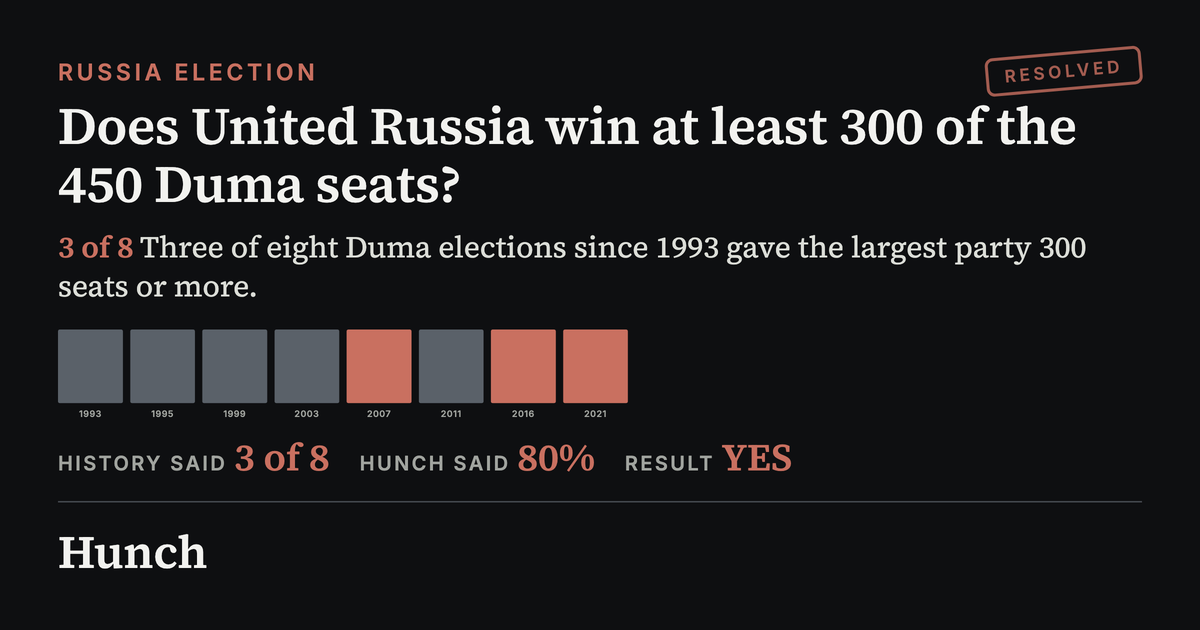
The number that matters is 300. A party with two-thirds of the Duma, 300 seats, can change the constitution without votes from other parties. United Russia has been judged against this line at every election since 2007. In 2021 it kept it with 324 seats, although it fell below 50% of the list vote, in a vote the opposition called a sham.
Sources: Al Jazeera (2), Kremlin
The Pattern
We looked at all eight Duma elections since 1993. For each one we checked how many seats the largest party won, and whether it reached 300, the two-thirds needed to change the constitution.
Show the other 6 cases
The Read
Across all eight elections, a party reached 300 seats only three times. The recent record is stronger: since 2007 United Russia has reached 300 at three of four elections. The district half of the ballot gave it 198 and 203 seats at the two elections that used it. So the party needed only about a third of the list vote to reach 300. With Yabloko off the list ballot, and the regions reportedly told to secure a majority, our market stood at 80%.
The one recent miss was 2011. Discontent was visible that year, and people protested against the count in the streets. The 2026 campaign came during a fuel crisis, with internet blackouts and strikes on Russian cities.
Two things could have stopped the party short of 300. One was a list vote so far below 40% that winning most districts could not make up for it. The other was a choice by the authorities to declare a smaller majority, so the result would look believable.
Disclaimer
Hunch works only from sources that are publicly available, and publishes on the basis of analysis of that material. We do not form an editorial opinion or take sides, we give a simpler and wider view of news that already exists. If information in a source we used was inaccurate, distorted, or later disputed but had already entered our analysis, Hunch accepts no liability for that. Predictions are not advice. Phase 1 markets use Hunch Points, not money.
Published by Hunch under the Editorial Code. Complaints and corrections: /contact/.