Russian court bars the only anti-war party. Such bans usually helped the rulers.
Russia's Supreme Court struck Yabloko off the ballot on 10 August, 5 weeks before the 18 to 20 September vote, and rejected its appeal within a week.
What happened
Russia’s Supreme Court struck the anti-war Yabloko party from the September Duma ballot, upholding a suit from the pro-Kremlin Rodina party. Yabloko, polling around 3%, was the only registered party campaigning against the war; leader Nikolai Rybakov said it would appeal.
The court annulled Yabloko’s federal list, the party’s national list of candidates for the State Duma. Rodina, a pro-Kremlin party, said Yabloko had taken campaign support it did not declare, including from Western sources. Yabloko denied it, and about a hundred supporters gathered outside the court.
Yabloko was polling around 3%, below the 5% a party needs to win list seats. Of the eleven parties the Central Election Commission approved in July, it was the only one campaigning against the war.
On the ban became final. The Supreme Court’s appeals chamber upheld it. The same day a court sentenced Yabloko’s deputy chair, Lev Shlosberg, to 11 years and one month in a penal colony for statements about the war.
Police detained dozens of supporters and journalists outside the court, and the party’s chair, Nikolai Rybakov, called the detentions intimidation. So two things that often follow a ban, a lost appeal and the prosecution of a party leader, came within seven days.
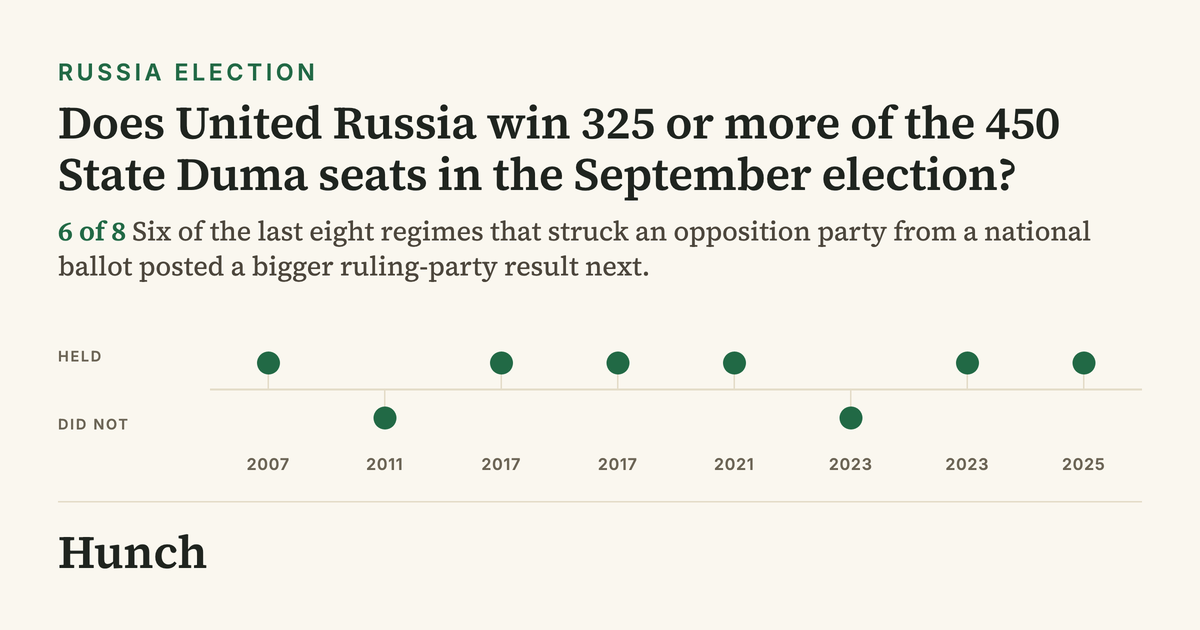
What is still open is the result of the vote. In the eight similar bans since 2007, the ruling party’s declared result grew six times and shrank twice. United Russia itself went from 37.6% to 64.1% after the Republican Party was closed down in 2007. Hun Sen’s party in Cambodia went from 68 seats to all 125 after it dissolved its rival in 2017.
The two falls were Cambodia in 2023, where the ruling party gave up five seats, and Russia in 2011, where United Russia lost 77 seats after PARNAS was kept off the ballot. Tanzania’s president went from 85% to 97.66% after her main challenger’s party was barred in 2025.
For United Russia the line is 324 seats, its 2021 total. The Central Election Commission’s seat count in the week after will settle it. The other thing to watch in the same weeks is whether the state moves from the party’s deputy chair to Rybakov himself.
Sources: Al Jazeera (2, 3, 4)
The Pattern
We looked for times when a court or an election commission removed a registered opposition party from a national ballot. We started with Russia, then looked at countries run in a similar way: Belarus, Cambodia, Venezuela, Nicaragua and Tanzania, from 2007 to 2026. We found nine cases. Eight are shown here.
Show the other 6 cases
The Read
History leans towards a bigger result for the ruling party. In six of eight cases it came out of the next vote stronger. The two biggest gains came where the barred party had been the main challenger, as in Cambodia in 2018 and Tanzania in 2025. Yabloko was polling 3%, so its absence frees few list votes. The question is whether the system that turned nearly 50% of the list vote into 324 seats in 2021, more than two-thirds of the chamber, can add to that total. A small rise in the list share, or a few more districts, takes the party past 324.
The main doubt comes from Russia itself. In 2011 the Kremlin kept PARNAS off the ballot and United Russia still lost 77 seats. In the state banned Navalny’s anti-corruption fund as extremist before the vote, and the party went in with 334 seats and came out with 324. Removing an opponent does not fix the count. Cambodia in 2023 shows a government can also choose to declare a smaller majority, so the result looks more open.
The first market fails if the list share slips and the districts do not make up for it. The second fails if the state decides that one prison sentence for a Yabloko leader is enough.
Sources: Al Jazeera (2)
Disclaimer
Hunch works only from sources that are publicly available, and publishes on the basis of analysis of that material. We do not form an editorial opinion or take sides, we give a simpler and wider view of news that already exists. If information in a source we used was inaccurate, distorted, or later disputed but had already entered our analysis, Hunch accepts no liability for that. Predictions are not advice. Phase 1 markets use Hunch Points, not money.
Published by Hunch under the Editorial Code. Complaints and corrections: /contact/.