England sets a tourist tax for 2028. Most such taxes needed over a year for a Bill.
The Prime Minister told the Commons on 1 September that mayors will get the power to charge a tax on overnight stays from the end of 2027-28.
What happened
In a Commons statement the Prime Minister says the next stage of English devolution will include fiscal devolution, starting with the ability to set an overnight visitor levy, to commence towards the end of the financial year 2027-28.
What is new is the start date. The power itself was promised before. The Prime Minister told the Commons that mayors in England would be able to set an overnight visitor levy, a charge on overnight stays, starting towards the end of the 2027-28 financial year.
He said it was part of the next stage of English devolution, set out in a July statement, which moves powers long asked for by mayors to local areas. He named post-16 technical education, help with finding work, and fiscal devolution, meaning control over some taxes. The visitor levy is the first of those tax powers.
The previous government announced the levy on , the day before its Budget. It would let England’s mayors charge for overnight stays at hotels, holiday lets, bed and breakfasts and guesthouses.
A consultation on how the power would work ran from to . As of this week the government page still says the department is analysing the responses.
The King’s Speech of , where the government sets out the laws it plans, then listed an Overnight Visitor Levy Bill. It called the Bill the first step in a new era of fiscal devolution and said a response to the consultation would follow shortly. No such Bill appears on Parliament’s register.
Scotland and Wales are already there. Edinburgh’s 5 per cent charge starts in July and other Scottish cities follow in 2027. Welsh councils will be able to charge £1.30 a night from the same year.
The Visitor Levy (Scotland) Act 2024 became law on , and the Welsh Act on . So by the time an English mayor can charge a pound a night, Scotland and Wales will have had the power for three to four years.
Sources: GOV.UK (2, 3, 4), PoliticsHome, legislation.gov.uk
The Pattern
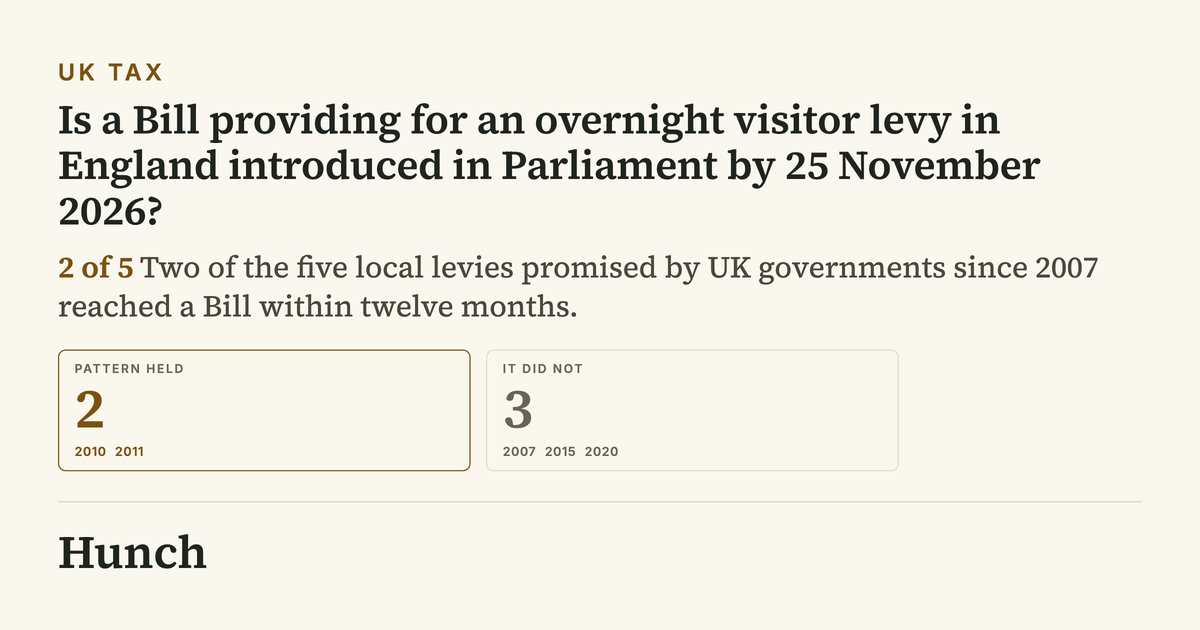
We looked at every time since 2007 that the UK government announced a new levy or tax that councils or mayors in England would charge and keep. For each we asked one question: did a Bill giving that power have its first reading in Parliament within twelve months of the first government paper? Changes that needed no Bill are left out. Five cases fit, too few for us to show a percentage. The visitor levy, announced on , is the open sixth.
Show the other 3 cases
The Read
History leans slightly against a Bill by . Only two of five such taxes reached a Bill within a year, and in both the consultation turned into a Bill within four months. This one has not taken that path. Its consultation closed in February, and the response promised in May has not appeared. On the other side, the Bill is already named in the King’s Speech, and a new Prime Minister has just given the levy a start date. None of the three slow cases had that at the same point. Our market opens a little below evens.
The record is also small, with five cases, and the three slow ones took fourteen, fifteen and twenty-one months to reach a first reading.
The sign to watch is the consultation response, which should come before the Bill. In 2010 the response and the Bill came on consecutive days. A response by the end of September would put this levy on the fast path, and no response by the Budget on would put it on the slow one. A levy that starts at the end of 2027-28 also needs an Act, regulations and a decision by a mayor before then.
Disclaimer
Hunch works only from sources that are publicly available, and publishes on the basis of analysis of that material. We do not form an editorial opinion or take sides, we give a simpler and wider view of news that already exists. If information in a source we used was inaccurate, distorted, or later disputed but had already entered our analysis, Hunch accepts no liability for that. Predictions are not advice. Phase 1 markets use Hunch Points, not money.
Published by Hunch under the Editorial Code. Complaints and corrections: /contact/.