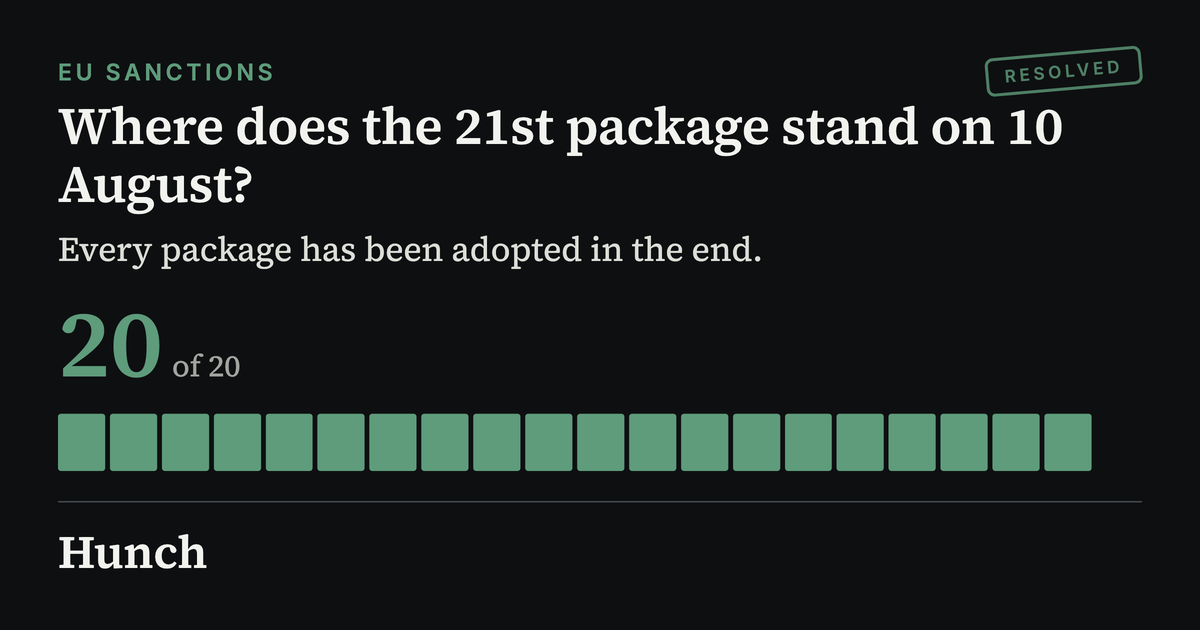
EU plans more sanctions on Russia. Every past round passed, lately after delays.
The EU extended its economic sanctions on Russia for a full year and adopted a small set of new listings. The 21st sanctions round is still waiting.
What happened
The Council extended EU economic sanctions on Russia for twelve months, to , the first annual renewal instead of the usual six-month roll-over.
On the EU proposed a 21st round of sanctions on Russia. Ursula von der Leyen, President of the European Commission, said it was aimed at energy, financial services and trade. It pauses the system that adjusts the price cap on Russian oil until , and lists 30 more ships of the shadow fleet, the tankers Russia uses to move oil past sanctions.
It also targets 20 companies outside Russia, including banks, crypto platforms and oil traders accused of helping Russia get round sanctions. For the first time it sanctions Russian fishing, with a complete ban on cod.
Two smaller steps passed soon after. On EU governments approved a short list of new names: 34 more people and 47 entities, including 24 entities tied to exporting Russian crude oil through the shadow fleet. The yearly renewal of also ends the six-month roll-over that gave Hungary’s government a chance to veto the sanctions twice a year.
The full 21st round still needs every EU government to agree, and the last round shows how hard that can be. Hungary and Slovakia blocked the 20th round from late February over the shutdown of the Druzhba oil pipeline. They lifted their veto only after oil flows returned on . The new round’s shipping and energy measures touch the same interests.
Sources: Council of the EU (2), European Commission, The Guardian
The Pattern
The EU has passed twenty rounds of sanctions on Russia in four years, and every one was adopted in the end. But the wait has grown longer. Early rounds passed in days. Recent ones were delayed for weeks or months by one or two governments that wanted something in return. Here are the last five.
Show the other 3 cases
The Read
History points to adoption, but late. The EU has never failed to pass a round of sanctions. The twelve-month renewal on removed the regular expiry date that one government could use as a threat, and the smaller listings in June show the system still works while the main text is argued over. Von der Leyen announced the round expecting adoption before the EU’s August break, and the Commission has often won over holdouts with special exemptions for them. Our market leans towards adoption with carve-outs, meaning exemptions for some countries, which is how the 18th and 20th rounds ended.
The doubts are the calendar and the pipeline. Five weeks is the quick end of recent hold-ups. The 21st round touches oil shipping and energy income, the same ground as the Druzhba dispute that froze the 20th round for ten weeks. Hungary’s government faces elections and has fewer reasons to give Brussels a quick win. EU decisions also slow down sharply in August.
The answer is in the EU’s official texts on : whether a 21st round has been adopted by then, and whether it carries special terms for one or two governments.
Disclaimer
Hunch works only from sources that are publicly available, and publishes on the basis of analysis of that material. We do not form an editorial opinion or take sides, we give a simpler and wider view of news that already exists. If information in a source we used was inaccurate, distorted, or later disputed but had already entered our analysis, Hunch accepts no liability for that. Predictions are not advice. Phase 1 markets use Hunch Points, not money.
Published by Hunch under the Editorial Code. Complaints and corrections: /contact/.