EU-UK summit put off again. Past delays rarely got a new date within a month.
The FT says the second EU-UK summit is delayed again, to late November at the earliest. The sticking point is the EU's Made in Europe rules.
What happened
The Financial Times reported on that the EU-UK talks to reset relations after Brexit have been delayed again, with the next leaders’ meeting now expected no earlier than late November, amid tension over the EU’s Made in Europe procurement rules.
This is the third time the second EU-UK summit has been put off. Both sides had been working towards a meeting in October. The new problem is the EU’s Made in Europe rules. The European Commission’s Industrial Accelerator Act gives EU-made goods first place when governments in the EU buy things, and names the non-EU countries it counts as trusted partners. Britain has asked since February to be one of them.
Pressure at home grew the same weekend. George Osborne told the Independent that the economy had fallen off a cliff since Brexit. He said Andy Burnham should take Britain back into the customs union, where members charge the same taxes on goods from outside. He called it an easy decision, because it does not require free movement of people.
Sir John Curtice said support for rejoining the EU now averages 61 per cent against 39, the highest since 2016. He warned that a referendum would still be won or lost on how the question is put. The government’s line has not changed. In August Hamish Falconer, the EU relations minister, repeated that Labour’s red lines rule out the single market and the customs union.
The first summit, in London in , agreed in principle a deal on food and farm checks, known as SPS. It also agreed to link the two carbon trading systems and to set up a youth scheme with a cap on numbers.
Since then the dates have kept moving. The second summit was expected in . It moved to July over the cap on the youth scheme and university tuition fees. On it was set for , then called off when Keir Starmer resigned. Officials on both sides pointed to October, but no date was ever published. Separate talks on Britain joining EU civilian security missions began in the summer.
Sources: Financial Times, Politico (2, 3), The Guardian (2, 3), The Independent, GOV.UK, BBC
The Pattern
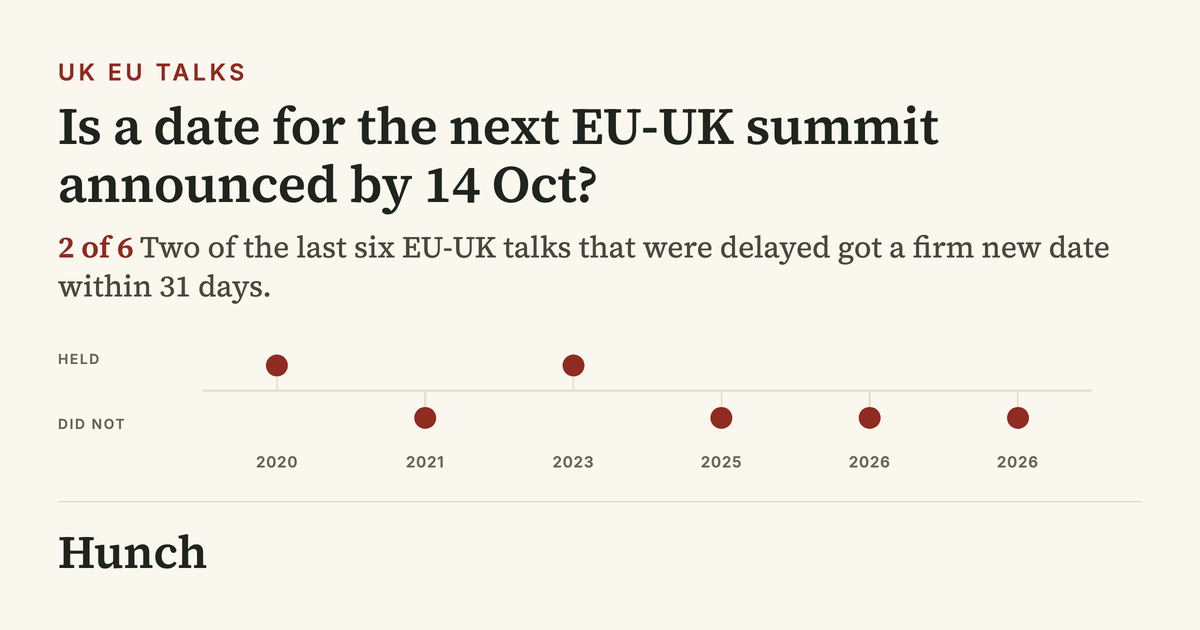
We found six public delays of EU talks since 2020. We looked for every reported delay of a planned EU-UK round of talks or summit, and added the EU’s talks with Switzerland, a similar partner. For each one we asked whether either side named a day for the next meeting within 31 days. A month or a season without a day does not count.
Show the other 4 cases
The Read
History points to another month without a date. Only two of the six delays got a firm new date within 31 days, and in both a text was already agreed. The two delays this year took 35 days and more than 80 days. The FT’s late-November window also suggests that a date, if one comes, may be set closer to the meeting. Against that, both governments say they want the summit this year, and in July the Commission told EU ambassadors it wanted the meeting back on the agenda quickly. On the customs union, Hamish Falconer has already set out the red lines, and Osborne’s call invites ministers to repeat them on the record.
Each side also has a reason to let the date drift. The EU decides whether British-made goods count as European when EU governments buy things, and Britain wants that settled in its favour before it signs anything. The UK Budget on fixes what the Treasury can pay towards EU students’ tuition fees, the issue Brussels will not leave open. The UK needs the SPS deal for food exporters, whose EU sales fell 21 per cent after Brexit. With Reform ahead in the polls, it also needs the youth scheme to look capped and limited in time. The people who can move in this window are Falconer, Maroš Šefčovič for the Commission, and the EU ambassadors who hear the Commission’s briefings.
The record also shows how fast things can change. In talks that looked dead restarted six days later, after one side gave a speech the other could call a step towards it. In the Windsor deal was signed six days after a delay, once Rishi Sunak had his own MPs on side. The tuition fee offer the Commission floated in July shows Brussels has a move of this kind ready. A late-November summit day published by the UK government or the Commission before would break the pattern. On the customs union, the question stays open if ministers refuse to comment through the party conference season and nothing appears in Hansard, the Commons record, before MPs return.
Sources: The Guardian (2, 3), Politico (2, 3), GOV.UK (2), BBC (2)
Disclaimer
Hunch works only from sources that are publicly available, and publishes on the basis of analysis of that material. We do not form an editorial opinion or take sides, we give a simpler and wider view of news that already exists. If information in a source we used was inaccurate, distorted, or later disputed but had already entered our analysis, Hunch accepts no liability for that. Predictions are not advice. Phase 1 markets use Hunch Points, not money.
Published by Hunch under the Editorial Code. Complaints and corrections: /contact/.