EU met Donald Trump's tariff deadline. His threats mostly ended in delay or a deal.
The EU put its trade deal with the US into law on 2 July, 2 days before Donald Trump's deadline. The threatened 25% tariff on EU cars did not happen.
What happened
The EU published the texts enacting its side of the US trade deal in the Official Journal, meeting Trump’s deadline. The 15% US tariff ceiling on EU autos applies in place of the 27.5% rate.
Donald Trump had threatened 25% tariffs on EU cars and trucks. On he said he would raise them from 15% to 25%, because the EU had not kept to the deal agreed at his Turnberry golf course in . Six days later, after a call with Commission President Ursula von der Leyen, he set a date. The EU had to put the deal into law by or face “much higher” tariffs.
The EU moved faster than many expected. EU governments settled a hard argument among themselves in May. On the European Parliament gave its final approval. It added a safeguard that lets the Commission suspend the deal if Washington does not keep its promises. On the texts appeared in the EU’s Official Journal, where EU laws are published. Commission spokesman Olof Gill said the promise had been kept.
Most EU goods now pay a single US duty of 15%, with no extra tariffs added on top. Steel and aluminium are the exception and still pay 50% under Section 232, a US national security law. A second stage on is due to drop the 15% ceiling entirely for several kinds of EU goods.
Sources: European Commission, Bloomberg, Al Jazeera, European Parliament
The Pattern
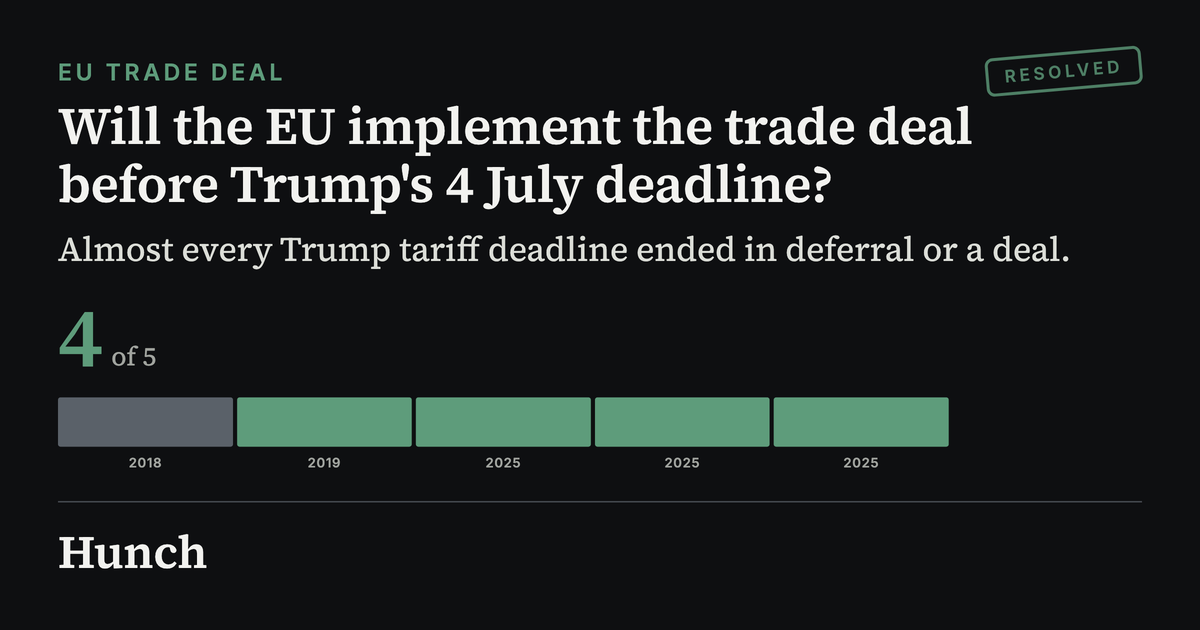
We found five tariff deadlines Donald Trump set since 2018. Each time he named a date, spoke to the other leader, and then the higher tariff was either put off or replaced by a deal. Only once did the threatened tariff actually arrive on the date.
Show the other 3 cases
The Read
History pointed to calm, and the EU met the deadline. Both sides spent fourteen months and a lot of political effort getting this deal into law. The Parliament’s safeguard gives Brussels a written way out if things go wrong, so it has less reason to pick a fight. Lower car tariffs are a clear gain for German and Italian carmakers, and neither side wants to lose that. In four of Trump’s five past deadlines the higher tariff was put off or replaced by a deal, and this one ended in a deal before the date.
History is weaker on what happens next. It shows how deadlines end, and says little about whether peace lasts. Trump has reopened this same deal twice in twelve months. Steel and aluminium still pay 50% with no agreement in sight, and the second stage on gives Washington a new point of pressure within weeks. The Supreme Court’s February ruling also forces the government to rebuild the legal basis for its tariffs, and new tools built in a hurry tend to get used. The 2018 steel case is the reminder that sometimes the threat is the policy.
Disclaimer
Hunch works only from sources that are publicly available, and publishes on the basis of analysis of that material. We do not form an editorial opinion or take sides, we give a simpler and wider view of news that already exists. If information in a source we used was inaccurate, distorted, or later disputed but had already entered our analysis, Hunch accepts no liability for that. Predictions are not advice. Phase 1 markets use Hunch Points, not money.
Published by Hunch under the Editorial Code. Complaints and corrections: /contact/.