Ukraine wants Europe to name one voice for Russia talks by 30 November. Will it?
Ukraine's President Volodymyr Zelenskyy wants Europe to choose by the end of November who speaks for it in peace talks with Russia.
What happened
Ukraine’s President Volodymyr Zelenskyy said European countries supporting his cause must decide fast who will represent them in peace talks.
Ukraine wants Europe to choose one voice for peace talks with Russia. On in Denmark, President Volodymyr Zelenskyy said he hoped Europe would settle it by the end of November, best on in Germany at the Coalition of the Willing, a group of countries that back Ukraine. He wants one person with a mandate from the European Union (EU) and from countries outside it, such as the UK and Norway.
I think that in November, not later, we need to accept who will represent Europe in negotiations.
Volodymyr Zelenskyy, President of Ukraine, to reporters in Denmark, 10 November 2026
The United States wants Europe at the table from the next round. Russia, Ukraine and the US met in Abu Dhabi, in the United Arab Emirates, on 10 and . European advisers came but were kept out of the main talks because Russia objected. US officials want to discuss a new long-term security set-up between Russia and Europe, and said this should be the last round without Europe taking full part.
Russia now asks Europe to pick one person first. On Vladimir Medinsky, who led Russia’s team, said it was unclear what Russia and the EU had to discuss. On US envoys Steve Witkoff and Jared Kushner asked Vladimir Putin in Moscow to let Europe in. Afterwards Witkoff said the Europeans would join the next meeting. The Kremlin spokesman, Dmitry Peskov, said Europe must first name a representative, and Putin’s aide Yuri Ushakov said Europe must decide whether it wants peace or war.
Europe has argued about this for months. In May the EU turned down Putin’s idea that Gerhard Schröder, a former German chancellor and his long-time ally, could help restart talks with Europe. Italy has asked for an EU special envoy since January. On António Costa, who chairs the meetings of EU leaders, answered that the EU’s interests “need to be represented by its institutions, in accordance with the Treaties”.
EU leaders meet in Dublin on and in Brussels on 26 and . On Costa said Europe’s voice “needs to be a team effort between European nations, the European Union and NATO”. Several leaders back Costa himself, while Germany’s Friedrich Merz wants to keep the group of five countries that already talks for Europe. Meloni wants a decision in Dublin and a formal one in December, together with Britain and Norway.
Sources: Politico Europe (2, 3, 4), The Guardian (2, 3), CBC News, Kremlin, The Independent
The Pattern
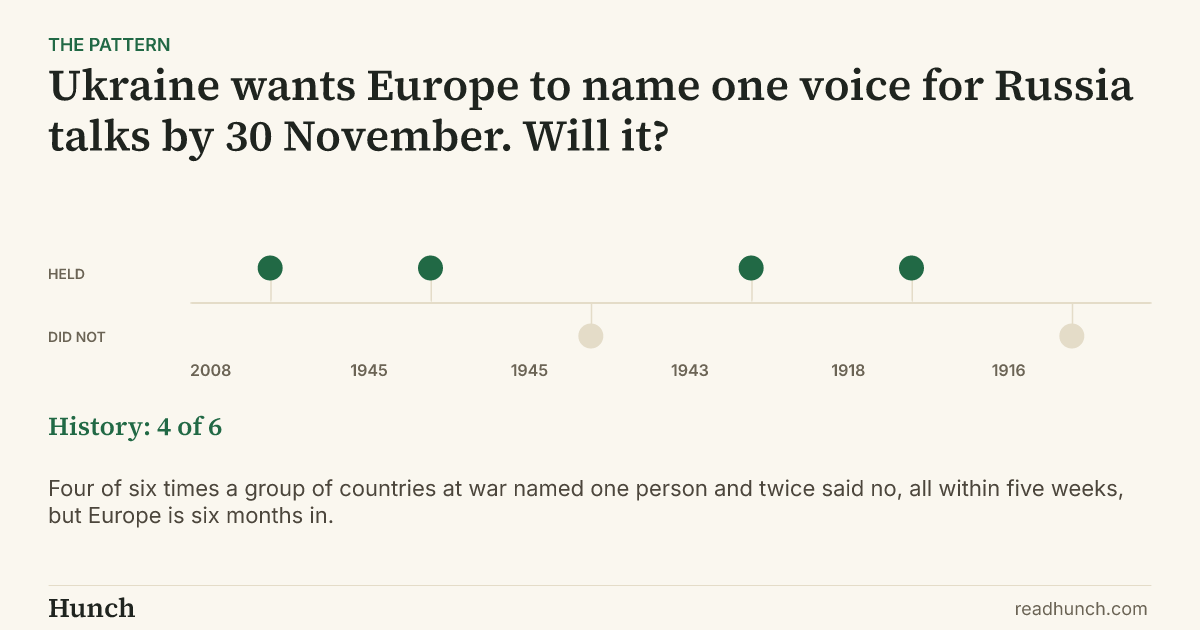
We looked for cases where a group of countries on one side of a war had to decide whether one person would speak for all of them in talks with the other side. We found six such times from 1916 to 2008. Five were alliances in the two world wars, and one was the EU after Russia’s war with Georgia.
Show the other 4 cases
The Read
Every past answer came within five weeks of an offer of talks. The group named one person or said no between 2 and 34 days after the other side asked to talk or agreed a peace plan, and it never named a team. In 2008 the EU took 34 days to name Pierre Morel, with a summit first and a decision of ministers after. This time the question has been open since Putin’s offer in May, for more than six months.
There are reasons for doubt. Five of the six times came from the two world wars, and the US government took part in four of them. No side at war set the group a date before, as Zelenskyy has now. Each time the other side itself asked for talks, while Russia now says Europe must first name one person. Both refusals were refusals to talk at all, not disputes over who should go.
Sources: EUR-Lex, US Office of the Historian (2, 3, 4), The Guardian, CBC News, Politico Europe
Disclaimer
Hunch works only from sources that are publicly available, and publishes on the basis of analysis of that material. We do not form an editorial opinion or take sides, we give a simpler and wider view of news that already exists. If information in a source we used was inaccurate, distorted, or later disputed but had already entered our analysis, Hunch accepts no liability for that. Predictions are not advice. Phase 1 markets use Hunch Points, not money.
Published by Hunch under the Editorial Code. Complaints and corrections: /contact/.