Nigel Farage faces MPs' watchdog. Top MPs found at fault mostly left within a year.
A Labour MP reported Nigel Farage to Parliament's standards watchdog. He says Farage privately lobbied the Bank of England against a digital pound.
What happened
Labour MP Phil Brickell asked Standards Commissioner Daniel Greenberg to examine Farage’s meeting with Andrew Bailey, alleging undisclosed lobbying against a UK central bank digital currency.
The complaint says Farage urged the Bank of England to drop its plans for a central bank digital currency, a digital pound issued by the Bank itself. The Bank later softened its approach. It also dropped a proposed £20,000 limit on how much of a stablecoin, a crypto coin tied to a normal currency, one person could hold. Farage had attacked that limit in public, and he later took credit for the change.
Greenberg already has one open inquiry into Farage. Since he has been checking whether Farage should have declared an alleged £5 million personal gift from the crypto investor Christopher Harborne. The money came shortly before Farage was sworn in as an MP. Electoral Commission records also show £25,000 payments from Harborne to Farage in . Farage says he broke no rules of Parliament because the money was not used for politics. No wrongdoing has been found.
Reform UK still leads the polls. Ipsos polling in June put the party on 26%, ahead of every rival. The same survey found 63% of Britons unhappy with Farage himself, up from 49% a year earlier. In the same month Farage declared £270,000 in earnings for advertising gold bullion, for four hours’ work a month over three months.
Sources: The Guardian, BBC, Ipsos
The Pattern
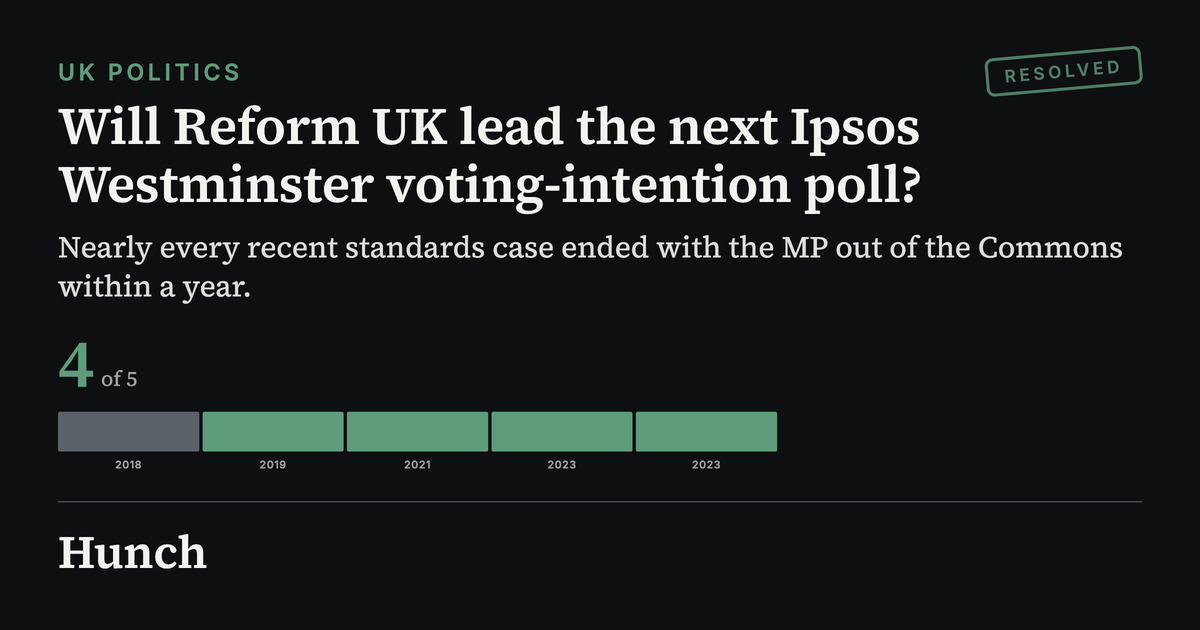
Four of five well-known MPs found at fault left within a year. We looked at recent high-profile cases where Parliament’s standards or privileges process ruled against a prominent MP. In four the MP was out of the Commons within a year of the ruling. These cases say much less about how fast a complaint turns into a formal inquiry.
Show the other 3 cases
The Read
History says that when the watchdog rules against a well-known MP, the MP usually leaves. But every one of those cases took months from complaint to ruling, so the question now is only whether a second inquiry opens. Several things point that way. The Commissioner already has an open file on Farage. This complaint comes with a paper trail: a private meeting on record, public claims of credit, and a policy that then changed. The inquiry also shows Greenberg is ready to open cases against the most prominent name in British politics, whatever Reform’s poll lead. A complaint this specific is easier to open than to throw out.
The weak point is that lobbying complaints are harder to prove than failures to declare money. Declaring a gift is a paperwork test. The lobbying rules need proof that Farage sought a benefit linked to one of his declared interests, and a meeting with the Bank’s governor about public policy is disputed ground. Commissioners often turn down complaints that look like one party attacking another, and this one comes from a Labour MP against Labour’s main rival at the polls. Saying no, or saying nothing, is the easier path for the institution. A new entry against Farage’s name on the Commissioner’s list of inquiries would answer the question.
Disclaimer
Hunch works only from sources that are publicly available, and publishes on the basis of analysis of that material. We do not form an editorial opinion or take sides, we give a simpler and wider view of news that already exists. If information in a source we used was inaccurate, distorted, or later disputed but had already entered our analysis, Hunch accepts no liability for that. Predictions are not advice. Phase 1 markets use Hunch Points, not money.
Published by Hunch under the Editorial Code. Complaints and corrections: /contact/.