House of Lords checks next year's tax law. Will its report come before Christmas?
A House of Lords sub-committee opened its yearly inquiry into the draft tax bill on 18 September. Written evidence closes at 5pm on 11 October.
What happened
The House of Lords Finance Bill Sub-Committee launched its inquiry into the draft Finance Bill 2026-27 on , setting a deadline of 5pm on Sunday for written evidence and booking its first public hearing for .
A small House of Lords committee has asked the public to write in about next year’s tax law. The Finance Bill Sub-Committee, chaired by Lord Liddle, opened its inquiry into the draft Finance Bill 2026-27 and gave three weeks for written evidence.
The inquiry looks at three parts of the draft law. The first is how taxpayers correct mistakes in their tax returns. The second would make employers report benefits in kind, such as company cars and medical insurance, through the payroll in real time from . The third rewrites the customs rules for cheap imports, the law that decides what a parcel from Shein or Temu costs when it arrives.
The draft text of the law was published for comment on , so the committee is working on text that already exists.
The Budget comes in the middle of the inquiry. John Healey delivers it on , after the committee’s first public hearing on at 9.45am.
Both Houses of Parliament then stop for Christmas on and do not come back until . A report that misses has to wait until January.
Sources: UK Parliament (2, 3), GOV.UK, UK Parliament, Lords recess dates
The Pattern
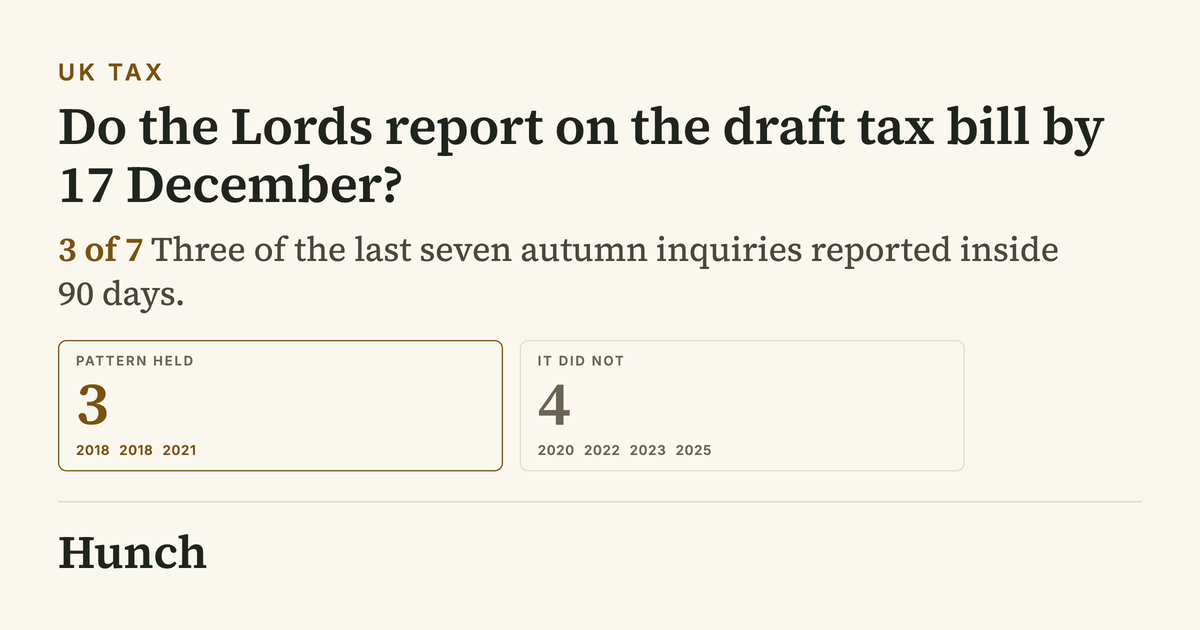
We found seven autumn reports from this committee since 2018. For each one we counted the days from the call for evidence to the report. We left out four rounds in January and February, which ran to a different timetable. Two of the seven reports came from one call for evidence in 2018. The committee also closed when Parliament was dissolved in and was rebuilt in 2025, so the three latest reports came from a different group of members under a different chair.
Show the other 5 cases
The Read
History leans against a report before Christmas. The seven autumn reports since 2018 took 71, 83, 90, 99, 109, 133 and 141 days, and only the three fastest came within 90 days, the gap between the call for evidence and the Christmas break this year. By , when the Lords return, five of the seven had reported. The dates this year are all known. Written evidence closes on , the first hearing is on , the Budget comes on in the middle of the inquiry, and both Houses go home on .
The record gets weaker the closer you look. The three latest reports were the three slowest, and the last two both came out at the end of January, so they missed even the date. The committee also never says in advance when it will report, so there is no promise to check. One thing points the other way. The rules on cheap imports decide the price of a parcel from Shein or Temu, and the government wants the new system running by at the latest. Whether that makes the committee work faster than it has in eight years is the open question.
Disclaimer
Hunch works only from sources that are publicly available, and publishes on the basis of analysis of that material. We do not form an editorial opinion or take sides, we give a simpler and wider view of news that already exists. If information in a source we used was inaccurate, distorted, or later disputed but had already entered our analysis, Hunch accepts no liability for that. Predictions are not advice. Phase 1 markets use Hunch Points, not money.
Published by Hunch under the Editorial Code. Complaints and corrections: /contact/.