Edouard Philippe, the centre and right poll leader in France, says no to a primary.
Gabriel Attal wants one vote to pick a single centre and right candidate for France in April 2027. Edouard Philippe, best placed in polls, says no.
What happened
Gabriel Attal said a primary of the centre and right cannot be avoided, a day after Edouard Philippe refused it again.
France holds the first round of its presidential election on , and the centre and right have four candidates. Only the top two go through to the second round on . On Gabriel Attal of Renaissance, the party of President Emmanuel Macron, proposed one primary for all four: him, Edouard Philippe of Horizons, Bruno Retailleau of Les Républicains and David Lisnard, the mayor of Cannes. On Mr Philippe, who polls best of the four, said: “I don’t think this primary will take place.”
Two of the other three now want the vote. On Mr Retailleau, who also leads Les Républicains, said a primary would be needed early next year, or he would stay in the race to the end. Mr Lisnard has asked for one for a long time. On Mr Attal said many talks were going on, and on 66 lawmakers of Renaissance and its ally MoDem called for a primary.
Mr Philippe said no again on 6 and . He said that if he sees no chance in February, he will not stay in as one more candidate, and he asked the others to promise the same. Polls put Marine Le Pen of the far right first and Jean-Luc Mélenchon of the hard left second. Mr Macron, who cannot run for a third term in a row, believes only a broad coalition can stop a second round between the two.
Only the two candidates polling the greatest number of votes in the first ballot, after any withdrawal of better placed candidates, may stand in the second ballot.
Constitution of France, Article 7
Sources: France 24 (2, 3, 4, 5, 6, 7, 8), Politico Europe (2), Le Monde (2), Vie publique, Reuters, Conseil constitutionnel
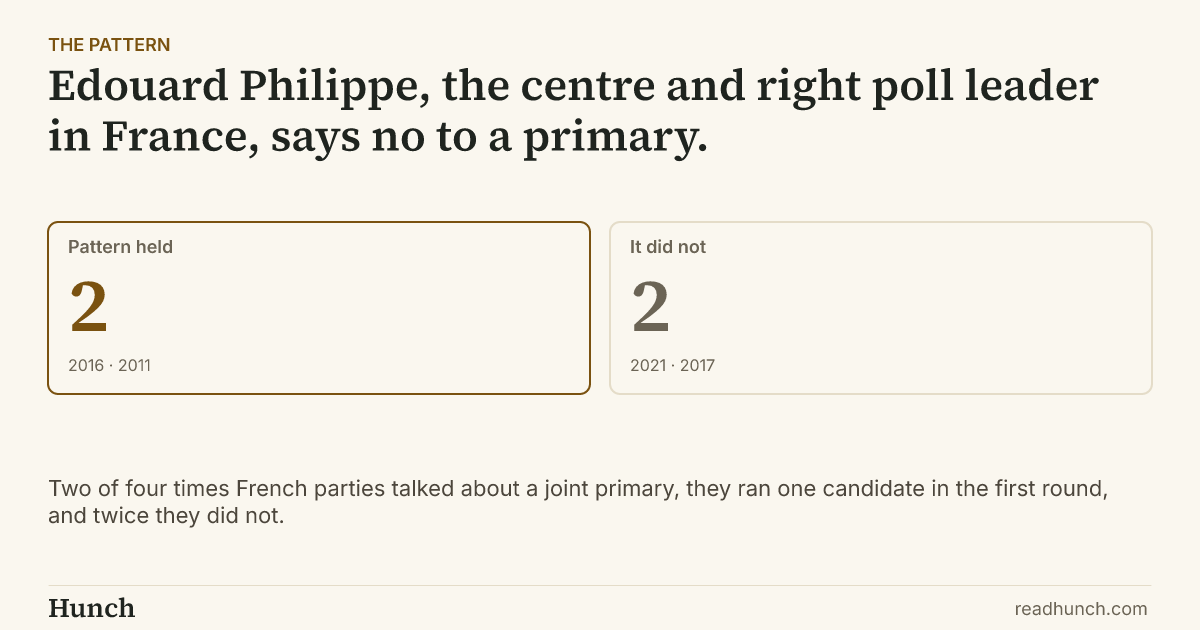
The Pattern
We looked for cases where parties of one French camp, the left or the centre and right, had a joint primary on the table before a presidential election. We found five such times since 2011, four on the left and one on the centre and right. The Socialist vote of 2011 was the first open vote of its kind in modern France. (The Guardian; The Guardian; BBC; Politico Europe; Le Monde)
Show the other 3 cases
The Read
Three of the four candidates now want a primary, and only the poll leader says no. On the left in 2011 and early 2017 several parties ran a primary together, and in five left parties announced one. Each time a strong rival of the same family stayed out and ran alone: Jean-Luc Mélenchon in 2012 and 2017, and France Unbowed in 2026. The one time no primary came, in 2021, every partner of the Socialists said no. Les Républicains and Renaissance could announce a primary without Horizons. Mr Retailleau has said the vote could take place in the first half of February at the latest, if Mr Philippe agreed to take part, and he has not promised to back the winner.
There are reasons for doubt. Each time parties set a joint primary, it was in place at least 222 days before the first round. This time that point passed on , and 160 days are left. In 2016 the primary of the right belonged to Les Républicains, under its own charter. Here a primary counts only if the parties announce it together, by a party decision or a signed deal. This camp also has three parties with their own candidates, and the one leading the polls is the one saying no. An announced primary did not always bring one candidate: in 2017 Benoît Hamon and Jean-Luc Mélenchon both ran for the left.
Sources: Primaires citoyennes (2, 3), Conseil constitutionnel (2), France 24 (2, 3), Politico Europe (2), The Guardian (2), Le Monde, Vie publique
Disclaimer
Hunch works only from sources that are publicly available, and publishes on the basis of analysis of that material. We do not form an editorial opinion or take sides, we give a simpler and wider view of news that already exists. If information in a source we used was inaccurate, distorted, or later disputed but had already entered our analysis, Hunch accepts no liability for that. Predictions are not advice. Phase 1 markets use Hunch Points, not money.
Published by Hunch under the Editorial Code. Complaints and corrections: /contact/.