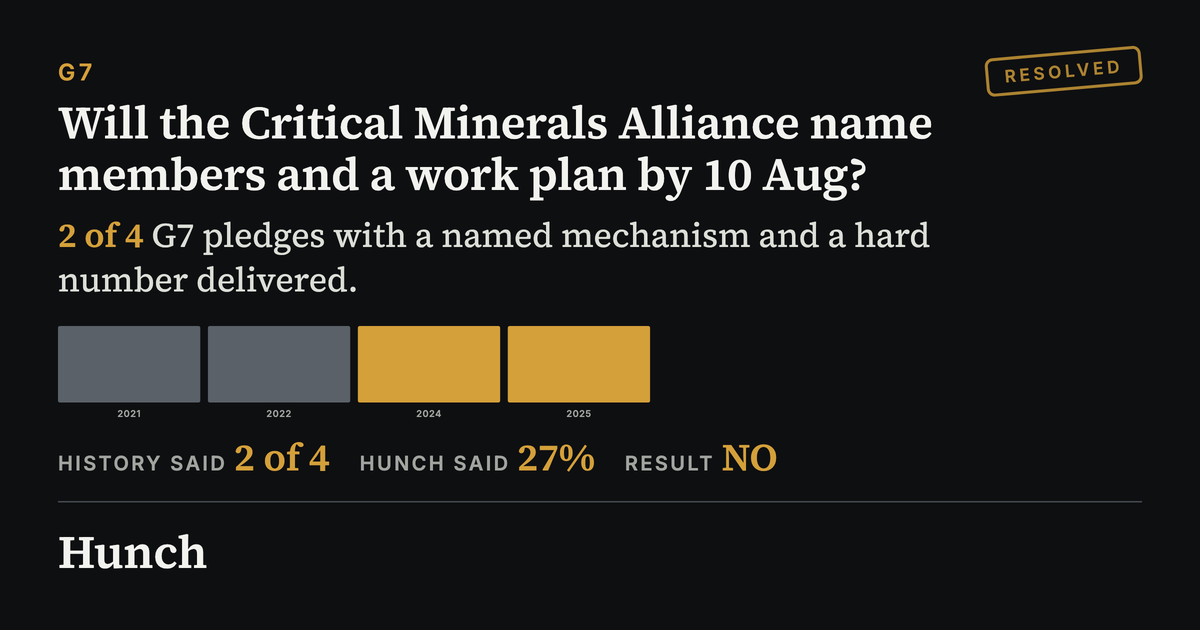
G7 wants no rare earth supplier over 60% by 2030. Half its recent big plans worked.
The G7 at Évian created a Critical Minerals Resilience and Production Alliance. By 2030 no outside supplier may top 60% of rare earths and magnets.
What happened
G7 leaders at Évian established a Critical Minerals Resilience and Production Alliance and a crisis platform, targeting below-60% dependence on any single outside supplier for rare earths and magnets by 2030.
The 52nd G7 summit ran from 15 to in Évian-les-Bains and produced nine declarations, on subjects from Ukraine and the Middle East to AI. With Volodymyr Zelensky present, leaders promised more military support for Ukraine, including air defence and long-range weapons. France, the host, also brought India, Kenya, South Korea, Brazil and Egypt into the working sessions.
The one promise with a number is on minerals. The new alliance does not bind anyone. Members will work together on funding, on tracing where minerals come from, and on stockpiling and recycling. Beyond the 60% target for 2030, leaders set an ambition of 50% as soon as possible. Tracing starts with pilots on lithium and nickel and adds five new minerals each year.
The declaration never names China. But it follows Chinese limits on exports of permanent magnets, which disrupted carmakers and defence suppliers and showed how much the G7 depends on them. China processes roughly 90% of the world’s permanent magnets. The 60% limit therefore means replacing around a third of today’s supply share in under four years.
Sources: Élysée, Council of the EU
The Pattern
We looked at the last four big G7 economic pledges. Two delivered on time and two faded away. The two that worked had a named way to move money and a clear number. The two that failed were broad plans with little behind them.
Show the other 2 cases
The Read
History gave little reason to expect quick action. Summit plans usually go quiet over the European summer. The alliance does not bind anyone, and nothing in the Évian texts sets a July deadline. Even the pledges that worked took months to get going: the loans to Ukraine agreed in were first paid out in December. Five weeks, including a quiet August, is a short time for seven governments and their partners to agree on members and a work plan.
This alliance was better prepared than most. It grew out of a 2025 action plan that lasted a year and survived a change of G7 chair, and the lithium and nickel pilots are written into the declaration itself. Chinese limits on magnet exports keep costing G7 industry money. France also has a reason to show its year as chair produced working tools, and the partner countries it brought in give it early news to announce. The record itself is thin. One of the two successes, the 2025 minerals plan, counts as a success because it grew into this alliance, so only three earlier cases really test it.
Disclaimer
Hunch works only from sources that are publicly available, and publishes on the basis of analysis of that material. We do not form an editorial opinion or take sides, we give a simpler and wider view of news that already exists. If information in a source we used was inaccurate, distorted, or later disputed but had already entered our analysis, Hunch accepts no liability for that. Predictions are not advice. Phase 1 markets use Hunch Points, not money.
Published by Hunch under the Editorial Code. Complaints and corrections: /contact/.