Germany's AfD leads a state poll by 5 points. Since 2023 such leads always won.
Two German states vote on Sunday. The far-right AfD is five points ahead in Mecklenburg-Vorpommern. In Berlin the Left leads the CDU by one point.
What happened
Voting is under way in Berlin and Mecklenburg-Vorpommern, the first state elections since the AfD won Saxony-Anhalt on . Polls close at 18:00 local time.
Berlin and Mecklenburg-Vorpommern, a state on Germany’s Baltic coast, elect their state parliaments on Sunday . In each state the returning officer, the official who runs the count, publishes a provisional result the same night.
The last poll put the far-right AfD five points ahead in Mecklenburg. The final Infratest dimap poll, taken on 7 to , has the AfD on 38%, up three points, and the Social Democrats (SPD) on 33%, up one. Die Linke has 9%, the CDU 7% and the Greens 5%. One voter in ten says their choice could still change.
In Berlin the last Infratest dimap poll puts Die Linke, the Left party, on 21% and the CDU of the city’s mayor on 20%. The AfD has 18%, the Greens 16% and the SPD 12%.
The SPD has led the Mecklenburg government since 1998. It won 39.6% in 2021, when the AfD took 16.7%. Premier Manuela Schwesig is still the most popular candidate: 59% would pick her over the AfD’s Leif-Erik Holm, who has 28%, and 55% want an SPD-led government.
The Guardian reported on that the SPD had made a strong comeback over the summer. This came after the AfD won Saxony-Anhalt on with 43.8%.
Sources: BBC, Infratest dimap (2), The Guardian, Al Jazeera
The Pattern
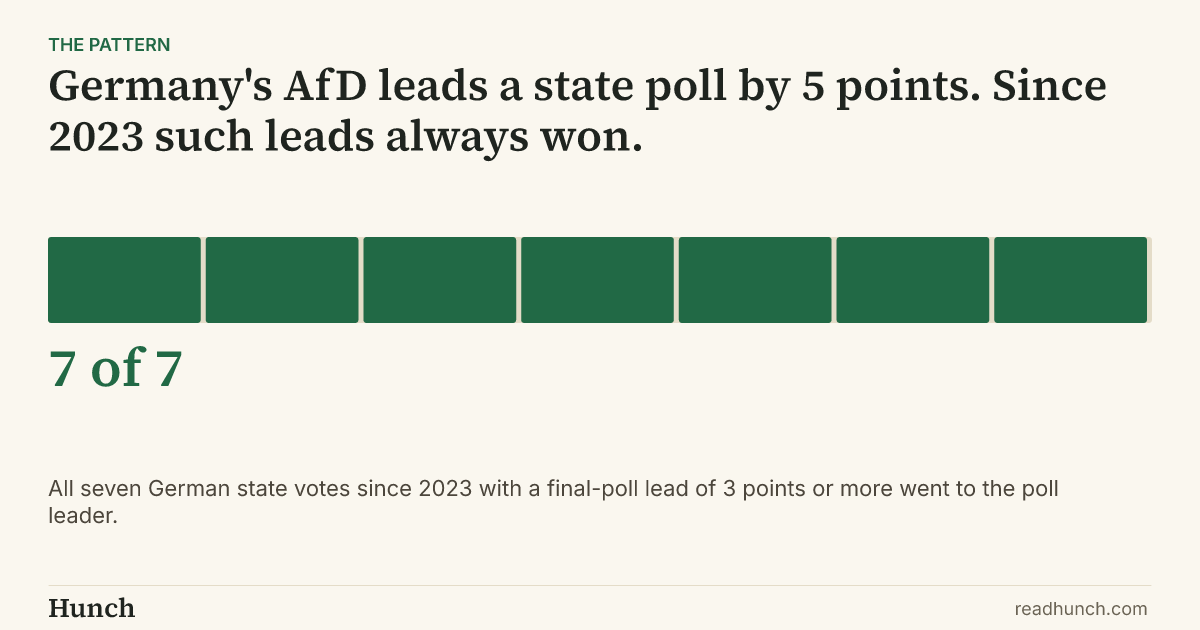
We found seven state votes since 2023 with a clear poll lead. In each one a party went into the vote 3 points or more ahead in the last Infratest dimap poll, and we checked whether it won the most second votes, the party-list votes. Each case is a different state. The closest leads were Bremen in 2023, at 3 points, and Berlin in 2023, at 6. Berlin’s own question sits on the other side of that line. In the four state votes since 2023 where the final lead was under 3 points, the poll leader came first twice.
Show the other 5 cases
The Read
History points to an AfD win in Mecklenburg. Every final-poll lead of this size since 2023 ended in first place. The smallest, three points in Bremen, still came first, and in Saxony-Anhalt this month a twenty-point lead grew to 26.6.
The record is short, and a five-point lead is near its low end. The SPD has a popular premier and gained over the summer. In Brandenburg in 2024, an SPD premier with similar personal ratings turned a one-point deficit into a 1.7-point win. The AfD also rose three points in the last poll, so the trend is not one-way. The AfD could still lose if voters who like Schwesig but not her party switch to the SPD in the last ten days to stop an AfD win, as happened in Brandenburg.
Berlin is far less certain. A one-point lead is inside the poll’s own margin of error, and in both past cases where the poll leader lost, the party of the sitting head of government came from behind. In Berlin that party is the CDU.
Disclaimer
Hunch works only from sources that are publicly available, and publishes on the basis of analysis of that material. We do not form an editorial opinion or take sides, we give a simpler and wider view of news that already exists. If information in a source we used was inaccurate, distorted, or later disputed but had already entered our analysis, Hunch accepts no liability for that. Predictions are not advice. Phase 1 markets use Hunch Points, not money.
Published by Hunch under the Editorial Code. Complaints and corrections: /contact/.