Republicans have held this Kansas seat since 1932. Now they are paying to keep it.
Senator Roger Marshall faces a stiff challenge from a Methodist pastor. The Republican Senate fund is reported to be moving money to him.
What happened
The Senate Leadership Fund, the campaign arm of Senate majority leader John Thune, pulled its ads from North Carolina and reportedly will redirect that spending to support Kansas senator Roger Marshall.
Republican Senator Roger Marshall of Kansas faces a stiff challenge from Adam Hamilton, a Methodist pastor. The Cook Political Report rates the race as “leans Republican”, one step short of safe.
The Senate Leadership Fund, the campaign arm of Senate majority leader John Thune, has pulled its ads from North Carolina. It had pledged $71m to hold that seat and planned $30m more. Semafor first reported the move, and The New York Times and CNN confirmed it with sources close to the fund. The fund reportedly will move that money to support Marshall.
The Senate majority is narrow. Republicans hold 53 seats to 47 and can lose no more than three and keep control, with Vice-President JD Vance breaking ties. Cook rates seven other races as toss-ups, and five of them are Republican seats: Alaska, Iowa, Maine, Ohio and Texas.
Kansas has not sent anyone but a Republican to the Senate since 1932. (PBS NewsHour, 23 Sep 2014) The election is on .
Sources: The Guardian, Kansas Secretary of State
The Pattern
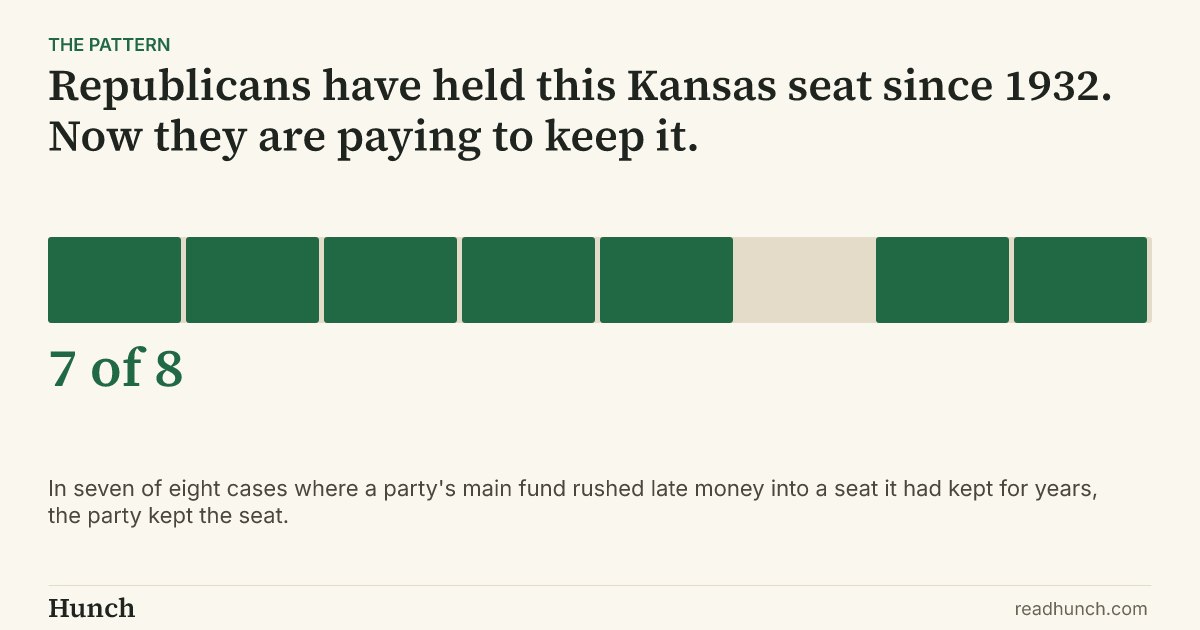
We looked for cases where a party’s main Senate fund put new money into a seat the party had kept for years, six weeks or less before the vote, while the Senate majority could change hands on six seats or fewer. We found eight since 2006, from both parties. Three of the eight decisions came from one fund, the Senate Leadership Fund, which is the fund moving money to Kansas now.
Show the other 6 cases
The Read
History points to Marshall keeping the seat. In seven of eight cases since 2006 where a party’s main fund rushed late money into a seat it had kept for years, the party won, by 10 to 15 points in the three races where we found the margin. In Arizona in 2012 the polling average had put the Democrat ahead just before the money came, and the Republican still won.
The one loss is worth knowing. In Alabama in 2017 the national party had dropped its candidate and came back to him a week before the vote. Nothing like that has happened in Kansas. The record also leans one way for a reason: rescues that work get written up more often than ones that fail, so losses may be missing from what we found. Three of the eight decisions came from the same fund that is moving money now.
Two things would change the picture before . Reports from the Federal Election Commission will show whether the fund really spends in Kansas, and the result will show whether a long Republican record lasts in a hard year for the party.
Disclaimer
Hunch works only from sources that are publicly available, and publishes on the basis of analysis of that material. We do not form an editorial opinion or take sides, we give a simpler and wider view of news that already exists. If information in a source we used was inaccurate, distorted, or later disputed but had already entered our analysis, Hunch accepts no liability for that. Predictions are not advice. Phase 1 markets use Hunch Points, not money.
Published by Hunch under the Editorial Code. Complaints and corrections: /contact/.