New law gives Trump a month to sanction Putin. Such laws were rarely used so soon.
Donald Trump signed the Lindsey O Graham Sanctioning Russia and Iran Act on Friday. It orders sanctions on named Russian officials within 30 days.
What happened
Trump signed the Lindsey O Graham Sanctioning Russia and Iran Act into law on Friday, two days after the House passed it 262 to 159, giving him power to sanction Russian officials and to put tariffs of up to 100 per cent on buyers of Russian energy.
The new law gives Donald Trump 30 days to sanction Vladimir Putin and other named Russian officials. He signed the Lindsey O Graham Sanctioning Russia and Iran Act on Friday , two days after the House passed it 262 to 159.
The government had resisted new sanctions on Moscow for a year. It changed its position after repeated attempts to end the war in Ukraine stalled. The law is named after the senator who pushed for it for years and who died on .
Section 102 of the law, H.R. 5334, says the president shall first review and then sanction the people it lists. The list starts with the President of Russia, the prime minister, the defence minister and the chief of the general staff. Thirty days from is , and the last working day before it is Friday .
The same law also lets the president step back. Section 115 allows him to waive any sanction, limit or duty in it. First he must tell Congress in writing that the waiver is in the national interest, with a report explaining why.
Volodymyr Zelenskyy thanked Donald Trump for signing. He wrote that the best way to honour the senator’s memory would be to put the law into effect fully and quickly.
Nothing has been done under the law yet. As of the Office of Foreign Assets Control, the Treasury office that runs sanctions, had published no action naming it. Its three latest Russia entries went the other way. People were taken off the sanctions list on 3 and , and a Russia general licence was changed on , the day of the signature.
Sources: The Guardian, Enrolled text of H.R. 5334, govinfo, BBC, OFAC recent actions, read
The Pattern
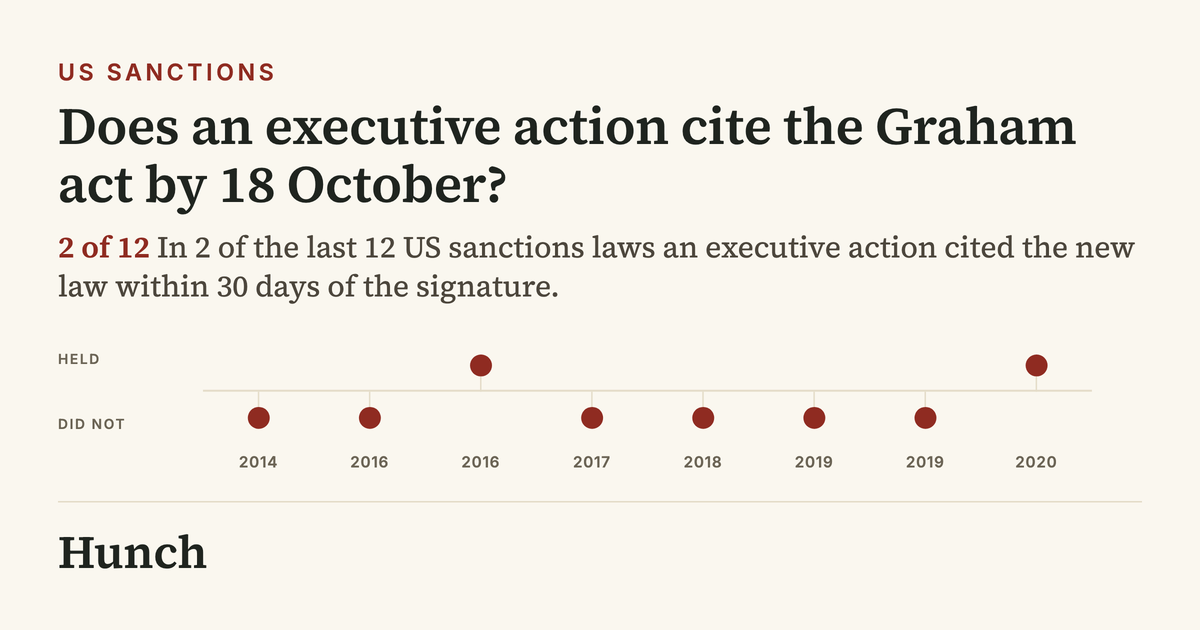
We looked at US sanctions laws aimed at a named country since 2004. For each one we counted the days from the president’s signature to the first government action that named the new law. That could be an executive order, a Treasury listing or a State Department decision. We found twelve such laws. Newest first.
Show the other 10 cases
The Read
History says a deadline in a law does not often bring action on time. Only two of the last twelve sanctions laws led to an action naming them within 30 days. In both, the executive order was written before the president signed: Hong Kong in 2020 on the same afternoon, and North Korea in 2016 on day 26. The next fastest took 60 days, and a law signed in 2004 has never been named in any action.
There are reasons this time could be faster. The law says shall, and its list starts with the President of Russia. Section 113 gives the same 30 days to put tariffs of up to 100 per cent on the biggest buyers of Russian energy. Both deadlines fall on , the first Sunday in the six weeks before the midterm elections. The people named are also already under US sanctions, so listing them again under the new law is paperwork more than a policy fight. That is why our estimate is higher than history alone.
Two things point the other way. Section 115 lets the president undo any part of the law with one certificate to Congress. And in the three weeks before the signature, every Russia entry on the Treasury’s sanctions page was a removal or an easing, including a changed general licence on the day the law was signed. What the Treasury publishes next is the thing to watch.
Disclaimer
Hunch works only from sources that are publicly available, and publishes on the basis of analysis of that material. We do not form an editorial opinion or take sides, we give a simpler and wider view of news that already exists. If information in a source we used was inaccurate, distorted, or later disputed but had already entered our analysis, Hunch accepts no liability for that. Predictions are not advice. Phase 1 markets use Hunch Points, not money.
Published by Hunch under the Editorial Code. Complaints and corrections: /contact/.