Green leader Zack Polanski runs for MP. Most such races drew over 40% turnout.
Zack Polanski, the Green leader, will stand in the Holborn and St Pancras byelection on 8 October, the sixth party leader since 2012 to do so.
What happened
The Green party selected its leader, Zack Polanski, as its candidate for the Holborn and St Pancras byelection on , the seat left vacant when Keir Starmer stood down from parliament.
Green party members chose their leader, Zack Polanski, on Friday to stand in the Holborn and St Pancras byelection on . He beat the local councillor Hamza Chowdhury, who had argued the seat did not need an MP who turns up for a campaign and leaves once the votes are counted.
A byelection is a vote for a single seat in parliament between general elections. It is rare in Britain for the leader of a national party to stand in one in person.
Turnout in this seat is high. At the 2024 general election, when Keir Starmer won it, 54.46% of voters in Holborn and St Pancras took part, and Labour won by more than 11,000 votes. The Greens now have ten council seats in the area, up from one before May. Byelections usually lose a large part of that turnout, because no government is being chosen.
A famous name on the ballot does not always bring voters out. Nigel Farage stood in the Clacton byelection on . Turnout was 44%, on 35,111 votes, the lowest the seat has had since it was created in 2010.
The BBC called the 46.1% turnout in Uxbridge in 2023 high for a byelection. So in these contests a turnout in the mid-40s counts as strong.
Sources: Guardian (2), Camden Council, Independent, BBC
The Pattern
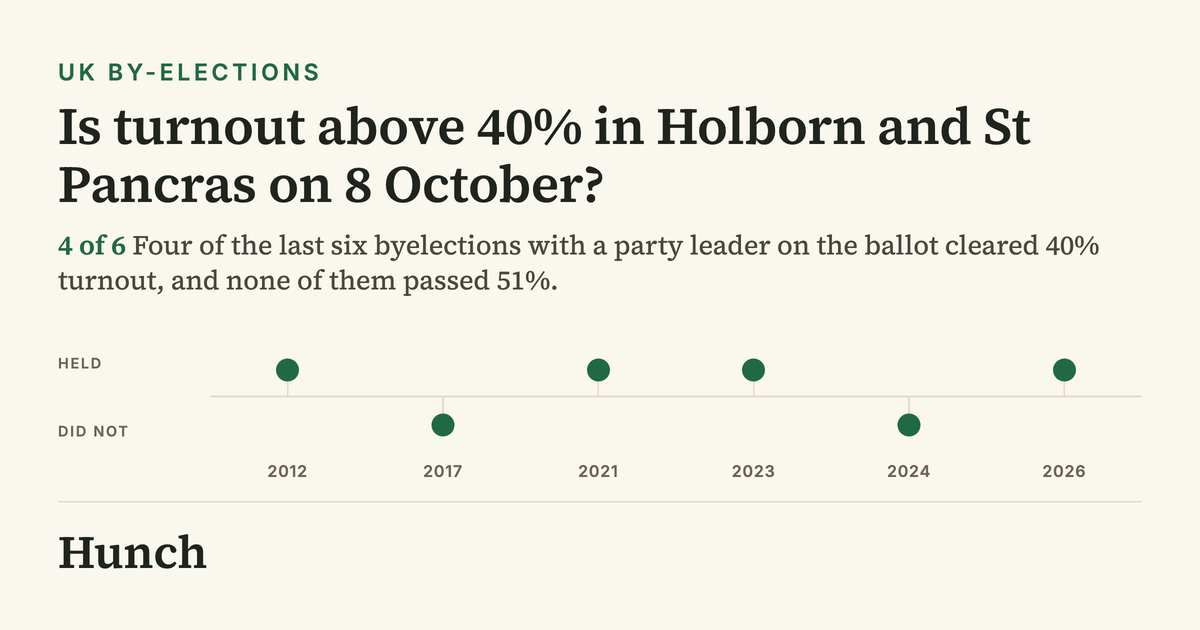
We looked at UK byelections since 2012 where the leader of a national party stood in person, and checked whether more than 40% of voters turned out. We found six. Four passed 40%, and none passed 51%.
Show the other 4 cases
The Read
History leans towards a turnout above 40%, since four of the six races with a party leader on the ballot passed it. This seat also votes in large numbers, and the Greens have grown fast here, from one councillor in the area to ten in May.
The weak spot is the recent record. The three latest races of this kind all came in at 46.1% or below, and Rochdale in 2024 fell under 40%. Clacton in August had the lowest turnout that seat has ever recorded. So a leader on the ballot seems to bring out fewer voters than the news coverage suggests. The record is also small, and George Galloway stood in three of the six races.
The other questions are about the smaller parties. When a party leader stands, the race often narrows to two names, and the parties outside that pair lose votes they would keep at a general election. That puts the Conservatives’ 7.2% and Reform UK’s 6.1% from 2024 at risk. Two things could change the picture. The government is expected to decide on the Jackdaw and Rosebank fields around the time of the vote, and a decision during the campaign would bring more people out. If Labour voters think the seat is safe and stay home, turnout falls without helping the other parties.
Disclaimer
Hunch works only from sources that are publicly available, and publishes on the basis of analysis of that material. We do not form an editorial opinion or take sides, we give a simpler and wider view of news that already exists. If information in a source we used was inaccurate, distorted, or later disputed but had already entered our analysis, Hunch accepts no liability for that. Predictions are not advice. Phase 1 markets use Hunch Points, not money.
Published by Hunch under the Editorial Code. Complaints and corrections: /contact/.