Gulf states plan to meet Iran on Hormuz. Most such talks got no deal in a month.
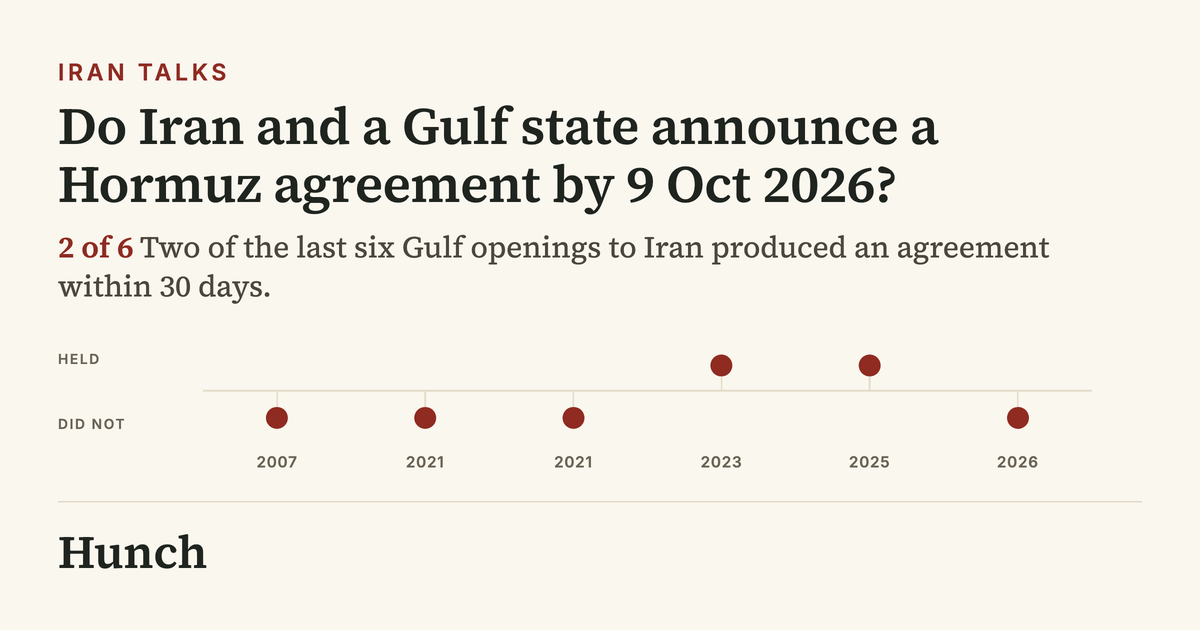
Gulf states are preparing to meet Iran about the Strait of Hormuz. Since 2007, only 2 of 6 such talks led to an agreement within a month.
What happened
Iran and Gulf states are to meet in a push for a deal on the Strait of Hormuz, six months into the US-Iran war and days after the heaviest exchange of attacks on shipping so far.
Gulf Arab states are preparing to meet Iranian officials to try to reach a deal on the Strait of Hormuz. On Qatar’s foreign ministry said new ideas were being discussed with partners including China.
Qatar said reopening the strait without conditions was a priority for the region, and that a state of neither war nor peace was unacceptable. So Gulf governments are opening direct talks with Tehran while the fight over the strait goes on.
The strait is at the centre of the war. On Iran said it had struck ten ships near the strait after US forces sank five Iranian tankers. The oil price passed $100 a barrel for the first time since July.
At least 75 ships have been attacked since the war began and 21 seafarers killed. As of , 42 tankers were waiting to pass through.
Oman already tried a Gulf plan this summer. In July it offered Iran a shared regional system, modelled on the voluntary payments made by ships using the Strait of Malacca. Tehran rejected an equal split of the shipping lanes, but said talks with Oman were moving step by step. Six weeks later there is still no such system, and the question is whether a wider Gulf meeting changes that.
Sources: Financial Times, Al Jazeera (2, 3), The Guardian
The Pattern
We looked for times since 2007 when Gulf Arab states opened direct talks with Iran to settle a live dispute, either as a side in it or as the go-between. We found six. Two led to an agreement announced within 30 days. The other four brought no agreement in that time.
Show the other 4 cases
The Read
History leans against a quick deal, since only two of the six talks produced an agreement within a month. The split comes down to who arrived with a written text. Qatar in and China in brought terms that only needed a yes, and both closed within days. Doha in 2007, Baghdad and Tehran in 2021 and Oman this July all began with proposals still passing between capitals, and none produced a signed paper within a month. Next week’s meeting looks like the second group.
The case against that is the pressure, which is much heavier now than in the four slow cases. Oil is above $100 and 42 tankers are waiting, which gives Gulf governments a reason to push. Qatar has also said it is working with China, which brokered the 2023 deal.
The answer turns on whether China or the United States brings a written plan to the table. Both quick deals in the record had one.
Disclaimer
Hunch works only from sources that are publicly available, and publishes on the basis of analysis of that material. We do not form an editorial opinion or take sides, we give a simpler and wider view of news that already exists. If information in a source we used was inaccurate, distorted, or later disputed but had already entered our analysis, Hunch accepts no liability for that. Predictions are not advice. Phase 1 markets use Hunch Points, not money.
Published by Hunch under the Editorial Code. Complaints and corrections: /contact/.