GWR staff vote to strike four weeks before a state takeover.
Members of the TSSA union at Great Western Railway backed strikes in a vote announced on 13 November. A state company takes over GWR on 13 December.
What happened
General secretary Maryam Eslamdoust said strike action and action short of a strike was “now inevitable unless the company addresses these perfectly legitimate demands”.
Staff at Great Western Railway (GWR) have voted for strikes. They are members of the Transport Salaried Staffs’ Association (TSSA), a union for rail managers and office staff. They plan train crews and work in or near the control centre. In one group 85% voted to strike, in another 71.5%, and 95% in both backed action short of a strike, such as working strictly to the rules. No dates have been set.
The union wants shift payments moved into basic pay, so they count for pensions. GWR says it is working with the union “to find a mutually beneficial solution to the dispute and avoid damaging strike action”. The union says it only strikes as a last resort and is ready to talk at any time.
Strike action and action short of a strike which will have a real impact on services at GWR are now inevitable unless the company addresses these perfectly legitimate demands.
TSSA General Secretary Maryam Eslamdoust, 13 November 2026
The employer changes on . From that day a new state company, Greater Western Railway Limited, runs the trains instead of First Greater Western Limited, which belongs to FirstGroup. It is part of the government’s plan to bring all rail services in England into public ownership by 2027. A strike vote stays valid for 12 months, and the union must warn the employer at least 10 days before any action. For action before , that warning must come by .
Sources: BBC (2), TSSA, GOV.UK, legislation.gov.uk (2)
The Pattern
We looked for cases where TSSA announced that its members had won a vote for strikes or other action. We found nine such votes since 2015, at rail companies in England, Scotland and Northern Ireland. Avanti West Coast and GWR in 2022 were part of one national rail dispute, so they count once. In four votes TSSA named dates in the same statement as the result; in the other five, as now, it named none at first.
Show the other 7 cases
The Read
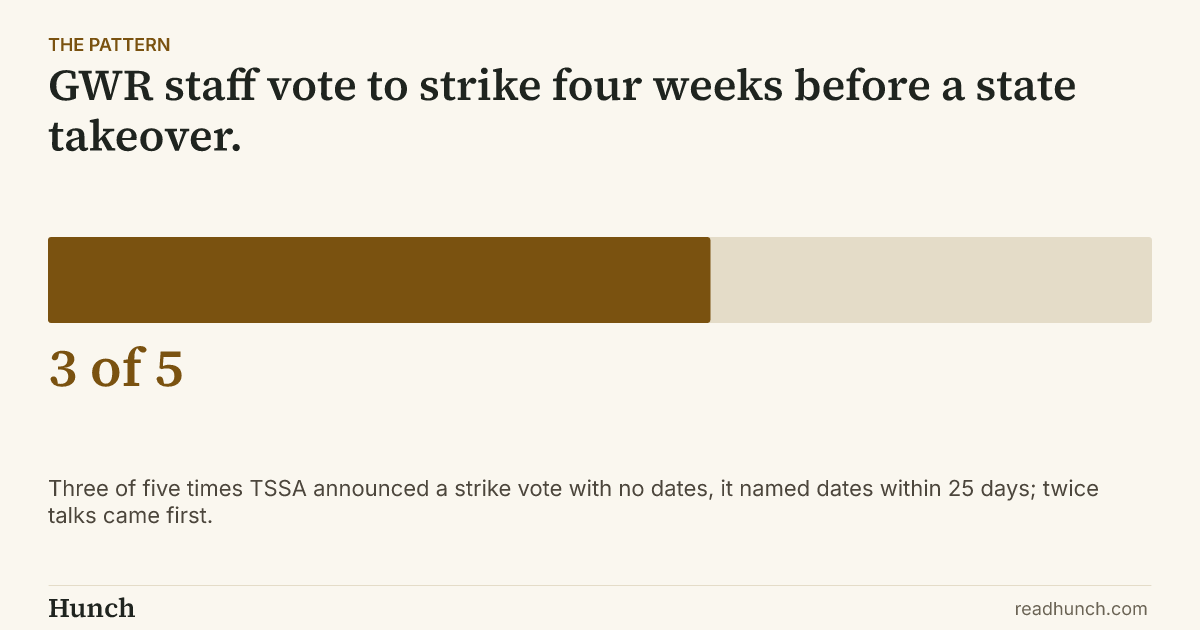
Four times TSSA named dates in the same statement as the vote result. This time it did not, and three days later there were still no dates. After the five votes with no dates at first, TSSA later named dates three times: after 14 days at Avanti West Coast in 2022, within 19 days at ScotRail in 2023 and after 25 days at Translink in 2025. From this result on to is 29 days.
There are reasons for doubt. In none of the nine votes was the employer about to change. The closest was CalMac in 2015, when the ferry contract could pass to another company, and the union put off a date to allow for talks. In 2021 Balfour Beatty made a better offer three days after the vote. All nine votes were run by the same union, and since the warning to the employer is 10 days, down from 14.
Disclaimer
Hunch works only from sources that are publicly available, and publishes on the basis of analysis of that material. We do not form an editorial opinion or take sides, we give a simpler and wider view of news that already exists. If information in a source we used was inaccurate, distorted, or later disputed but had already entered our analysis, Hunch accepts no liability for that. Predictions are not advice. Phase 1 markets use Hunch Points, not money.
Published by Hunch under the Editorial Code. Complaints and corrections: /contact/.