Hong Kong convicts two vigil leaders. Most such cases got a sentence in two weeks.
A Hong Kong court found the 2 surviving leaders of the Tiananmen vigil movement guilty of inciting subversion under the national security law.
What happened
Lee Cheuk-yan, 69, and Chow Hang-tung, 41, were found guilty of incitement to subversion over the Hong Kong Alliance’s call to end one-party rule; both face up to ten years, sentencing was deferred, and the UK Foreign Office condemned the verdict the same day.
The conviction turns on a slogan. On three national security judges found Lee Cheuk-yan, 69, and Chow Hang-tung, 41, guilty of incitement to subversion, which means urging others to undermine the state.
The court ruled that the Hong Kong Alliance’s decades-old call to end one-party rule broke the 2020 national security law, because it was meant to make people lose confidence in the Chinese Communist party. The court did not find the candlelit vigils themselves to be the crime.
A third defendant, the former lawmaker Albert Ho, 74, pleaded guilty in January. The trial ran 24 days, and Lee and Chow have been in custody since 2021.
The crime carries up to ten years in prison. Cases the court sees as serious get five to ten years, and lesser ones get under five. Nearly five years already spent in custody before trial count towards any sentence. The court put off sentencing and has not yet set a date.
For three decades the Alliance’s June vigils for 1989 were the only mass commemoration of Tiananmen allowed on Chinese soil.
Britain responded the same day. The Foreign Office minister Baroness Winterton condemned the verdict, saying it showed peaceful acts of remembrance in Hong Kong were now being treated as threats to national security.
Since the law came in in 2020, Britain has answered each of its big steps with statements and with measures such as visa routes and the suspension of treaties. It has not put sanctions on the officials involved.
Sources: The Guardian, FCDO gov.uk
The Pattern
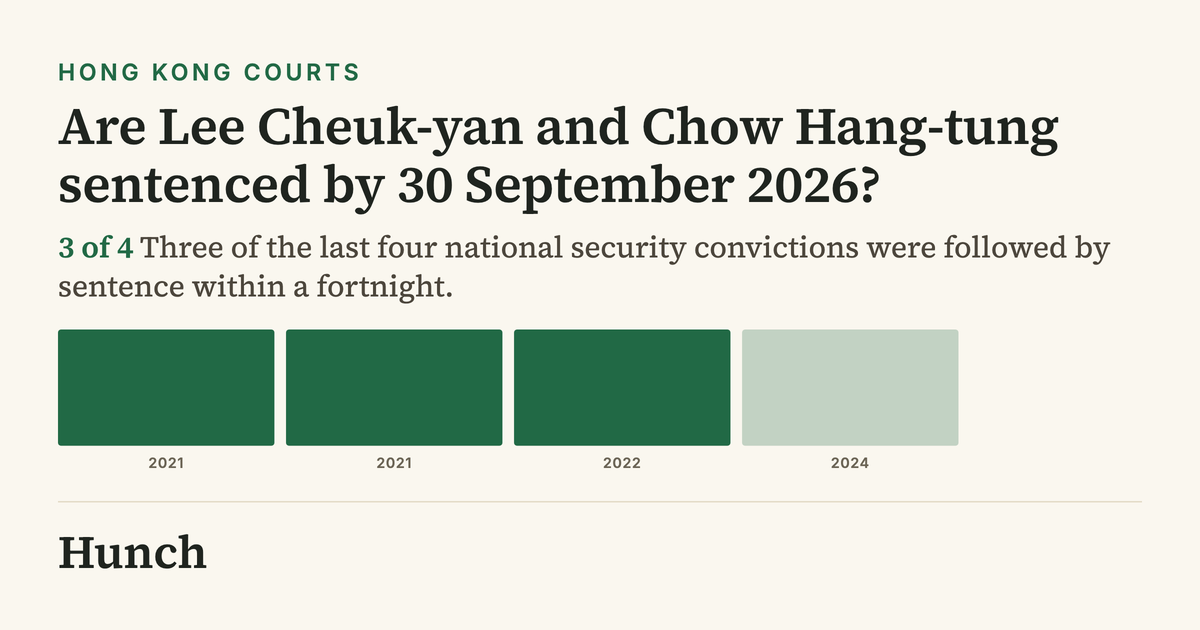
We looked at every major conviction under Hong Kong’s national security law since 2021 where the sentence did not come straight away, as in this case. We asked one question: was the sentence passed within 14 days of the verdict? Four cases fit, and we show all four. In three of them it was.
Show the other 2 cases
The Read
History says a sentence usually comes fast. In three of the four earlier cases it came within two weeks. But each of those three had a single defendant or a single charge. The one case with many defendants, the 47 democrats, waited six months. This trial has three defendants, one of whom pleaded guilty. The court also has to hear each side’s case for a lighter sentence and weigh nearly five years in custody.
On the length of the sentence, the judgment points towards the serious range of five to ten years. The court called the slogan the core of the crime and found an aim to weaken confidence in the party. The same kind of language was used to justify ten years for the organiser Benny Tai in 2024. Lee and Chow led the Alliance for years and fought the charge, so they get no discount for a guilty plea.
There is room for a lighter sentence too. The Alliance’s actions were openly peaceful, and two of the three defendants are 69 and 74. A court that wants to look fair after criticism from abroad could stay under five years. The question on five years or more also resolves no if the hearing slips past October, because no sentence would be read out in time.
Disclaimer
Hunch works only from sources that are publicly available, and publishes on the basis of analysis of that material. We do not form an editorial opinion or take sides, we give a simpler and wider view of news that already exists. If information in a source we used was inaccurate, distorted, or later disputed but had already entered our analysis, Hunch accepts no liability for that. Predictions are not advice. Phase 1 markets use Hunch Points, not money.
Published by Hunch under the Editorial Code. Complaints and corrections: /contact/.