Iran hits a ship after the US deal. Until 2026, Gulf clashes stopped short of war.
Donald Trump and Masoud Pezeshkian signed a 14-point deal on 17 June to end the US-Iran war. 13 days later, ships are burning in the Strait of Hormuz.
What happened
Tehran rejected third-party intervention over the Strait of Hormuz and denied Trump’s claim of a planned meeting in Doha, after a week of tit-for-tat strikes strained the memorandum.
The deal signed on has 14 points. It is a memorandum of understanding, a written promise short of a treaty. It includes an immediate and permanent end to military operations, the reopening of the Strait of Hormuz to commercial ships and the lifting of the US blockade.
It also promises a $300bn fund to rebuild Iran. Other points cover sanctions waivers on Iranian ports and oil, and the unfreezing of Iranian assets.
Donald Trump signed it at the Palace of Versailles during a G7 dinner hosted by Emmanuel Macron, and Masoud Pezeshkian signed in Tehran. The two governments gave themselves 60 days to agree a full treaty.
The war it is meant to end began in late February with US and Israeli strikes that killed Supreme Leader Ali Khamenei and senior Iranian officials. The fighting has not fully stopped. On Iran attacked a cargo ship in the Strait of Hormuz, and US forces struck Iranian targets in response. A second ship was hit the next day, and the US struck again.
By the talks themselves were in dispute. Tehran rejected any outside help over the Strait of Hormuz and denied Trump’s claim that the two sides had met in Doha.
A separate ceasefire in Lebanon, announced by Trump on with help from Qatar and Iran, is also under strain. Hezbollah says it is not bound by terms it did not negotiate. Israel says it will not pull back from southern Lebanon until Hezbollah disarms.
Sources: Al Jazeera (2, 3, 4)
The Pattern
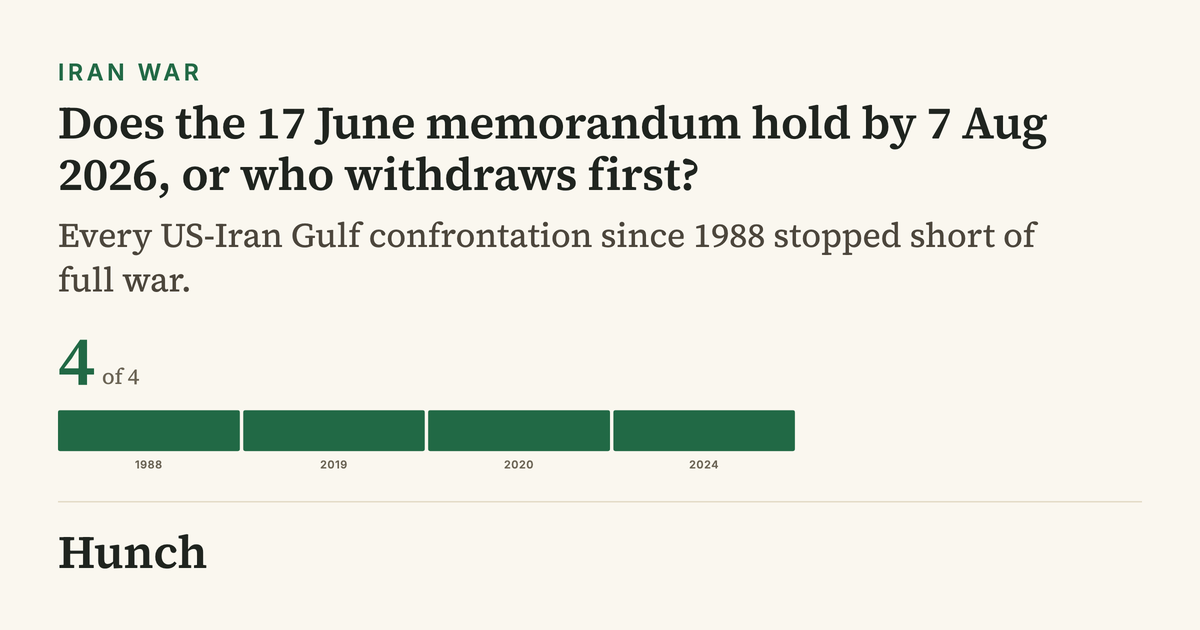
We looked at clashes between the US and Iran in and around the Gulf since 1988. We found four. Each time an attack and a military reply were followed by a step back before full-scale war. The 2026 war broke that run, and the question now is whether the old pattern returns.
Show the other 2 cases
The Read
History leans towards the deal surviving. Both governments keep saying the deal stands even while they fire at each other. In 2019 and 2020 fighting and face-saving also ran side by side, and both sides stepped back. The 60-day clock to agree a treaty, running to mid-August, gives each side a reason to put up with breaches. The $300bn fund is also a prize Iran’s new leaders cannot easily walk away from.
The weak spots are serious. The ceasefire was broken twice in ten days, and the attacks hit the reopened Strait of Hormuz, the part of the deal that gives it its economic value. Tehran’s refusal of outside help narrows the talks just when they are most needed. The February strikes killed Iran’s top leaders, and hardline groups in Tehran have every reason to wreck the deal.
Each new attack on a ship makes it more likely that Washington will call the deal dead. A formal withdrawal by either side would settle the question, and so would a signed treaty.
Disclaimer
Hunch works only from sources that are publicly available, and publishes on the basis of analysis of that material. We do not form an editorial opinion or take sides, we give a simpler and wider view of news that already exists. If information in a source we used was inaccurate, distorted, or later disputed but had already entered our analysis, Hunch accepts no liability for that. Predictions are not advice. Phase 1 markets use Hunch Points, not money.
Published by Hunch under the Editorial Code. Complaints and corrections: /contact/.