Republicans hold the US House by five seats. Will the midterms cost them far more?
Americans elect all 435 members of the House of Representatives on 3 November. Republicans won 220 seats in 2024 and Democrats 215.
What happened
A month before the midterms, the Cook Political Report has moved 15 House races toward Democrats and expects them to gain five to 15 seats.
Americans vote on for all 435 seats in the House of Representatives. Analysts have long expected Democrats to win the House. The Cook Political Report, which rates US races, has moved 15 races toward Democrats and expects them to gain five to 15 seats. It now rates the Texas border seat of Republican Monica De La Cruz as a toss-up. (Cook Political Report, via Al Jazeera)
Republicans won 220 seats in 2024 and Democrats 215. If nothing else changes, a net loss of three seats would give Democrats the majority.
An AP-NORC poll puts approval of President Donald Trump at 31%. Trump has asked supporters to vote “like I’m on the ballot“ and has promised $400m to $500m from MAGA Inc, his political group.
Democratic leaders say investigations into the Trump family’s businesses would be a priority if they win. Republicans have more money, with $233.4m in cash against $130.4m for Democrats.
Sources: Al Jazeera, US House history, AP-NORC
The Pattern
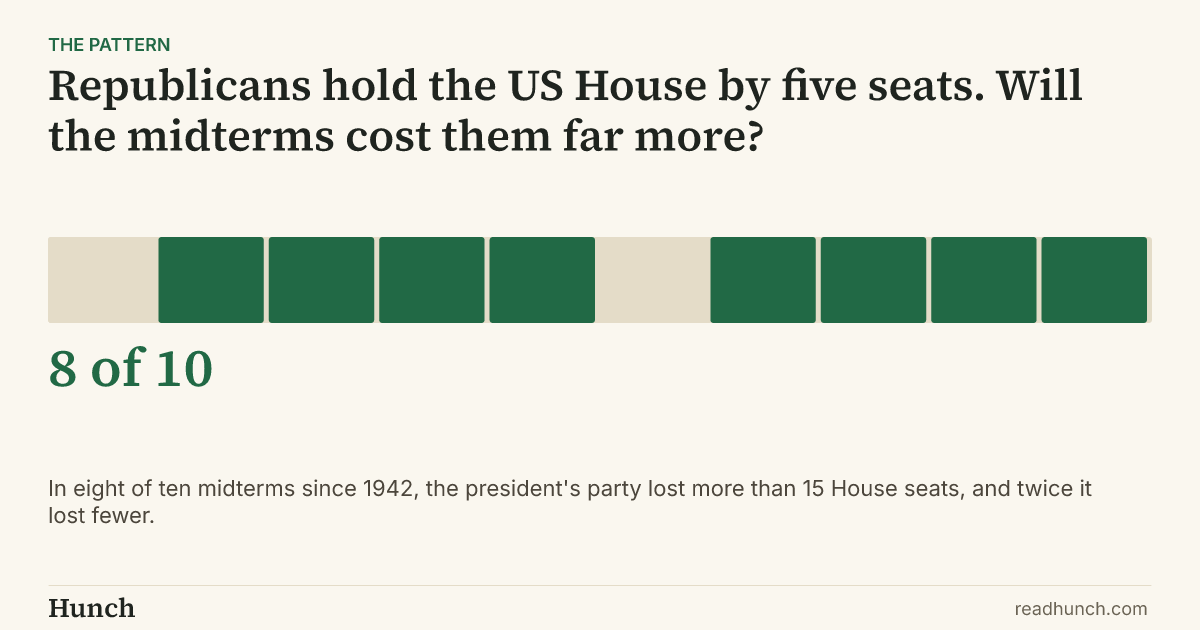
We looked for cases where the president’s party ran the House going into a midterm election and the president’s approval was under 50% or not yet measured. We found 16 since 1914 and kept the ten most recent, from 1942 to 2022. The president’s party lost seats every time, and in eight of the ten it lost more than 15.
Show the other 8 cases
The Read
Past midterms point to a big Republican loss. The president’s party lost seats in all ten, and in eight of them it lost 28 or more. The losses came in groups: 9 to 14 seats, 28 to 30, 42 to 47 and 54 to 64. Cook’s forecast of five to 15 seats sits in the lowest group.
Two things could keep the loss small. In 2022, with approval at 40%, Democrats lost only nine seats; Gallup had said before the vote that a party with a thin majority has fewer seats to lose. Republicans now hold 220 seats, the same bare majority Gallup pointed to then. Trump’s 31% also comes from AP-NORC, while Gallup measured the earlier presidents, and the lowest it found was 33% in 1946.
The majority question needs a much smaller loss. A net loss of three seats is enough, and every loss in this list was nine seats or more. Ten midterms cannot cover everything: the six older ones from 1914 to 1938 also fit, and the party kept the House in all six.
Sources: US House history, Gallup
Disclaimer
Hunch works only from sources that are publicly available, and publishes on the basis of analysis of that material. We do not form an editorial opinion or take sides, we give a simpler and wider view of news that already exists. If information in a source we used was inaccurate, distorted, or later disputed but had already entered our analysis, Hunch accepts no liability for that. Predictions are not advice. Phase 1 markets use Hunch Points, not money.
Published by Hunch under the Editorial Code. Complaints and corrections: /contact/.