Democrats won Congress. Will Republicans pass their own budget bill before January?
Democrats won both houses of the US Congress and take over on 3 January. Until then, Republicans want one more budget bill passed without Democrats.
What happened
Congress returned after the midterm elections, and Republicans are still eyeing a third party-line budget bill while time runs out.
A reconciliation bill is a budget bill with its own fast-track rules. It can pass the Senate with a simple majority, so the other party cannot block it. First the House and the Senate must agree a budget plan that tells committees to write it. Republicans have used this route twice since 2025 and want a third bill, with more money for the Pentagon.
On the House passed its plan for the 2027 budget year, 216 to 214. No Democrat voted for it. The plan lets four House committees add up to $95bn to the deficit over ten years, $60bn of it for the armed services committee. The Senate received the plan on and has not voted on it.
In the House of Representatives, not later than September 11, 2026, the committees named in subsection (b) shall submit their recommendations on changes in laws within their jurisdictions to the Committee on the Budget of the House of Representatives to carry out this section.
House budget plan for 2027, section 201
Republicans lost both houses in the election. Democrats won at least 54 Senate seats and 254 House seats, and the new Congress meets on . Until then Republicans still lead both houses. The House plans to stop work on and the Senate a day later.
Some Republicans still push for the bill. Defense Secretary Pete Hegseth asked for at least $350bn more for the military. Senator Ron Johnson, who leads the Senate budget committee, said he was “working behind the scenes preparing for reconciliation 3.0”. In late October Senate leader John Thune said such a bill “takes 50 votes, which right now we don’t have”. Rosa DeLauro, the top Democrat on the House spending committee, said the bill would threaten talks between the parties on government funding, which runs out on .
Sources: CBS News, Congressional Research Service (2), House Budget Committee, GovInfo (2), The Guardian, Al Jazeera, US House
The Pattern
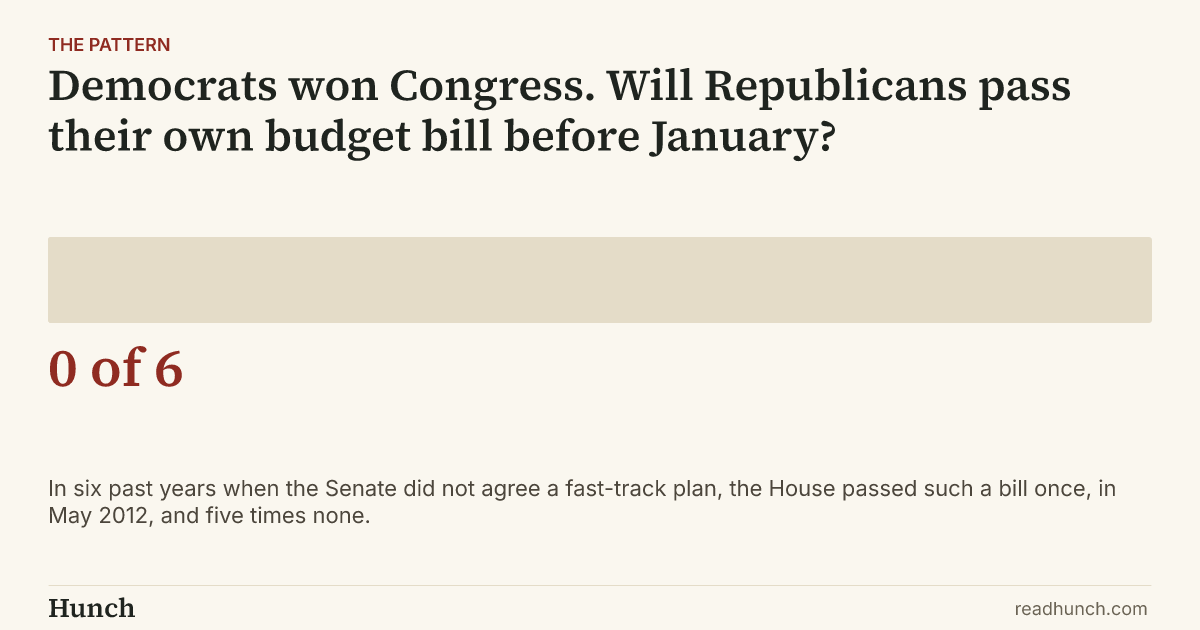
We looked for cases where the US House passed a budget plan that opened the way to a reconciliation bill, with no more than five votes from the other party, and the Senate never agreed to such a plan for that year. We found six such years since 1990: 1998, 2004, 2006, 2008, 2012 and 2013. (Congressional Research Service; Congressional Research Service)
Show the other 4 cases
The Read
In six years when the Senate did not agree a fast-track plan, the House passed such a bill once. That was in , 42 days after the House plan, and the Senate never voted on it, because without a joint plan the bill lost its fast-track rules there. In the other five years no bill came, and none of the six saw a House vote in the weeks after an election. This year 111 days have passed since the House plan, and 37 are left before the House stops on . In the five earlier years without a joint plan, the House made its own plan count for itself, and by early November it had not done so this year.
There are reasons for doubt. The Senate agreed the plan 16 other times, and each time the House passed a fast-track bill, including all six plans since 2017. Ron Johnson says he now hears the White House wants one more bill, and Representative Chip Roy called for one on . Republican lawmakers told The Guardian that “the votes are technically there” but time may not be. Against that, Thune called the bill “a heavy lift” on and said judges come first. Only in 2006 did a majority lose an election while its plan was still open, and no bill came then.
Sources: Congressional Research Service (2, 3), GovInfo (2), The Washington Post, The Guardian, US House archives
Disclaimer
Hunch works only from sources that are publicly available, and publishes on the basis of analysis of that material. We do not form an editorial opinion or take sides, we give a simpler and wider view of news that already exists. If information in a source we used was inaccurate, distorted, or later disputed but had already entered our analysis, Hunch accepts no liability for that. Predictions are not advice. Phase 1 markets use Hunch Points, not money.
Published by Hunch under the Editorial Code. Complaints and corrections: /contact/.