Hungary may get its frozen €4.2bn back. New leaders usually saw such penalties end.
The European Commission proposed on 23 September to release €4.2bn frozen under Viktor Orbán. EU governments have one month to decide.
What happened
The European Commission proposed on that EU governments lift the 2022 measures that froze part of Hungary’s EU regional money, saying Hungary has addressed the rule of law problems behind them.
On the Commission asked EU governments to end the freeze. In the Council, where EU governments sit, held back 55% of the EU money for three of Hungary’s regional development programmes and stopped new EU grants to universities run by foundations close to the government. The Commission now says Hungary has fixed the problems with public contracts, corruption and prosecutors. If governments agree, €4.2bn comes back and students and researchers at those universities can use Erasmus+ and Horizon Europe again.
The Council has one month from the Commission Proposal to decide on the lifting of protective measures adopted in 2022.
European Commission, 23 Sep 2026
The EU law behind the freeze lets governments change the Commission’s proposal by a qualified majority, and in exceptional circumstances extend the one-month deadline by up to two months. The EU’s Justice Commissioner, Michael McGrath, said the proposal is expected to be adopted. Some of the money cannot come back: Commission officials said in May that about €2bn had already been lost for good when spending deadlines passed.
The change came with a new government. Péter Magyar’s Tisza party won 141 of 199 seats in the April election, and he was sworn in on , ending Viktor Orbán’s 16 years in power. On he and Commission President Ursula von der Leyen agreed a plan to release €16.4bn if Hungary made a list of reforms. Other EU money stays blocked: officials said in May that more than €530m was held back over migration, asylum and LGBTQ rules. On the government sent parliament a bill to change the 2021 child-protection law that the EU objected to.
Sources: European Commission, EUR-Lex, Regulation 2020/2092, Politico Europe (2), Al Jazeera (2), BBC
The Pattern
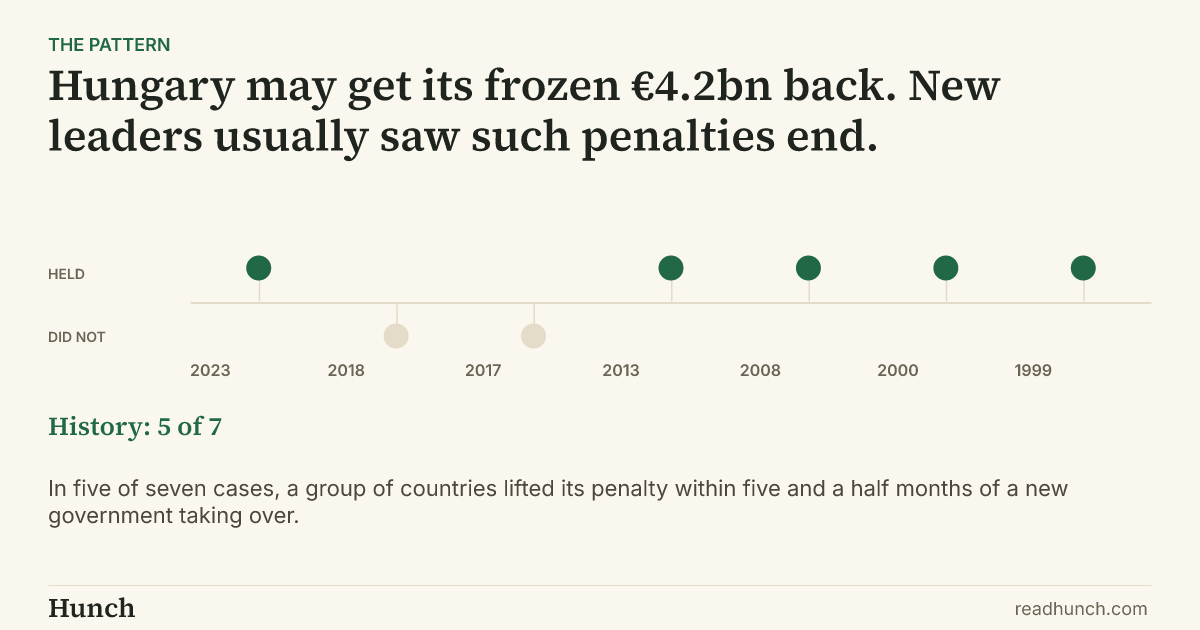
We looked for cases where a group of countries punished a member for the way its government ran the country, and that government then lost power. Most penalties were a lost seat or membership; only Poland’s was money. We found seven cases from 1999 to 2024. In each we counted the days from the new government taking office to the group lifting the penalty. Hungary’s government will have had 167 days by .
Show the other 5 cases
The Read
History points to a yes. In five of the seven cases the group lifted its penalty within 78 days of the new government taking office, and in two of them on the day of the handover. The two slow cases, the Maldives and Zimbabwe, had left the group and had to apply to rejoin, which needs every member to agree. Hungary never left, and the Council decides by a qualified majority.
The record is weaker on money. Only Poland’s penalty was money, and in almost every case the group lifted everything at once. Hungary is also slower than the fast cases: the Commission made its proposal 137 days after Péter Magyar took office. A Council vote before would settle the question.
Disclaimer
Hunch works only from sources that are publicly available, and publishes on the basis of analysis of that material. We do not form an editorial opinion or take sides, we give a simpler and wider view of news that already exists. If information in a source we used was inaccurate, distorted, or later disputed but had already entered our analysis, Hunch accepts no liability for that. Predictions are not advice. Phase 1 markets use Hunch Points, not money.
Published by Hunch under the Editorial Code. Complaints and corrections: /contact/.