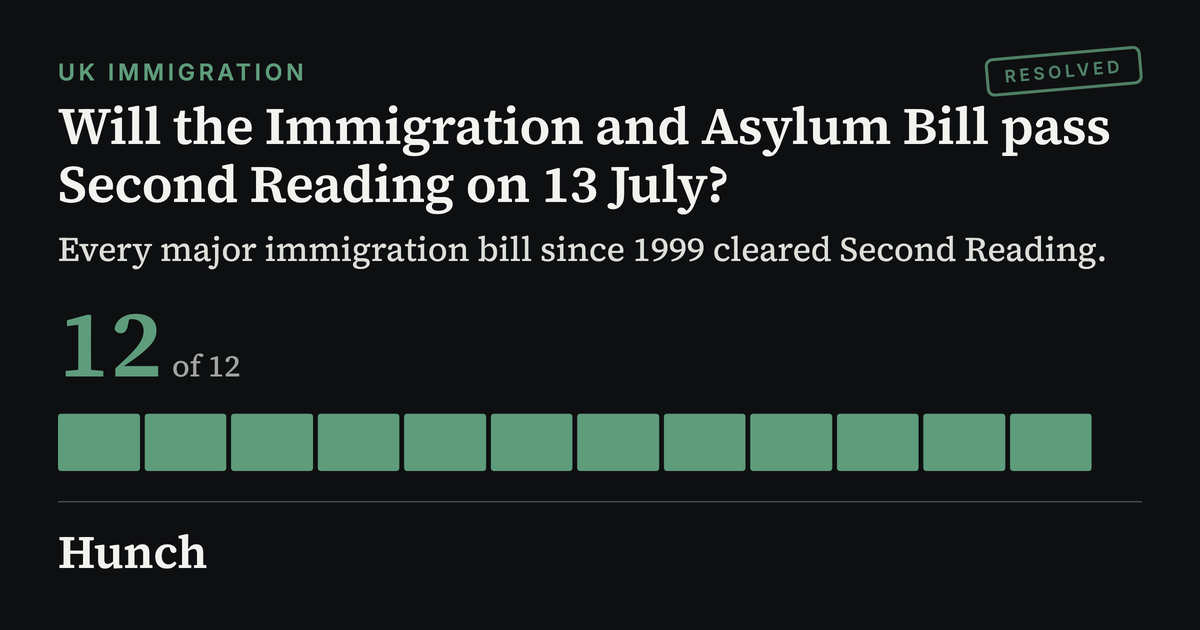
MPs vote on the asylum bill on 13 July. Every major one since 1999 got through.
The government put forward its Immigration and Asylum Bill on 30 June. MPs vote on it on 13 July. The question is how many Labour MPs vote against it.
What happened
The Immigration and Asylum Bill has its First Reading in the Commons; Second Reading is scheduled for , days before the House rises.
The government put forward the Immigration and Asylum Bill in the House of Commons on . It puts into law plans from its asylum and returns policy.
The bill has three main parts. Part 1 sets up an Independent Immigration Appeals Authority to replace the immigration chamber of the First-tier Tribunal, the court that hears immigration appeals. Part 2 changes how courts apply Article 8 of the European Convention on Human Rights, the right to family life, in deportation cases.
Part 3 brings in a ‘core protection’ model for people granted asylum.
Asylum seekers would repay £10,000 once they earn enough. This clause draws the most criticism. The money covers housing and support costs built up while their claims were being decided, and repayment starts once they earn above a set level. Second Reading, the first main vote by MPs, is set for , in the last sitting days before the summer break.
The timing matters. The vote falls in the middle of the race for a new Labour leader, and nominations close on , three days after the vote.
The bill is disputed on Labour’s left, and Home Secretary Shabana Mahmood’s future under a new leader is openly questioned. Andy Burnham, expected to be the next prime minister, is under pressure to say whether he would soften the bill he is about to inherit.
Sources: House of Commons Library, Home Office (2), Politico
The Pattern
We looked at the major immigration laws passed since 1999. There are twelve, under governments of different parties, and every one got through Second Reading. What changes from bill to bill is how many of the government’s own MPs vote against it, and there the recent record is split.
Show the other 3 cases
The Read
History says the bill passes and the rebellion stays small. Governments push their MPs hard at Second Reading because it is the vote with the most symbolic weight. MPs who hope to be ministers under a new leader do not want to be seen as rebels in the week nominations close. The government also has three days of debate to offer changes, the tool that shrank the welfare revolt. The closest past case is the 2025 border bill, an immigration law the Labour party managers had months to prepare for, and it passed with no real Labour rebellion.
The weak spot is that no one is firmly in charge of discipline. Keir Starmer is leaving and has no jobs left to hand out. The £10,000 repayment clause gives unhappy MPs a clear objection to point to, and voting against costs little for anyone seeking votes from the party’s soft left in the members’ ballot. The welfare bill showed that these Labour MPs will produce 49 rebels when the political cost drops. If more than 30 Labour MPs vote against, it would be a hard measure of how much of Keir Starmer’s programme survives him.
Disclaimer
Hunch works only from sources that are publicly available, and publishes on the basis of analysis of that material. We do not form an editorial opinion or take sides, we give a simpler and wider view of news that already exists. If information in a source we used was inaccurate, distorted, or later disputed but had already entered our analysis, Hunch accepts no liability for that. Predictions are not advice. Phase 1 markets use Hunch Points, not money.
Published by Hunch under the Editorial Code. Complaints and corrections: /contact/.