India has cut 130 million names from its voter lists. Will its top court stop it?
India's Supreme Court has asked the government and the Election Commission to explain a review that removed 130 million voters.
What happened
India’s Supreme Court sent notices to the Modi government, the Election Commission and its head, Gyanesh Kumar, over a review of voter lists that has removed 130 million names.
On India’s Supreme Court sent notices to the government of Prime Minister Narendra Modi. Notices also went to the Election Commission and its head, Gyanesh Kumar. They concern a special review of voter lists, which the commission says removes duplicates, dead people and people with no right to vote.
The review has removed 130 million names so far. Opposition parties led by Congress accuse the commission of working with the government. Students and a protest group called the Cockroach Janta party want Kumar to resign, and police detained hundreds of protesters in Delhi.
The court is hearing two petitions that ask for an independent inquiry into Kumar’s decisions. It wants clear and open answers, and its next hearing is due the following week. If the court gives no order, the review goes on. In the same court ruled that an earlier review in the state of Bihar was lawful.
Sources: The Guardian, The New York Times, Supreme Court Observer
The Pattern
We looked for cases where a country’s highest court heard a challenge to a mass removal of voters that was already under way. We found five since 2017: one in the United States, one in Ghana and three in India, all three before the same Indian court since .
Show the other 3 cases
The Read
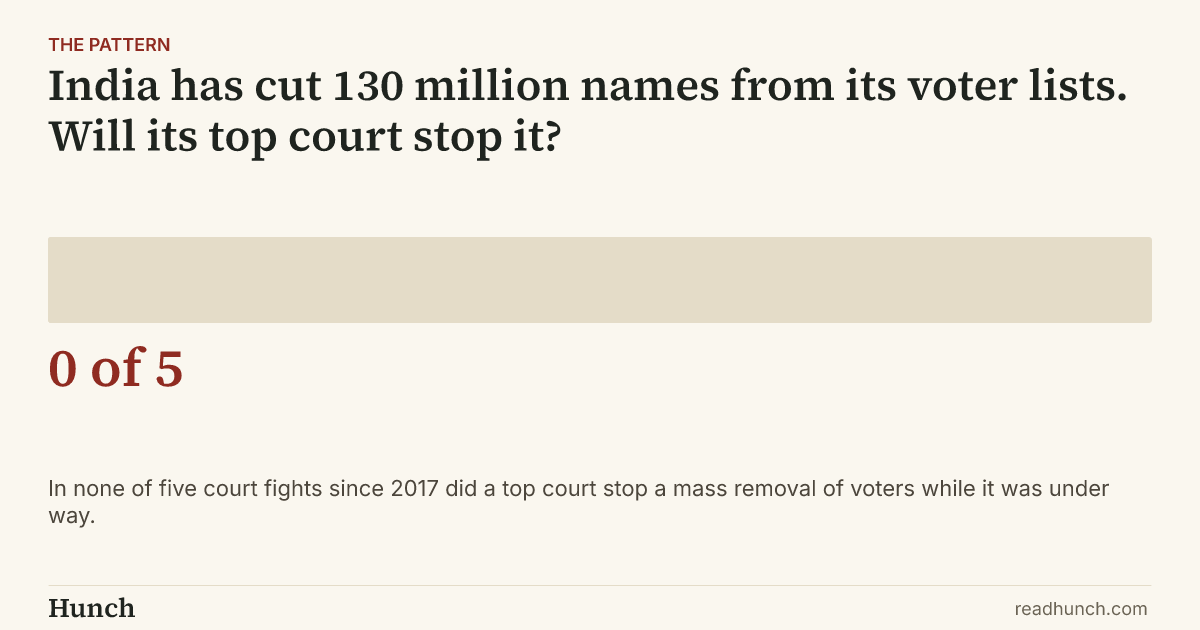
Past court fights point one way on the review itself. In none of the five did a top court stop a mass removal while it was under way, and three times the court ended up backing the body that runs the lists. Twice, both in India, it changed the rules for removed voters: after 35 days it ordered removed names published with reasons, and after 71 days it allowed an extra list.
Three of the five fights were before the same Indian court since , and it decided the West Bengal and Delhi matters after backing the Bihar review. The petitions now in court also ask for something new: an inquiry into Gyanesh Kumar’s own decisions. The court sits less in the next ten weeks, with holidays in late October and mid-November.
Readers can follow two dates. The hearing due the week of will show whether the court asks for more than answers, and is its last working day before the winter break.
Disclaimer
Hunch works only from sources that are publicly available, and publishes on the basis of analysis of that material. We do not form an editorial opinion or take sides, we give a simpler and wider view of news that already exists. If information in a source we used was inaccurate, distorted, or later disputed but had already entered our analysis, Hunch accepts no liability for that. Predictions are not advice. Phase 1 markets use Hunch Points, not money.
Published by Hunch under the Editorial Code. Complaints and corrections: /contact/.