Iran's oil minister has quit. Will parliament approve a new one by January?
Iran's oil minister Mohsen Paknejad resigned as the rial fell sharply. The law lets a temporary head run a ministry for three months.
What happened
The Iranian president, Masoud Pezeshkian, said he had accepted the resignation of Paknejad, who had given personal reasons for going.
Iran’s oil minister, Mohsen Paknejad, has resigned. President Masoud Pezeshkian said he accepted the resignation, and Paknejad gave personal reasons. It came days after the Farhikhtegan newspaper reported that a trust set up under him to bring home money from oil sold abroad owed the state oil company nearly $2bn.
The country is in a deep money crisis. Inflation is 85%, and the economy shrank by 10% in the first three months of the year. The rial, Iran’s currency, is more than 10% weaker than a month ago, largely because a US naval blockade stops Iran selling oil.
Reza Sepahvand, a spokesperson for the energy committee of Iran’s parliament, has announced an inquiry. Under Iran’s constitution, each new minister needs a vote of confidence in parliament. Until then the president can put a temporary head in charge of the ministry, but only for three months.
The President can appoint a caretaker for a maximum period of three months for the ministries having no minister.
Constitution of the Islamic Republic of Iran, Article 135
Oil is the main source of the government’s money. If parliament does not approve a new minister, the ministry stays in temporary hands while oil income falls.
Sources: The Guardian, Constitution of Iran
The Pattern
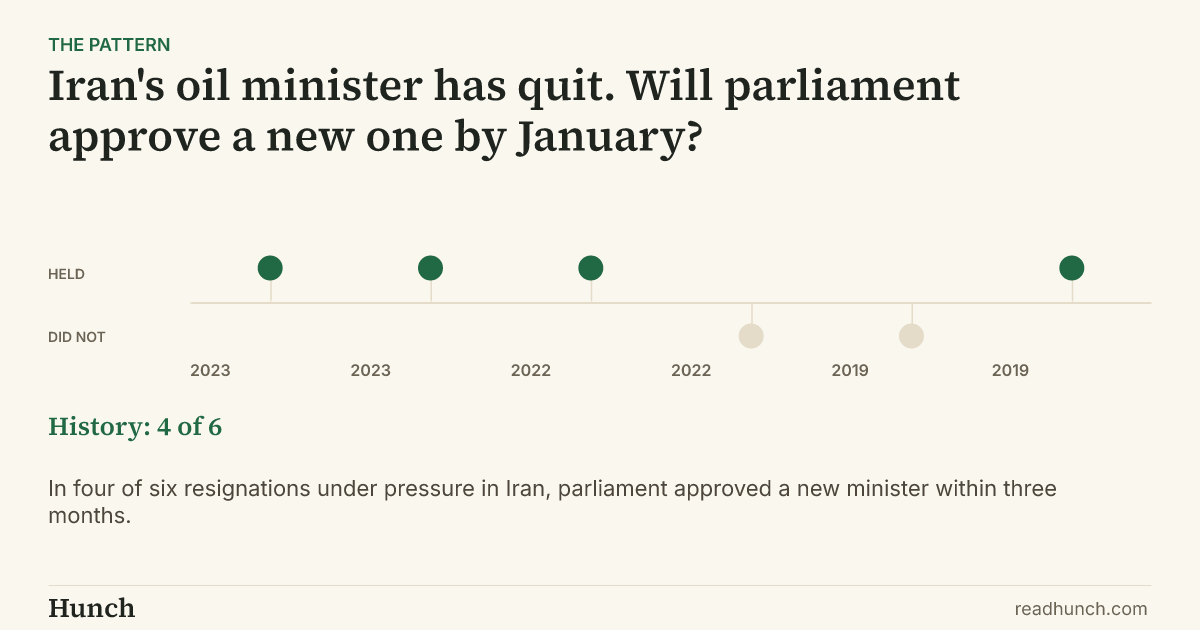
We looked for cases where an Iranian minister resigned in the middle of a scandal at his ministry or open anger at his work, and parliament then had to vote on the next minister. We found six since 2019, under two earlier presidents. Two were education ministers and two were agriculture ministers.
Show the other 4 cases
The Read
The likeliest outcome is a new oil minister by early January. In four of the six earlier resignations parliament approved the next minister within three months, after 15 to 89 days. In all six it approved someone in the end, and five times it was the first person put forward.
There are reasons for doubt. This time parliament has already opened an inquiry into the ministry. Twice the wait ran past four months: in 2020 the vote on a new agriculture minister came after 135 days, with the speaker ill with COVID-19 and 215 of 290 members in the hall. In 2022 parliament turned down the first choice for labour minister after nearly four months.
Disclaimer
Hunch works only from sources that are publicly available, and publishes on the basis of analysis of that material. We do not form an editorial opinion or take sides, we give a simpler and wider view of news that already exists. If information in a source we used was inaccurate, distorted, or later disputed but had already entered our analysis, Hunch accepts no liability for that. Predictions are not advice. Phase 1 markets use Hunch Points, not money.
Published by Hunch under the Editorial Code. Complaints and corrections: /contact/.