US Senate votes 50-48 to end the Iran war. No past vote like it stopped a war.
The Senate voted 50-48 to tell Donald Trump to pull US forces out of the Iran war, three weeks after the House did the same. It has no force of law.
What happened
The Senate votes 50-48 for a war powers resolution directing the removal of US forces from hostilities with Iran, with Cassidy, Collins, Paul and Murkowski joining Democrats.
The Senate vote has no force of law. The resolution does not need the president’s signature, and nothing in it makes him act. It is a formal record that members of both parties are unhappy with a war now in its fourth month.
The House had already acted. On it passed its own resolution 215-208. Four Republicans, Thomas Massie, Brian Fitzpatrick, Tom Barrett and Warren Davidson, voted against their party. It was the fourth House attempt to limit the war since US and Israeli strikes on Iran started it on .
The White House has questioned whether the War Powers Act itself fits the US Constitution. It treats this kind of vote, a concurrent resolution, as non-binding. Every administration has taken that view since the Supreme Court’s Chadha ruling in 1983 cast doubt on Congress blocking the president by a simple vote. The open question is whether anything changes in the war itself.
Sources: Al Jazeera (2), Congress.gov H.Con.Res.38
The Pattern
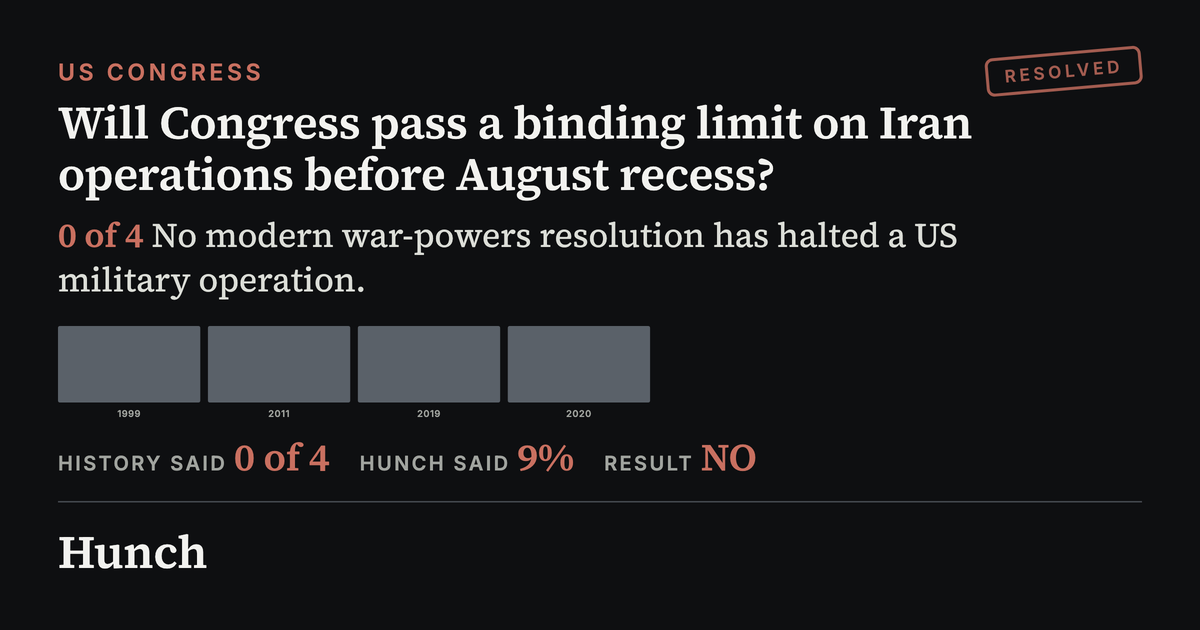
Congress has tried to end wars by resolution since 1973. We looked for votes where Congress told a president to stop a military operation or refused to back it, and asked whether the operation changed. We found four such votes since 1999. In none of them did the fighting stop because of the vote.
Show the other 2 cases
The Read
History says the war goes on. In all four past cases the president carried on after Congress voted against the operation or refused to back it. This vote is weaker still. As a concurrent resolution it never reaches Donald Trump’s desk, so he does not need to veto it, and the administration has already dismissed it. Nothing in it forces a single air strike to stop.
The doubt is that the earlier fights were about smaller wars. This is a major regional war in a year of midterm elections, when members of Congress face voters in November. A 215-208 vote in a Republican House is a real political signal. Four months in, some of the president’s own party are voting against him on the record, and presidents may move faster when their majority faces the voters.
A binding law would change the picture. The market on one before the August break opened at 9%, because a Republican-led Congress has shown no wish to cut off money for a war while it is being fought.
Disclaimer
Hunch works only from sources that are publicly available, and publishes on the basis of analysis of that material. We do not form an editorial opinion or take sides, we give a simpler and wider view of news that already exists. If information in a source we used was inaccurate, distorted, or later disputed but had already entered our analysis, Hunch accepts no liability for that. Predictions are not advice. Phase 1 markets use Hunch Points, not money.
Published by Hunch under the Editorial Code. Complaints and corrections: /contact/.