Irish public workers strike on 14 October. Will the 21 October strike go ahead too?
Teachers, nurses and civil servants in the Republic of Ireland plan strikes on 14 and 21 October over pay. No talks with the government have started.
What happened
Two teaching unions in the Republic of Ireland began work-to-rule action over pay, ahead of strikes planned for 14 and .
Teachers in the Republic of Ireland began a work-to-rule on , doing only their set duties, in a dispute over pay. Two teaching unions, ASTI and INTO, plan a full one-day strike on , and INTO a second on . A third, TUI, starts a work-to-rule on .
More than 100,000 public workers, including nurses, school staff and civil servants, moved to work-to-rule on . Strikes are planned for 14 and , when schools could close. Fórsa, the largest public sector union, said 96.6% of its members who voted backed action.
The last public sector pay deal ran out on . Fórsa says “there are currently no talks taking place”, and blames the “government’s unwillingness to address cost-of-living measures at the start of any negotiations”.
Meaningful progress can only be achieved where both parties are open to constructive and sustained engagement, without preconditions on either side.
Department of Public Expenditure, statement to RTÉ,
The department said officials are ready to talk and called the disruption “deeply unfair on the general public”. The government says it will not be held to an outcome decided in advance.
The Pattern
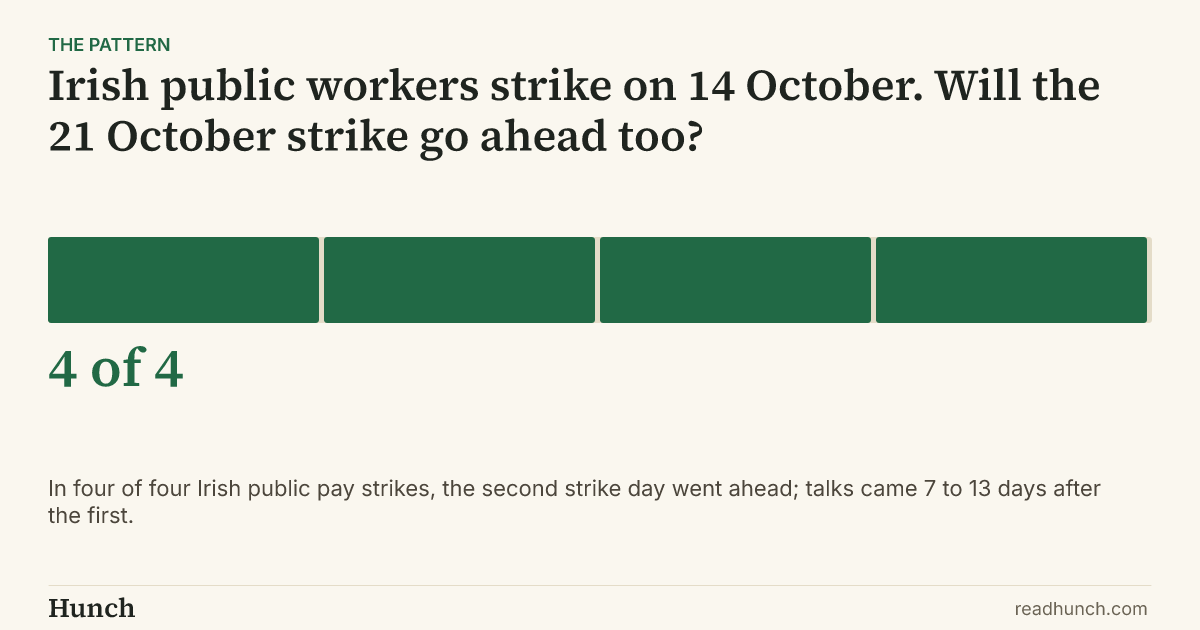
We looked for cases where unions of Irish public employees called at least two strike days, or an open-ended strike, over pay, and at least one day went ahead. We found four since 2016: teachers, nurses, hospital scientists and school support staff.
Show the other 2 cases
The Read
Each of the four past strikes reached its second day, and in none did formal talks start before it. Each time the union stopped on the day it accepted an invitation from a state body that settles disputes, such as the Labour Court or the Workplace Relations Commission (WRC), 7 to 13 days after the first strike. Here that would mean 21 to .
There are reasons for doubt. Three of the four past strikes involved one union in a narrower row, while this one brings many unions together after a national pay deal ran out. The government says it is ready to talk without conditions, and the unions want the cost of living settled first. Both questions fall away if the strike does not happen.
Disclaimer
Hunch works only from sources that are publicly available, and publishes on the basis of analysis of that material. We do not form an editorial opinion or take sides, we give a simpler and wider view of news that already exists. If information in a source we used was inaccurate, distorted, or later disputed but had already entered our analysis, Hunch accepts no liability for that. Predictions are not advice. Phase 1 markets use Hunch Points, not money.
Published by Hunch under the Editorial Code. Complaints and corrections: /contact/.