Israel votes on 27 October. Will the biggest party's leader run the government?
Israel elects a new parliament on 27 October. Polls put Gadi Eisenkot's new party slightly ahead of Benjamin Netanyahu's Likud.
What happened
Israel’s Central Elections Committee voted on to bar the two main Arab lists from the Knesset election of ; the lists can appeal to the Supreme Court.
Israel votes on for all 120 seats in its parliament, the Knesset. Voters choose party lists, and a list needs 3.25% of the vote to win seats. No party has ever won a majority alone, so every government is a coalition. A majority is 61 of the 120 seats.
The law does not give the job to the party that comes first. After the results are published, the president consults every party and has seven days to ask one member to form a government. That person has 28 days, and the president can add 14 more. If they fail, the president can ask someone else.
The race is close. On the Reuters average of polls put Yashar, the new party of former army chief Gadi Eisenkot, two points ahead of Likud, and said no candidate has a clear path to power. Netanyahu’s rivals have said they will not take Arab parties into a coalition.
On the Central Elections Committee voted to bar the two main Arab lists, Ra’am and the Joint List. The bans are not final: the lists can appeal, and the Supreme Court hears the cases next week. A Channel 12 poll gave the two lists 12 seats between them, so the ruling changes the possible routes to 61.
If nobody forms a government, the Knesset is dissolved and the country votes again. That happened twice in 2019.
Sources: Al Jazeera (2), Knesset, Basic Law: The Government, Reuters, IPU Parline
The Pattern
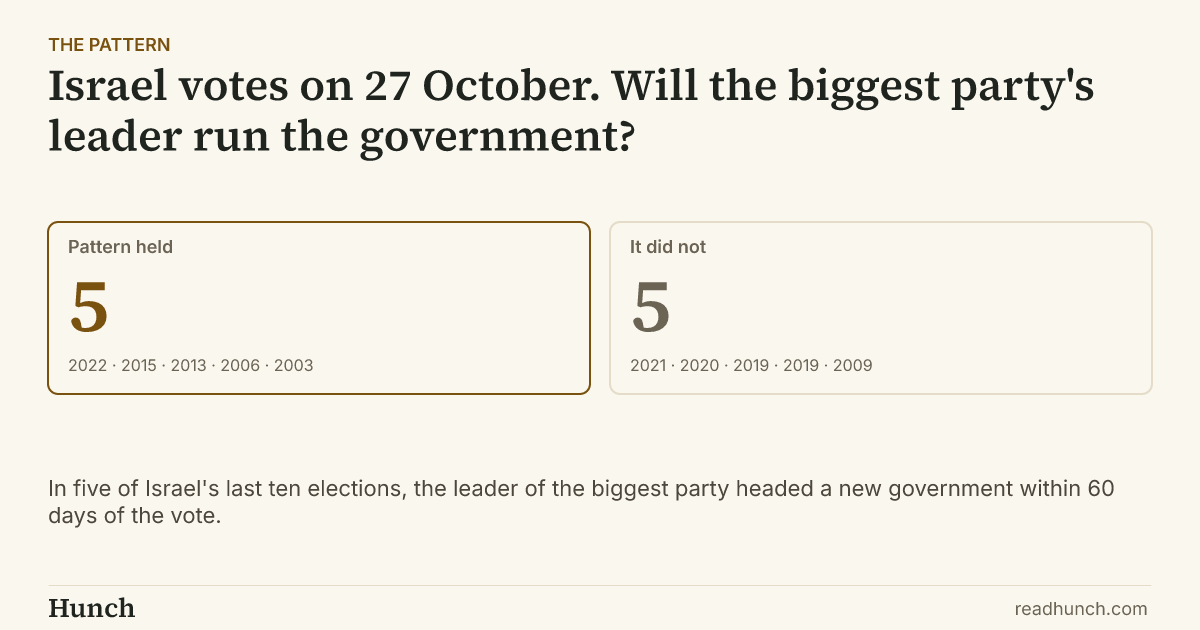
We looked for cases where Israel elected its parliament and no party came close to a majority. That is every election since 2003: in each, the biggest party won fewer than 40 of the 120 seats. For the ten elections from 2003 to 2022 we asked: did the leader of the biggest party head a new government within 60 days of the vote?
Show the other 8 cases
The Read
History gives the biggest party an even chance. In five of the ten elections its leader headed a new government within 60 days: Ariel Sharon in 2003, Ehud Olmert in 2006 and Netanyahu in 2013, 2015 and 2022. In 2009 the president asked Netanyahu, whose party came second. In 2021 Naftali Bennett became prime minister with a party of seven seats.
Close results were the hardest. In the four elections where the top two parties finished within three seats of each other, the biggest party’s leader never headed a government within 60 days. The polls show a gap of about two points today, but the real gap will only be known after the vote. Before 2003 the picture was different: from 1969 to 1992 the biggest party always won 40 seats or more, and its leader always became prime minister.
The record has weak spots. Netanyahu led a party in nine of the ten elections, so much of it is one politician’s story. The Supreme Court’s ruling on the Arab lists could change who can reach 61, and Netanyahu’s rivals say they will not govern with those lists.
Disclaimer
Hunch works only from sources that are publicly available, and publishes on the basis of analysis of that material. We do not form an editorial opinion or take sides, we give a simpler and wider view of news that already exists. If information in a source we used was inaccurate, distorted, or later disputed but had already entered our analysis, Hunch accepts no liability for that. Predictions are not advice. Phase 1 markets use Hunch Points, not money.
Published by Hunch under the Editorial Code. Complaints and corrections: /contact/.