Italy moves to ban covered faces at school. Will the president sign within a week?
Italy's cabinet approved a decree on 24 September that bans covered faces in class. President Sergio Mattarella must sign it first.
What happened
Italy’s Council of Ministers approved a decree-law on that bans taking part in school activities with a covered face and limits pupils without Italian citizenship who are new to the country to 30% of each first-year class from 2027/28.
The 30% limit applies in primary school to pupils without Italian citizenship who were not born in Italy or did not attend at least two years of nursery school. In secondary school it covers those who have not completed three years in Italian schools. If enrolments go over the limit, local school offices move pupils to nearby schools. Parents whose poor Italian stops them working with the school can be sent to free Italian courses, with a fine if they do not go. The face rule has exceptions for certified health reasons and for teaching activities.
Fines go up to €1,000. Education Minister Giuseppe Valditara said the class limit would affect about 1,000 classrooms, about 0.3% of the total. Giorgia Meloni first set out the plan on Sunday at a meeting of her party’s youth wing, and called the measures “common sense that do not divide”.
The decree is not in force yet. A decree-law takes effect when the president signs it and it is published in the Gazzetta Ufficiale, Italy’s official journal. Parliament then has 60 days to make it law, or it lapses. President Sergio Mattarella said this week he was wary of any barriers being placed on education. The decree was not in the issue of .
The government’s own summary speaks of covered faces and does not name the burqa or the niqab.
Opponents said the rules were meant to counter National Future, the far-right party of former army general Roberto Vannacci, before next year’s election. The party called for a crackdown on burqas in schools in July. Elly Schlein, leader of the centre-left Democratic Party, called it “a shameful decree that seeks to hide the government’s inability to address the real problems of the public school system”.
Sources: Italian government, Al Jazeera, Gazzetta Ufficiale
The Pattern
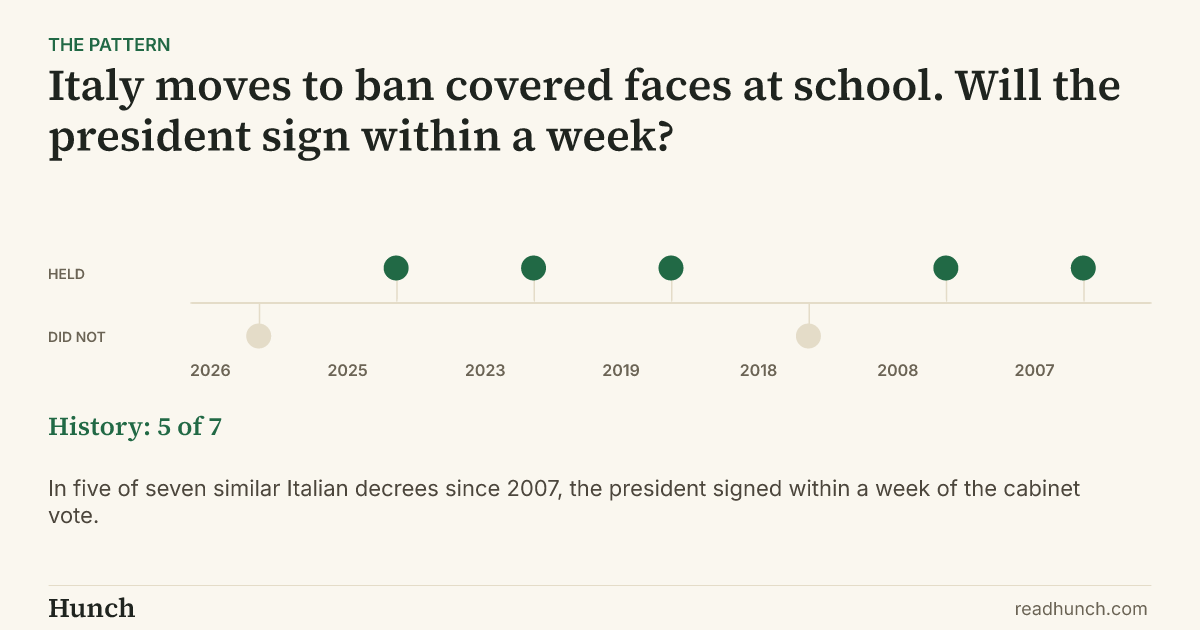
We found seven Italian decrees like this one since 2007. Each was an emergency decree on security, migration or public order, made by a government with its own majority, and in each the president had doubts on the record or asked for changes. We counted the days from the cabinet vote to the president’s signature, and checked whether parliament changed the text.
Show the other 5 cases
The Read
History points to a quick signature and a changed text. In five of the seven decrees, the president signed within a week, and parliament changed the text in five of seven, usually in the last week before the 60-day deadline.
The record is small and close to home. Sergio Mattarella decided five of the seven, and three were Meloni decrees. This time he spoke in public about barriers in schools days before the cabinet vote, as he did before the two slow signatures. On the other side, the government’s summary no longer names the burqa or the niqab.
The first sign is the Gazzetta Ufficiale. Once the decree is published, the 60 days begin and parliament can start amending it.
Disclaimer
Hunch works only from sources that are publicly available, and publishes on the basis of analysis of that material. We do not form an editorial opinion or take sides, we give a simpler and wider view of news that already exists. If information in a source we used was inaccurate, distorted, or later disputed but had already entered our analysis, Hunch accepts no liability for that. Predictions are not advice. Phase 1 markets use Hunch Points, not money.
Published by Hunch under the Editorial Code. Complaints and corrections: /contact/.