A Texas judge lost his race. Will the Senate make him a US judge before 3 January?
James Sullivan lost his race to stay on the Texas Supreme Court last week. Donald Trump now wants him as a federal judge for life.
What happened
Both are slated to appear before senators for confirmation hearings next week.
A judge nomination ends if the Senate runs out of time. The president picks federal judges for life, and the Senate decides, first with a hearing and a vote in its Judiciary Committee, then with a vote of all senators. A nomination still waiting when the session ends goes back to the president, who must send it again to the new Senate. This Congress ends at noon on .
Nominations neither confirmed nor rejected during the session at which they are made shall not be acted upon at any succeeding session
Standing Rules of the Senate, Rule XXXI, paragraph 6
Democrats will run the Senate from . After last week’s midterm elections they will have at least 54 seats. Until then Republicans lead the Senate and its Judiciary Committee, and majority leader John Thune said on : “The priority is going to be getting the judges across the finish line”. CBS News reports that seats still open on that date are likely to stay empty for at least two years.
James Sullivan is one of the late picks. He lost his race to stay on the Texas Supreme Court last week, and Trump then said he would nominate him as a federal judge in Texas. A source told CBS News that Sullivan has a hearing next week. Dick Durbin, the top Democrat on the committee, raised concerns about him and said one thing Democrats can do is “not to expedite nominees who have not been carefully vetted”.
Sources: CBS News, US Senate (2)
The Pattern
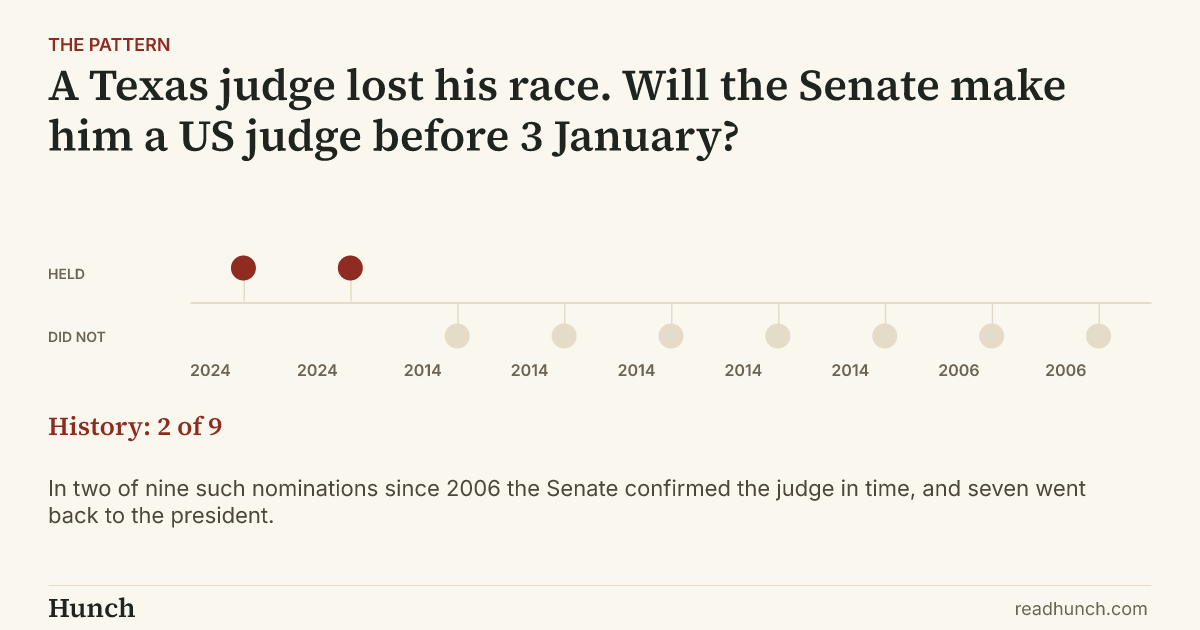
We looked for cases where a president sent the Senate a new pick for a federal trial court after an election that would hand the Senate to the other side, while his own party still led it. We found nine such nominations from 2006 to 2024, made by George W. Bush in 2006, Barack Obama in 2014 and Joe Biden in 2024.
Show the other 7 cases
The Read
For nominees sent after the election, the hearing decided the outcome. The two 2024 nominees had theirs two days after being sent and were confirmed on day 32, while none of the seven from 2006 and 2014 got a hearing. Across all 51 nominees in such sessions since 2006 who had no hearing by election day, the eight confirmed were the eight heard after it. Since 2013 a simple majority can end debate on these judges, so Democrats can slow a vote but cannot block one alone. Sullivan’s hearing is set for next week, but by his nomination was still not on the Senate’s list of nominations received.
There are reasons for doubt. Both confirmations came in 2024, when the president himself was leaving office. In 2006 and 2014 the president still had two years left, as Trump does now, and none of the seven was confirmed. Biden also named his two picks on , before the election, while Trump named Sullivan only after Sullivan lost his own race. The same Senate decided all nine, and in 2006 ending debate on a judge still needed 60 votes.
Sources: US Congressional Record (2, 3, 4, 5, 6, 7, 8), Federal Judicial Center, CBS News, The White House archive
Disclaimer
Hunch works only from sources that are publicly available, and publishes on the basis of analysis of that material. We do not form an editorial opinion or take sides, we give a simpler and wider view of news that already exists. If information in a source we used was inaccurate, distorted, or later disputed but had already entered our analysis, Hunch accepts no liability for that. Predictions are not advice. Phase 1 markets use Hunch Points, not money.
Published by Hunch under the Editorial Code. Complaints and corrections: /contact/.