Japan's food tax cut passed the lower chamber. Will it be law by 12 December?
Japan's lower chamber voted on 6 November to cut the tax on food from 8% to 1%. The ruling parties lack a majority in the upper chamber.
What happened
Japan’s lower chamber passed a bill to cut the tax on food from 8% to 1% for two years. All opposition parties voted against it.
On Japan’s lower chamber voted to cut the tax on food from 8% to 1%. The cut would last two years from . The same bill brings cash payments for workers on low and middle incomes. The government calls it its top task for this session of parliament, which ends on .
All opposition parties voted against, although most of them promised to cut this tax in the February election. They say the government has not shown where the money will come from or who will get the payments. The cut would cost about 10 trillion yen ($63 billion) over two years. In an October poll by the Sankei newspaper and Fuji News Network, 62.6% of people backed it.
In the upper chamber the ruling parties are four votes short of a majority. They are Prime Minister Sanae Takaichi’s Liberal Democratic Party and the Japan Innovation Party. With the two votes of the small Japan Conservative Party, which backs the bill, they would still be two short. Komeito, with 21 seats, could fill the gap. Its leader, Mitsunari Okamoto, said on that the vote in the lower chamber left a stain on the history of parliament, but in a TV interview recorded that day and aired on he said his choice would depend on the debate in the upper chamber. The Democratic Party for the People has 25 seats. Its leader, Yuichiro Tamaki, called support “impossible in its current form” on , and two days later promised to keep bargaining to the end.
If the upper chamber says no, Japan’s constitution gives the lower chamber a second vote. The bill becomes law if two-thirds of the members present pass it again, and the ruling parties hold three-quarters of the seats there. If the upper chamber does not vote within 60 days, the lower chamber may treat that as a no. For this bill the 60 days end around , after the session. Parliament can extend a session, and the lower chamber can decide that alone. A bill not passed by the end of a session dies, unless a chamber agrees to keep working on it between sessions.
A bill which is passed by the House of Representatives, and upon which the House of Councillors makes a decision different from that of the House of Representatives, becomes a law when passed a second time by the House of Representatives by a majority of two-thirds or more of the members present.
Constitution of Japan, Article 59
Sources: The Japan Times (2), Kyodo News, Kyodo News (2, 3), House of Councillors, Democratic Party for the People, Ministry of Justice of Japan, The Asahi Shimbun, e-Gov
The Pattern
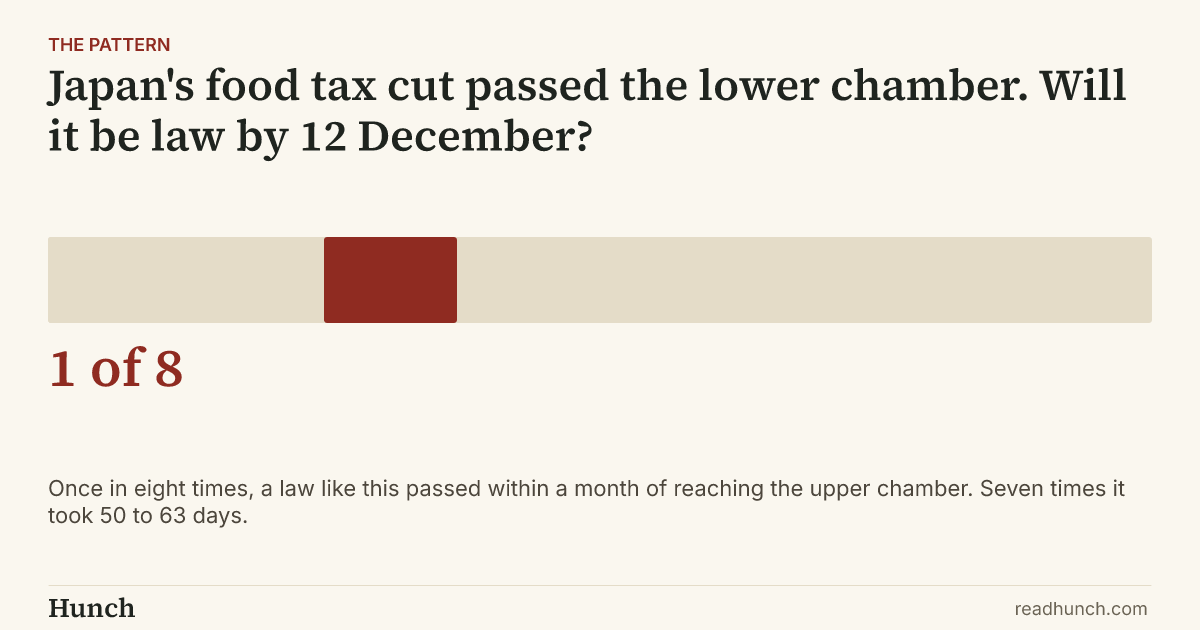
We looked for cases where Japan’s lower chamber passed a government bill that the opposition voted against, while the opposition had a majority in the upper chamber and the government had two-thirds of the lower chamber. We found eight such votes, from 2007 to 2009 and in 2013. Some covered several laws decided on the same day. (House of Councillors; National Diet Library)
Show the other 6 cases
The Read
All eight past laws came, but only one within 36 days, the time left before . Three times the 60 days ran past the end of the session, as they do now. Each time the government extended the session one or two days before its end, and the upper chamber voted only after that. So the second-vote route would most likely need parliament to sit past .
There are reasons for doubt. All eight came in two short periods, 2007 to 2009 and 2013, when one large party, the Democratic Party of Japan, led the opposition in the upper chamber and voted against each of these laws. Today the opposition there is split, and Komeito or the Democratic Party for the People could each give the four missing votes. The 2013 law fits only because one small party stayed away from the first vote and then backed the second. The 60 days also leave out any break, so may move later.
Sources: House of Councillors (2, 3), National Diet Library (2, 3, 4), Ministry of Justice of Japan
Disclaimer
Hunch works only from sources that are publicly available, and publishes on the basis of analysis of that material. We do not form an editorial opinion or take sides, we give a simpler and wider view of news that already exists. If information in a source we used was inaccurate, distorted, or later disputed but had already entered our analysis, Hunch accepts no liability for that. Predictions are not advice. Phase 1 markets use Hunch Points, not money.
Published by Hunch under the Editorial Code. Complaints and corrections: /contact/.