Hakeem Jeffries is set to lead the US House. Will nearly every Democrat back him?
Democrats take over the US House on 3 January with about 258 seats. On 13 November protesters called their leader, Hakeem Jeffries, a traitor.
What happened
Leftist protesters interrupted Jeffries multiple times during his Friday event on the main stage. They called him a traitor, accused him of not pushing back enough on the Trump administration and of ignoring younger Democratic voters.
Democrats take control of the US House on . Their leader in the House, Hakeem Jeffries of New York, says they have “258 Democrats and counting”, and NBC News estimates 259 of the 435 seats. On the first day the members elect a Speaker, who runs the House. Each member stands and says a name aloud.
The Congress shall assemble at least once in every year, and such meeting shall begin at noon on the 3d day of January, unless they shall by law appoint a different day.
US Constitution, 20th Amendment, US National Archives
No other Democrat is running against Jeffries. Jamie Raskin, another Democrat, said he is “supporting Hakeem and voting for Hakeem”. Democrats in the House choose their nominee on . A Speaker needs a majority of the members who vote, 218 if all 435 take part, so with 258 seats Jeffries could lose 40 Democratic votes and still win.
Some on the left want him to fight Donald Trump harder. On protesters interrupted Jeffries several times at a party conference in Denver. Greg Casar, who leads the group of left-wing Democrats in the House, said “Every single member here is going to have their individual vote”. By at least nine incoming Democrats had not promised to vote for Jeffries.
Sources: The Guardian (2, 3), PBS NewsHour, NBC News, Axios (2), BBC, Al Jazeera
The Pattern
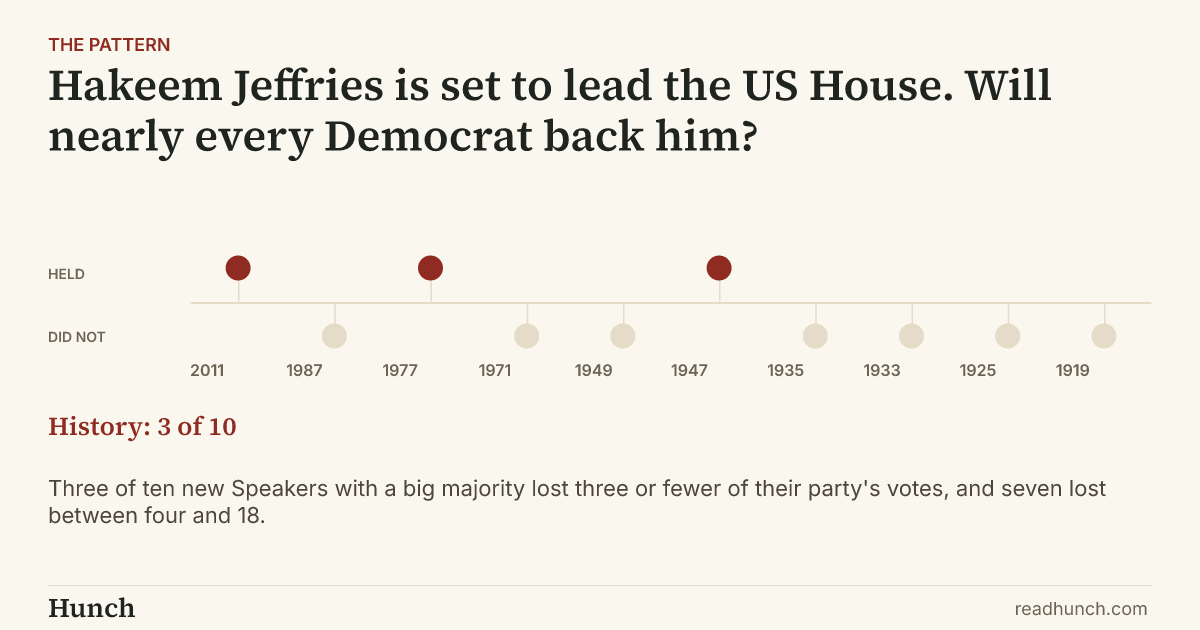
We looked for cases where the party in charge of the US House, with at least 20 seats more than the 218 needed, elected a new Speaker on the first day of a new Congress. We found ten such votes since 1919, from Frederick Gillett to John Boehner. For each we counted the party’s seats that did not give their nominee a vote on the first ballot. That includes votes for someone else, members who were away and empty seats, and in 2011 the nominee himself, who did not vote.
Show the other 8 cases
The Read
All ten new Speakers won on the first ballot, but few got almost every vote. Only three times, in 1947, 1977 and 2011, did three or fewer of the party’s seats fail to vote for the nominee. With 258 seats, Jeffries needs 255 votes, so he can lose only three, and for this question a member who is away or votes present counts as a lost vote. Several House Democrats told Axios on that they expect “at least a handful” of colleagues to openly oppose him.
There are reasons for doubt. Six of the ten votes took place before 1950, and from 1945 to 1995 only the two parties’ nominees got any votes for Speaker. Votes for other names became common only after 1997, and only the 2011 vote comes from those years. The seat count is not final either: NBC News estimates 259 Democratic seats, and at 259 Jeffries could lose four, which happened once more, in 1987. Among these ten votes, the only time members backed another of their own party was 1925, when the progressive wing put up Henry Cooper.
Sources: Congressional Research Service, PBS NewsHour, Axios, NBC News, US House Historian
Disclaimer
Hunch works only from sources that are publicly available, and publishes on the basis of analysis of that material. We do not form an editorial opinion or take sides, we give a simpler and wider view of news that already exists. If information in a source we used was inaccurate, distorted, or later disputed but had already entered our analysis, Hunch accepts no liability for that. Predictions are not advice. Phase 1 markets use Hunch Points, not money.
Published by Hunch under the Editorial Code. Complaints and corrections: /contact/.