UK ketamine seizures hit 1,298kg. Ministers have often overruled drug advisers.
7 months after the drug advisers said ketamine should stay Class B, the Home Office has not answered them. Border Force has seized a record 1,298kg.
What happened
Border Force seizures of ketamine reach 1,298kg in the first quarter of 2026, a 42% rise on the previous quarter and the highest quarterly total in 15 years.
The Home Office published the Border Force figures on . The previous record was 1,238kg, in the second quarter of 2025, and 915kg was seized in the last quarter of 2025. Harwich International Port alone accounted for 300kg over the past year, including two loads of 100kg and 200kg from the Hook of Holland.
The release is about enforcement. It warns of lasting bladder damage among young users and says nothing about the drug’s legal class.
The drug advisers said in January that ketamine should stay Class B. The Advisory Council on the Misuse of Drugs (ACMD) wrote to the minister on . It said ketamine and similar drugs should stay below Class A, the strictest group, and the rules for their medical use should not change. The government had asked it in to update its review of harms.
Not everyone agreed. The advice was a majority view in both the Council and its ketamine working group. It came with fourteen further recommendations on supply chains, field testing, treatment and prescribing, and the advisers said no single measure would be enough on its own.
The decision is with ministers. The Misuse of Drugs Act 1971 says the Home Secretary must ask the ACMD before changing a drug’s class, but does not have to follow its advice. It sets no deadline for a reply. If nothing is done, ketamine stays Class B without any decision. That is why the time passed, now seven months, matters more than any fixed date.
The Pattern
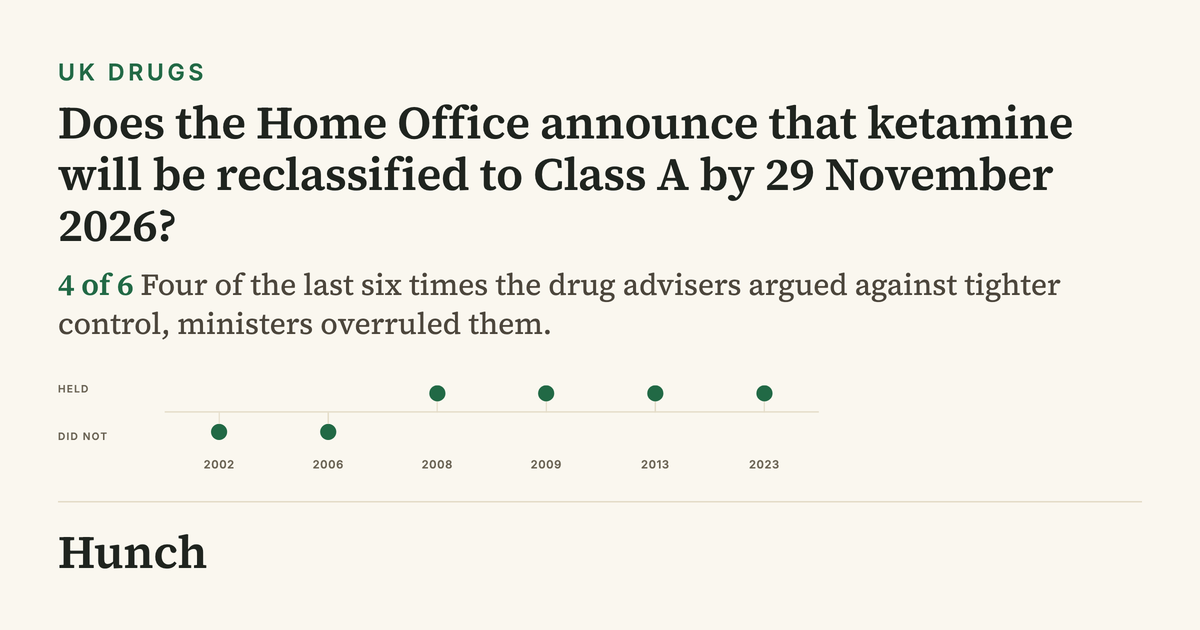
We found six cases since 2002 like the ketamine advice. In each, the ACMD advised the Home Secretary against a stricter class for a drug, by asking for no change, a lower class or no control at all, and ministers then decided. We asked whether the Home Secretary chose stricter control than the advisers wanted. Advice asking for stricter control is left out, because there both sides already agree. So are changes to the separate rules for medical use.
Show the other 4 cases
The Read
The most likely outcome is more waiting. Nothing forces a reply, and silence keeps ketamine in Class B without ministers having to defend either choice. So far the Home Office has answered with seizure figures and a health message. The record seizures can be read both ways. They can show the border working, as the release puts it, or show supply growing, which is the argument for Class A. In the past, when a Home Secretary did act on advice like this, it was usually to overrule it.
The advice itself was split. Not all the advisers agreed, which makes it politically cheaper to overrule them. The advisers also accepted that a drug’s class is not the main way to cut how many people use it. A minister could use that point, as one did on nitrous oxide in 2023.
A formal reply that accepts Class B would go against the pattern. It would be only the third time since 2002 that ministers followed advice against stricter control, and the first since 2006.
Disclaimer
Hunch works only from sources that are publicly available, and publishes on the basis of analysis of that material. We do not form an editorial opinion or take sides, we give a simpler and wider view of news that already exists. If information in a source we used was inaccurate, distorted, or later disputed but had already entered our analysis, Hunch accepts no liability for that. Predictions are not advice. Phase 1 markets use Hunch Points, not money.
Published by Hunch under the Editorial Code. Complaints and corrections: /contact/.