Kosovo voted again on 7 June. Can it have a government within two months?
Kosovo voted on 7 June in its second early election in six months. Vetëvendosje won 47% and 53 seats. The presidency fight is still not settled.
What happened
Final results from the snap election give Vetevendosje 53 of 120 seats; with nine minority MPs the party can reach the 61 votes needed to govern, but PDK and AAK refuse any coalition.
Kosovo held its second early election in six months on . Turnout was 37.03%, the lowest in the country’s history. Prime Minister Albin Kurti’s party, Vetëvendosje, came first for the fifth election in a row. Final results, announced ten days after the vote, gave it 47.13%, or 382,865 votes and 53 seats.
The election came because parliament could not elect a president. A first attempt on failed because too few members attended, and opposition parties stayed away from later sessions. When the deadline set by the Constitutional Court ran out, the Assembly, Kosovo’s parliament, was dissolved on . Acting president Albulena Haxhiu then called the vote.
The numbers have barely changed. With the support of nine MPs who hold seats kept for minorities, Vetëvendosje can reach the 61 votes needed to set up the Assembly and confirm a government. The opposition parties PDK and AAK have refused any coalition with Kurti’s party.
Electing a president is harder. It needs two thirds of the Assembly to take part, and the opposition can stop that. This is the same problem that broke the last parliament.
Sources: RFE/RL, Al Jazeera, Politico, Euronews
The Pattern
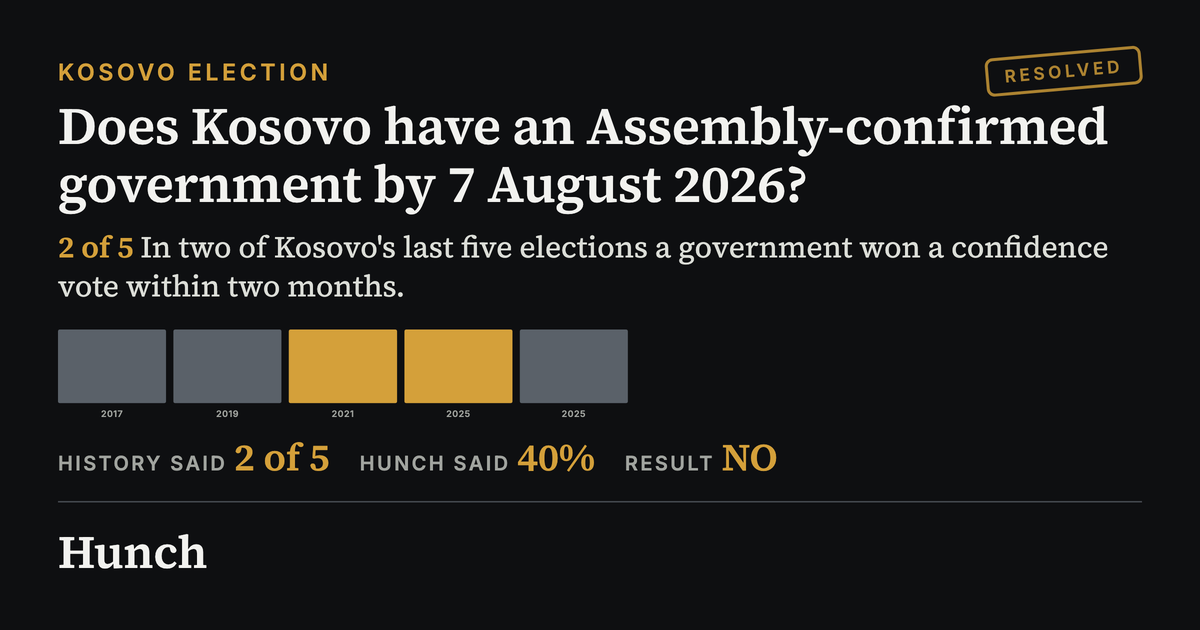
After an election, Kosovo often waits a long time for a government. We looked at the five parliamentary elections since 2017 and counted the days from polling day to a government confirmed by the Assembly. The fastest took five weeks. The slowest ran 199 days with no government at all and ended in new elections.
Show the other 3 cases
The Read
The case for a fast government rests on seats Kurti did not have last time. Fifty-three seats plus nine minority MPs are more than the 61 needed. That is enough to set up the Assembly, elect a speaker and confirm a government without a single opposition vote. After the last early election in December, a government was sworn in within about six weeks. From a vote, that would fall inside two months. On this reading the speaker vote passes in July and only the presidency stays stuck.
The doubt is that the presidency is what broke the last Assembly, and nothing about fixed that. Electing a president needs two thirds of the Assembly to take part, which the opposition can still block, and PDK and AAK have already refused to work with Kurti. In three of the five elections since 2017, a government took three months or more, or never came. The lowest turnout on record also weakens every party’s claim to speak for voters.
Two of the last five elections produced a government within two months, and three did not. A speaker elected in July would be the first sign of which way this one goes.
Disclaimer
Hunch works only from sources that are publicly available, and publishes on the basis of analysis of that material. We do not form an editorial opinion or take sides, we give a simpler and wider view of news that already exists. If information in a source we used was inaccurate, distorted, or later disputed but had already entered our analysis, Hunch accepts no liability for that. Predictions are not advice. Phase 1 markets use Hunch Points, not money.
Published by Hunch under the Editorial Code. Complaints and corrections: /contact/.