Andy Burnham promises a leasehold bill by Christmas. Most new leaders kept theirs.
Prime Minister Andy Burnham told the Labour conference on 29 September that a bill to reform leasehold will come to Parliament before Christmas.
What happened
In his first Labour conference speech as prime minister, Andy Burnham said a bill to reform leasehold, promised under Keir Starmer and then delayed, would come to Parliament before Christmas.
Andy Burnham gave his first speech to a Labour conference as prime minister in Liverpool on . He said a bill to reform leasehold would come to Parliament before Christmas. The reform had been promised under Keir Starmer and then delayed.
Leasehold means owning a home, usually a flat, for a fixed number of years, while a landlord owns the land. It covers an estimated five million homeowners in England and Wales. Through the Commonhold and Leasehold Reform Bill, ministers want residents to own and run their buildings together, a system called commonhold.
The same day, Angela Rayner added two new steps. The housing secretary said the government would legislate for an independent regulator of property agents and consult on caps for the fees landlords charge. A £250 yearly cap on ground rent was already announced, but it stalled during the change of prime minister over the summer. The government expects the cap in force in late 2028, and MPs have asked for late 2027.
The bill has to come from the government. On the Parliament bills site showed no government bill on leasehold or commonhold in this session. The two leasehold bills listed there were brought by individual members. MPs return on and break for Christmas after .
Sources: The Guardian, BBC, UK Parliament, UK Parliament
The Pattern
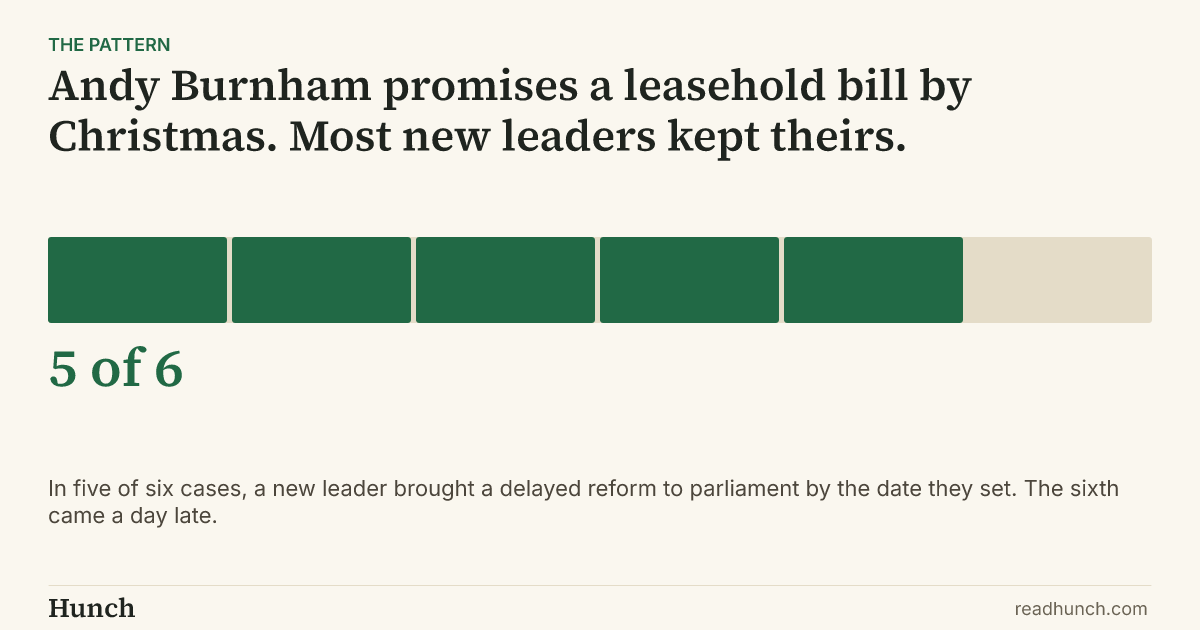
We looked for cases where a new head of government took over from a leader who had promised a reform and put it off, and then named a date for bringing it to parliament. In each case only the government could bring the bill. We found six from 2004 to 2022, in Britain, Canada, Australia and Japan.
Show the other 4 cases
The Read
History points to yes. In five of the six cases the new leader’s bill reached parliament, or the law passed, by the date they had named. The sixth, Canada in 2005, came on , one day after the month set. Yoshihiko Noda and Theresa May, like Burnham, had taken over between elections, and both kept their dates, May despite a court ruling that forced a new law late in the day.
The record has a weak side: it holds no real miss. The misses we found are not counted, because the date did not come from a new leader in person. In Scotland a Human Rights Bill was set for introduction before the summer of 2024 and never came after Humza Yousaf resigned as first minister that May; the date sat in his programme, not in his own words. Martyn’s Law in 2024 is left out for a similar reason.
There is a second risk in this case. Burnham’s date covers one bill, and Rayner’s new regulator and fee caps may need to be written into it or wait for a consultation. The market counts any government bill on leasehold or commonhold, whatever it contains.
Sources: Al Jazeera, UK Supreme Court, Scottish Parliament Information Centre
Disclaimer
Hunch works only from sources that are publicly available, and publishes on the basis of analysis of that material. We do not form an editorial opinion or take sides, we give a simpler and wider view of news that already exists. If information in a source we used was inaccurate, distorted, or later disputed but had already entered our analysis, Hunch accepts no liability for that. Predictions are not advice. Phase 1 markets use Hunch Points, not money.
Published by Hunch under the Editorial Code. Complaints and corrections: /contact/.