Wandsworth plans a 160% council tax rise. Will ministers set a limit after all?
4 London boroughs plan to challenge the government's new funding split. Wandsworth is drawing up a 160% council tax rise for April 2027.
What happened
Wandsworth Council and the Conservative front bench agree to challenge the local government funding settlement through the Sustainable Communities Act; Westminster, Kensington and Chelsea and Richmond are considering the same route.
Wandsworth is working on a 160% council tax rise from , followed by a freeze for the rest of the council’s term. Its council tax is one of the lowest in England, at around 0.1 per cent of property value a year. The council expects to lose about 40 per cent of its grant from government. It had earlier warned of 230 per cent without spending cuts.
The council says its full spending review will be finished in September. Around half of a Wandsworth bill is the Mayor of London’s share, which the borough does not set.
On , leaders of Conservative-run Wandsworth met the party’s shadow local government secretary and its chairman. They agreed to challenge the new funding settlement, the government’s share-out of money to councils, under the Sustainable Communities Act. The council will ask residents first, then send ministers a formal proposal to rethink the reforms. If ministers reject it, the Local Government Association can make its own recommendation.
Westminster and Kensington and Chelsea, both Conservative, and Liberal Democrat Richmond were considering the same route. Westminster has warned of rises of up to 200 per cent to keep spending at current levels. The department says its reforms send money where it is most needed, and that transition rules mean no area faces a sudden drop.
The limit most readers expect is not there. Since the Localism Act 2011, an English council that wants to raise council tax above a yearly limit has needed a local vote, called a referendum, or its own special limit from the Secretary of State.
The government proposed no limit for six councils. In the draft settlement of it proposed no limits in 2027-28 and 2028-29 for councils with 95 per cent income protection and below-average council tax. It named the City of London, Hammersmith and Fulham, Kensington and Chelsea, Wandsworth, Westminster and Windsor and Maidenhead, so that they can rebalance their bills if they wish.
In the consultation response of , thirteen respondents welcomed the change. The yearly report that puts the limits into effect is laid each February, so the freedom stands unless ministers change their minds.
Sources: PoliticsHome (2), MHCLG (2)
The Pattern
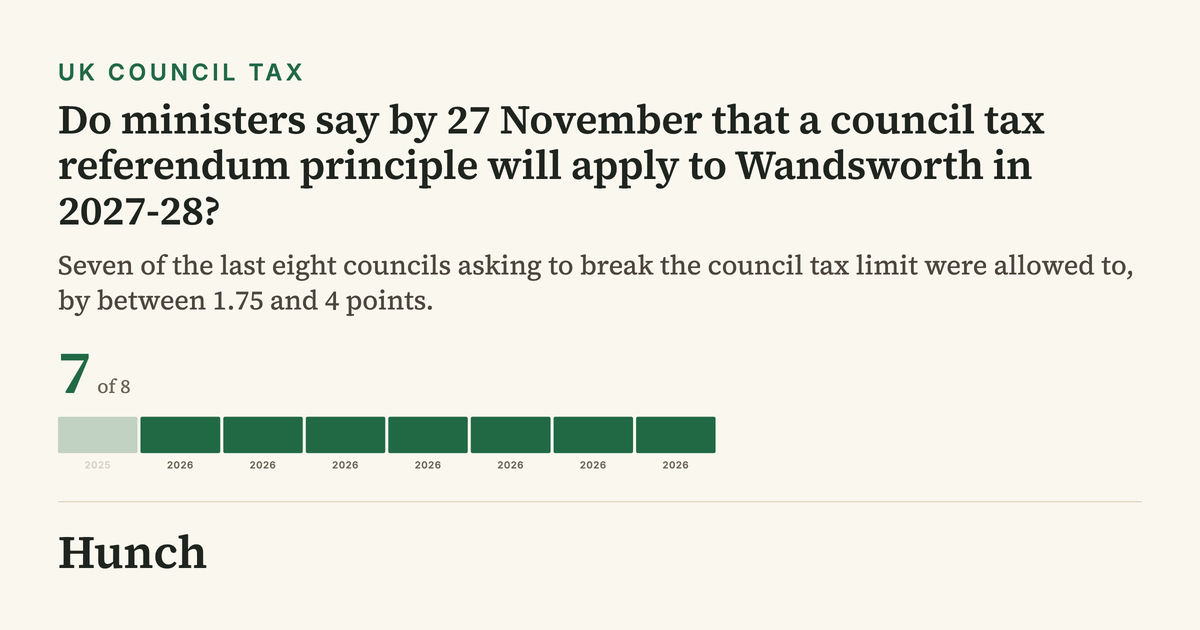
Councils that asked to go above the limit usually got a yes. We looked at every request by an English council for its own higher limit with a public outcome in the three yearly rounds from 2024-25 to 2026-27. We asked whether ministers granted a higher limit, at any level. Twenty requests are on record, and seventeen were granted. The eight most recent are shown below.
Show the other 6 cases
The Read
History points to Wandsworth keeping its freedom and not using all of it. Over three yearly rounds the department let low-tax councils in difficulty go higher seventeen times in twenty. In December it went further for six of them and proposed no limit at all, saying they should be able to rebalance bills if they wish. Setting a limit within weeks of a Conservative borough announcing a big number would mean undoing a step the department has just defended. That is why the market on a limit for Wandsworth opens at one in five.
The doubt is political. A rise of more than 100 per cent in a Conservative borough, blamed on a Labour funding formula, is a much bigger event than a 9 per cent limit for Shropshire. A government that removed the limit to let bills rise slowly may not want its name on a 160 per cent rise in .
The sign to watch is the September spending review. A formal proposal at or near 160 per cent, rather than a lower figure after the council asks residents, would force ministers to say before the December settlement whether the freedom still stands.
Disclaimer
Hunch works only from sources that are publicly available, and publishes on the basis of analysis of that material. We do not form an editorial opinion or take sides, we give a simpler and wider view of news that already exists. If information in a source we used was inaccurate, distorted, or later disputed but had already entered our analysis, Hunch accepts no liability for that. Predictions are not advice. Phase 1 markets use Hunch Points, not money.
Published by Hunch under the Editorial Code. Complaints and corrections: /contact/.