Brazil's Senate rejected Lula's Supreme Court choice. Will he name one this year?
In April Brazil's Senate rejected Jorge Messias for the Supreme Court. President Lula, just re-elected, says he wants to put him forward again.
What happened
After his election win, President Lula plans to insist on Jorge Messias for the empty Supreme Court seat, although the Senate rejected him in April.
In Brazil the president chooses Supreme Court judges and the Senate approves them. On , in a secret vote, 42 senators voted against Jorge Messias, the government’s top lawyer, and 34 for him. He needed 41. Folha de S.Paulo reported that Senate president Davi Alcolumbre worked against him because he wanted his ally Rodrigo Pacheco in the seat. Alcolumbre denies this.
Senate rules do not allow a second vote on the same name this year. The yearly session ends on , so the Senate could not vote on Messias again in 2026. It could still vote on another name. New senators take their seats on , when the party of former president Jair Bolsonaro, the PL, will hold 29 of the 81 seats, more than any other party.
Lula won re-election on and says he wants to try again with Messias. Allies told Folha he sees it as his last chance to put a person he fully trusts on the court. Part of his government and of his Workers’ Party want Pacheco instead. Alcolumbre faces Rogério Marinho of the PL for Senate president in early February, and has told allies that naming Messias again could cost him that vote.
A deadline from the heads of Congress passed on . Alcolumbre and Hugo Motta, head of the Chamber of Deputies, asked Lula to send Pacheco’s name to the Senate by that evening, O Globo reported. Lula did not answer, and neither man joined his trip to Turkey on . g1 reported that Lula will choose the name he sends to the Senate this year after he returns, in the week of .
The justices of the Federal Supreme Court shall be appointed by the president of the Republic, after their nomination has been approved by an absolute majority of the Federal Senate.
Constitution of Brazil, Article 101
Sources: Folha de S.Paulo (2, 3), Constitution of Brazil, g1 (2, 3), O Globo (2)
The Pattern
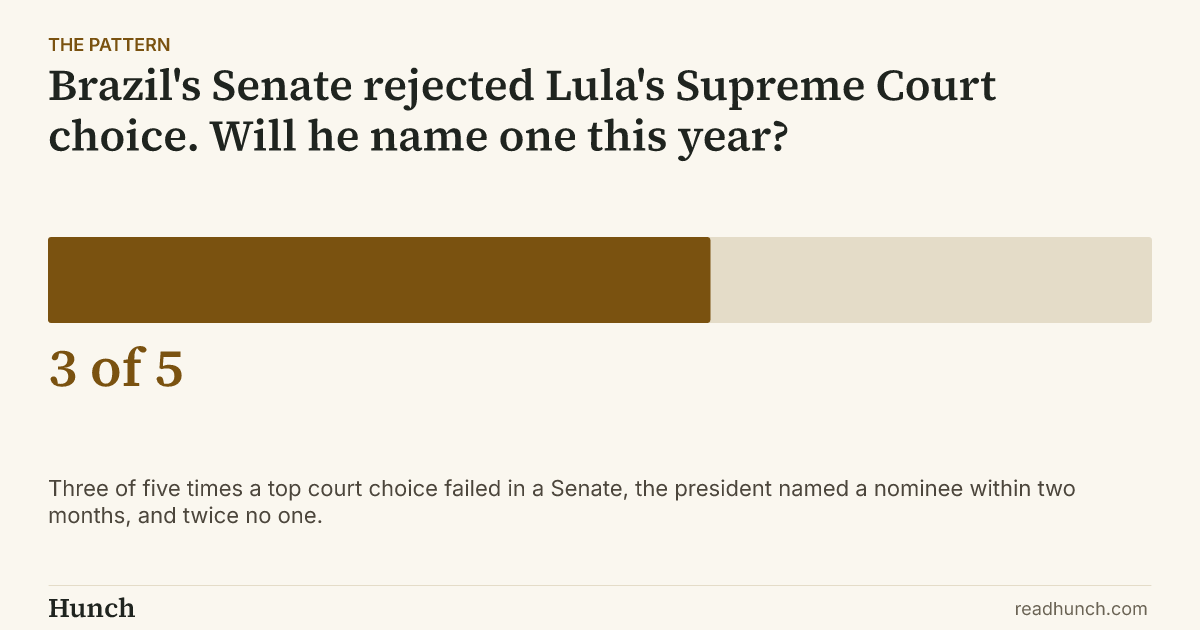
We looked for cases where a president’s choice for the country’s top court failed in the Senate after 1900, and a newly elected Senate was due to sit within about three months. We found five such times, four in the United States and one in Argentina. Brazil has none in this period: before Messias, its Senate last turned down a choice for the Supreme Court in 1894. (Federal Judicial Center; US National Archives; Casa Rosada; Folha de S.Paulo)
Show the other 3 cases
The Read
When a past president named someone, it came fast. Cristina Fernández de Kirchner sent two new names on the same day she withdrew hers in 2015. Warren Harding named Pierce Butler again within 14 days in 1922, and Dwight Eisenhower named John Marshall Harlan again within 62 days in 1954. The two who named no one, Lyndon Johnson in 1968 and Barack Obama in 2016, were about to leave office. Lula has just won a new term, and by 195 days have passed since the Senate rejected Messias with no new name.
There are reasons for doubt. In none of those five times did the Senate vote the name down: it fell without a vote or was withdrawn. Harding and Eisenhower sent the same name again to a new session or a new Senate, while Brazil’s rules block a vote on Messias until the session that starts in February. When US senators did vote a choice down, in 1930, 1969, 1970 and 1987, the president named another person within two months. In Argentina, after the Senate voted down two choices in , the court still had only three judges in , and the leader of the president’s own senators called for the empty seats to be filled.
Sources: Casa Rosada, Federal Judicial Center (2, 3, 4), American Presidency Project, Folha de S.Paulo (2), Buenos Aires Times, La Nación
Disclaimer
Hunch works only from sources that are publicly available, and publishes on the basis of analysis of that material. We do not form an editorial opinion or take sides, we give a simpler and wider view of news that already exists. If information in a source we used was inaccurate, distorted, or later disputed but had already entered our analysis, Hunch accepts no liability for that. Predictions are not advice. Phase 1 markets use Hunch Points, not money.
Published by Hunch under the Editorial Code. Complaints and corrections: /contact/.