Shabana Mahmood tells police to use the powers they have. Will ministers add more?
The home secretary told chief constables on Thursday to make full use of their powers against masked anti-migrant protests in Dover and Portsmouth.
What happened
At an online meeting with senior officers on Thursday , the home secretary Shabana Mahmood told police to make full use of their powers, including bans on face coverings, against far-right anti-migrant groups after protests at Dover on and Portsmouth on , where officers were assaulted, ports were disrupted and nobody was arrested.
At the online meeting on , the Home Secretary named the tools she expected police to use: bans on face coverings, body-worn video, facial recognition, CCTV and automatic number plate recognition. The meeting was called before a weekend when more protests are expected. Her instruction was about using the law as it stands, and did not change it.
Policing minister Sarah Jones gave the facts to the Commons three days earlier. At around 7.30am on Saturday about 150 people, many masked, arrived at the Port of Dover. Kent Police called it a no-notice protest, meaning police were not told in advance.
The next evening more than 200 people blocked coaches at Eastney Marina near Portsmouth, after a boat carrying about 120 people reached British waters. Hampshire officers used an order to leave the area, batons and PAVA spray, a pepper spray, before the crowd broke up at 4am. No arrests were made at either protest.
The face-covering power is new. Under the Crime and Policing Act, in force since April, a police force can name an area where hiding your identity at a protest is an offence. The penalty is a fine of up to £1,000 or a month in prison. The BBC reports that police chiefs are now considering using it. The open question is whether ministers go further than telling police to act.
Sources: Guardian, Home Office, BBC
The Pattern
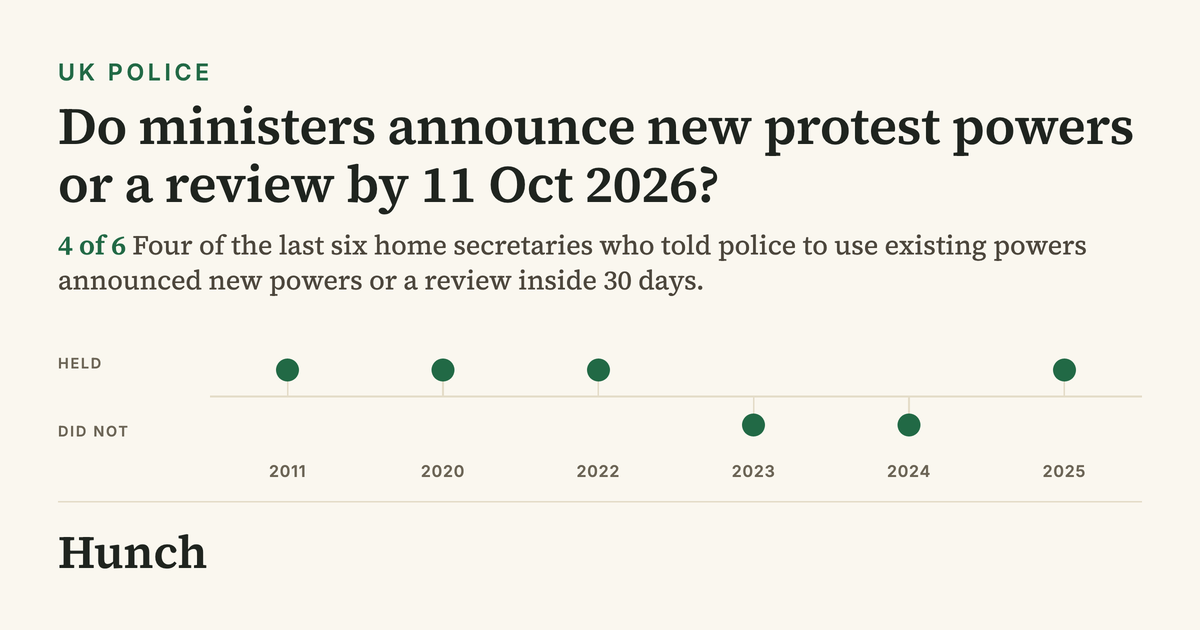
Since 2011 we found six times a Home Secretary did this. Each one publicly stepped into a live wave of protests to tell police forces to use the powers they already had. We asked whether ministers announced new or wider police powers, or ordered a formal review of protest policing, within the next 30 days.
Show the other 4 cases
The Read
History leans towards new powers or a review. In four of the six past cases, ministers offered police something more within 30 days, and all four came within a fortnight. This week looks similar. The instruction was given in private and reported the same day. The policing minister had already made a Commons statement on with nothing new in it. The Home Office is also answering criticism that it treats far-right protest more gently than climate protest.
The doubt is that this government has just passed a law. The Crime and Policing Act took effect in April with the face-covering power. The changes promised in on the combined effect of repeated protests are already law, and a review of public order and hate crime was announced in . So ministers can argue that police have the tools and the failure was on the ground.
The pattern fails if the Home Office holds that line into October, or if the weekend passes quietly and the pressure lifts. In the two past cases without new powers or a review in time, 2023 and 2024, nothing came within the month.
Disclaimer
Hunch works only from sources that are publicly available, and publishes on the basis of analysis of that material. We do not form an editorial opinion or take sides, we give a simpler and wider view of news that already exists. If information in a source we used was inaccurate, distorted, or later disputed but had already entered our analysis, Hunch accepts no liability for that. Predictions are not advice. Phase 1 markets use Hunch Points, not money.
Published by Hunch under the Editorial Code. Complaints and corrections: /contact/.