Tue, 19 May 2026
Hunch
US midterms6 Oct 2026

Maine voted for Kamala Harris. Will it keep Republican Susan Collins in the Senate?

Republican senator Susan Collins faces Democrat Troy Jackson on 3 November. Polls show a tie or Collins 3 points ahead.
5 min read

What happened

Republican senator Susan Collins faces former Maine Senate president Troy Jackson, with polls showing a tie or Collins slightly ahead before their debate on .

Republican senator Susan Collins, in the Senate since 1996, faces Troy Jackson on . Jackson is a former president of the Maine Senate. Graham Platner won the Democratic primary and then withdrew. The two candidates debate on Tuesday .

A CBS poll has the race tied, and a New York Times/Siena poll two weeks ago put Collins 3 points ahead. In that poll 44% of women and 13% of Democrats backed Collins, and she led 51 to 45 among other voters.

Kamala Harris won Maine by about seven points in 2024, and Democrats run the governor’s office and the state legislature. In 2020 polls showed Collins losing, and she won by about 8.6 points while Joe Biden carried the state by about nine.

Collins chairs the Senate committee that decides government spending. She voted to convict Donald Trump after , and against two of his nominees and his big budget bill. Democrats link her to the immigration agency ICE, because she voted for its funding.

Sources: The Independent

The Pattern

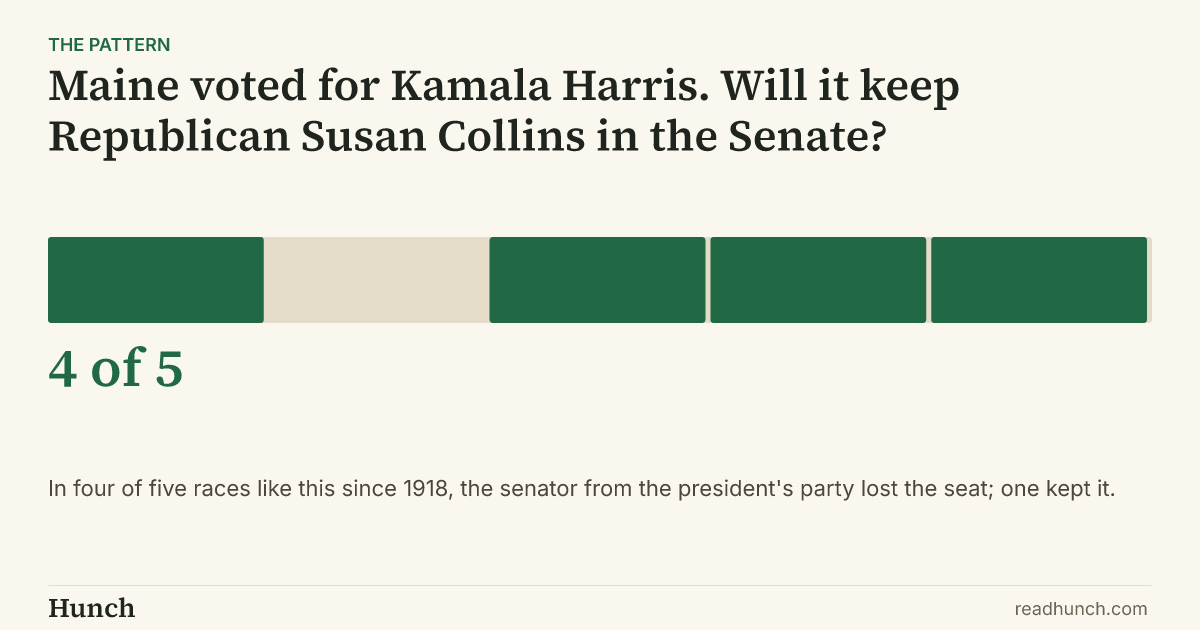
We looked for cases where a senator from the president’s party ran again in a midterm in a state that had voted for the other party for president, while chairing a Senate committee and facing a governor from the other party. We found five since 1918, all with the president under 50% approval or not yet measured. Only one kept the seat.

4 of 5
In four of five races the senator lost. Those who lost ran only 0.1 to 3.5 points ahead of their party's presidential candidate in the state; the one who won ran 29.8 points ahead. Editorial scoring note: Score the final election result, including a runoff, rather than a fixed 28-day window. Louisiana 2014 therefore counts as a loss despite its 32-day runoff. This gives four losses in five elections and two losses by more than eight points. The existing market resolution rules are unchanged.
2014 Louisiana, Landrieuheld
2014: Democrat Landrieu chaired the energy committee in a state her party lost with 40.6% in 2012. She led the first round, then lost the run-off on , 44.1% to 55.9%. Editorial scoring note: Score the final election result, including a runoff, rather than a fixed 28-day window. Louisiana 2014 therefore counts as a loss despite its 32-day runoff. This gives four losses in five elections and two losses by more than eight points. The existing market resolution rules are unchanged. (Office of the Clerk, election statistics)
2006 Maine, Snowenot held
2006: Republican Snowe chaired the small business committee in a state her party lost with 44.6% in 2004. Bush’s approval was 38%. She won 74.4% to 20.8%. Editorial scoring note: Score the final election result, including a runoff, rather than a fixed 28-day window. Louisiana 2014 therefore counts as a loss despite its 32-day runoff. This gives four losses in five elections and two losses by more than eight points. The existing market resolution rules are unchanged. (Office of the Clerk, election statistics)
Show the other 3 cases
1926 Oklahoma, Harreldheld
1926: Republican Harreld chaired the Indian affairs committee in a state Coolidge lost 42.8% to 48.4% in 1924. He lost to Thomas 44.1% to 55.4%. Editorial scoring note: Score the final election result, including a runoff, rather than a fixed 28-day window. Louisiana 2014 therefore counts as a loss despite its 32-day runoff. This gives four losses in five elections and two losses by more than eight points. The existing market resolution rules are unchanged. (Office of the Clerk, election statistics)
1918 Illinois, Lewisheld
1918: Democrat Lewis chaired a committee in a state Wilson lost 43.3% to 52.6% in 1916. He lost to McCormick 44.9% to 50.5%. Editorial scoring note: Score the final election result, including a runoff, rather than a fixed 28-day window. Louisiana 2014 therefore counts as a loss despite its 32-day runoff. This gives four losses in five elections and two losses by more than eight points. The existing market resolution rules are unchanged. (Official vote of the State of Illinois, 1918)
1918 Delaware, Saulsburyheld
1918: Democrat Saulsbury chaired a committee in a state his party lost 47.8% to 50.2% in 1916. He lost to Ball 47.8% to 51.2%. Editorial scoring note: Score the final election result, including a runoff, rather than a fixed 28-day window. Louisiana 2014 therefore counts as a loss despite its 32-day runoff. This gives four losses in five elections and two losses by more than eight points. The existing market resolution rules are unchanged. (World Almanac 1920)

The Read

Past races point against Collins. In four of five similar races since 1918, the senator from the president’s party lost, by 3.4 to 11.8 points. Those who lost ran only 0.1 to 3.5 points ahead of their party’s presidential candidate in the state. Collins needs much more, because her party lost Maine by about seven points in 2024.

The one who kept the seat was also from Maine: Snowe in 2006, who ran 29.8 points ahead of her party. Two of the five races took place on the same day in 1918, and three came before anyone measured a president’s approval. Collins has many votes against her party’s leader, which none of the past races can be compared on, and in 2020 she beat the polls by a wide margin.

The debate on and polls through October will show whether Collins still runs well ahead of her party.

Disclaimer

Hunch works only from sources that are publicly available, and publishes on the basis of analysis of that material. We do not form an editorial opinion or take sides, we give a simpler and wider view of news that already exists. If information in a source we used was inaccurate, distorted, or later disputed but had already entered our analysis, Hunch accepts no liability for that. Predictions are not advice. Phase 1 markets use Hunch Points, not money.

Published by Hunch under the Editorial Code. Complaints and corrections: /contact/.

Comment

Comments are moderated. Members post under their prediction record.