Congress rarely delays a rule weeks before it starts. Will Medicaid's?
The US government told states on 13 November they need not remove anyone from Medicaid for not working until July. The rule still starts on 1 January.
What happened
The decision also could give some breathing room to Congress to consider changes to the requirement.
A US law from 2025 says many adults on Medicaid must work, study or volunteer. Medicaid is public health insurance for people on low incomes. The rule asks for at least 80 hours a month and covers people who joined under an expansion in 40 states. The law says states must start it no later than .
…beginning not later than the first day of the first quarter that begins after December 31, 2026…
Public Law 119-21, section 71119, 2025
On the government gave states more time. The Centers for Medicare and Medicaid Services (CMS) said states do not have to remove anyone or refuse cover for missing the rule until . States must still check from January who meets the rule, and they may choose to act earlier. A change by CMS is not a change in the law.
Democrats want a full delay, and they take control of both chambers of Congress in January. That week Senator Ron Wyden and Representative Frank Pallone asked CMS to delay the rule. Until January, Republicans hold the majority in both chambers, and Congress must agree new money to keep the government open by . A delay written into law this year would need their votes and the signature of President Donald Trump.
Sources: PBS NewsHour, GovInfo, NBC News (2), The Guardian
The Pattern
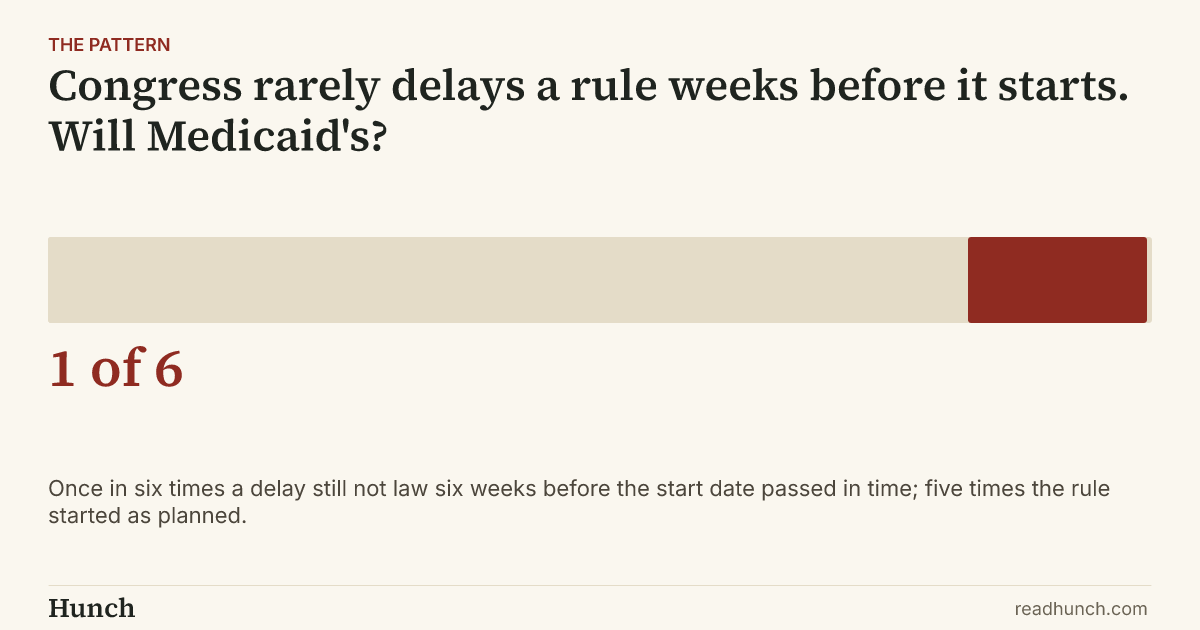
We looked for cases where the US Congress had a plan on the table to delay or end a rule set by an earlier law, and about six weeks before the start date the change was still not law. We found six such plans since 2009. Four of them were in 2013, when Republicans in the lower chamber tried to delay parts of President Barack Obama’s health law.
Show the other 4 cases
The Read
Only one of the six plans became law this close to the start. In Congress moved the switch to digital TV six days before it was due. Between 2012 and 2013 the lower chamber passed five delays or repeals, and none became law in time; four times the Senate did not vote at all. When Congress did delay rules, it usually wrote the delay into a yearly spending law eight months to two years before the start.
There are reasons for doubt. None of the six plans came in the weeks between an election and a handover of Congress to the other party, as now. Four of the six were 2013 attempts to delay parts of President Barack Obama’s health law. In two of those the government had already given its own delay, as CMS did on , and Congress then passed no law before the start.
Sources: GovInfo (2, 3, 4, 5, 6), The Guardian (2), IRS, PBS NewsHour
Disclaimer
Hunch works only from sources that are publicly available, and publishes on the basis of analysis of that material. We do not form an editorial opinion or take sides, we give a simpler and wider view of news that already exists. If information in a source we used was inaccurate, distorted, or later disputed but had already entered our analysis, Hunch accepts no liability for that. Predictions are not advice. Phase 1 markets use Hunch Points, not money.
Published by Hunch under the Editorial Code. Complaints and corrections: /contact/.