Friedrich Merz loses two more state votes. Past chancellors nearly all stayed on.
Exit polls show Friedrich Merz's party beaten in Berlin and far behind the far right in Mecklenburg. He says he will stay as chancellor.
What happened
Exit polls in Berlin and Mecklenburg-Vorpommern show heavy losses for Friedrich Merz’s CDU. He called the result a disaster and said he would stay in office.
Polls closed at 18:00 on Sunday . In Mecklenburg-Vorpommern, exit polls put the CDU only just above 5%, the share a party needs to win seats, and the far-right AfD on course to win most votes. In Berlin the CDU was behind Die Linke, the Left party.
Merz said he would carry on with his coalition’s plans on tax, welfare and the economy.
Two weeks earlier the AfD won Saxony-Anhalt with 43.8%, while the CDU fell to 17.2%, about half of what it took in 2021. It was the first time since the Second World War that a far-right party came close to running a German state.
Since then there has been more talk of a Kanzlertausch, a change of chancellor in the middle of the term. On the heads of eight German state governments, all from the CDU, published a joint statement. They said their party needed listening and action rather than arguments about people. Merz has been in office 16 months.
Merz also cancelled a planned speech at the United Nations in New York because he was needed in Berlin. He called the CDU leadership together for Sunday evening.
Two possible replacements are being named: Hendrik Wuest, head of the North Rhine-Westphalia government, and Markus Soeder, head of the Bavarian government. Both have backed Merz. The next federal election is due in 2029.
Sources: BBC (2), The Guardian (2)
The Pattern
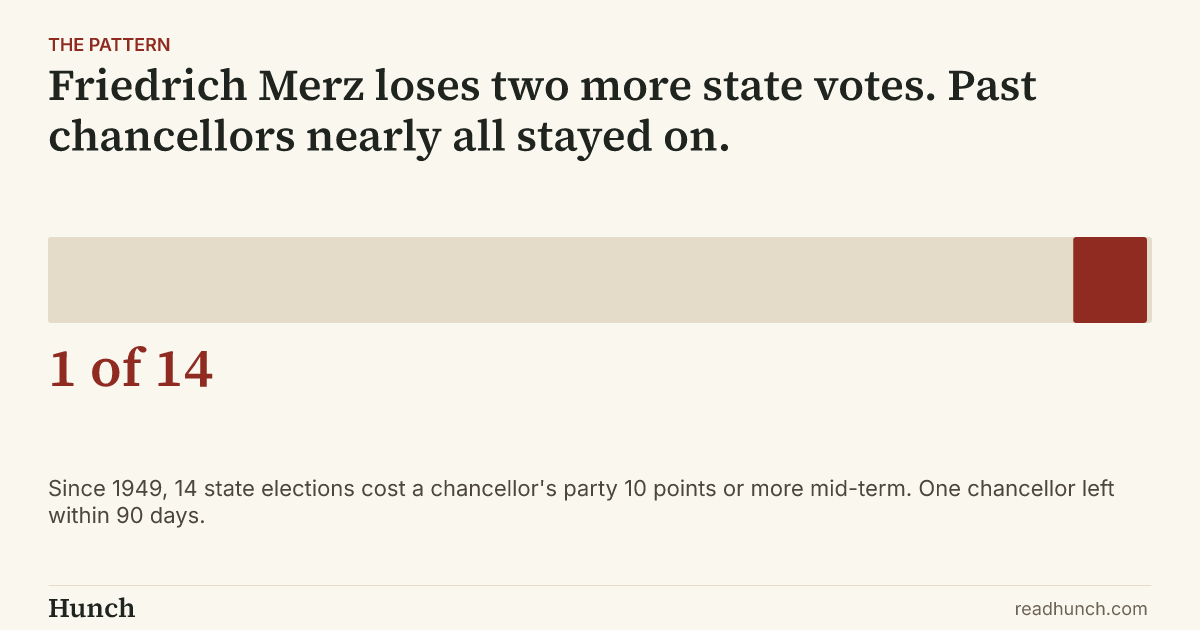
We looked for every German state election since 1949 where the sitting chancellor’s own party lost 10 points or more, with more than a year left before the next federal election. Then we checked whether that chancellor was still in office 90 days later. We found 14 such defeats. Five chancellors account for them, and six belong to Angela Merkel. Hesse and Lower Saxony voted on the same day in 2003 and were read as one verdict on Gerhard Schroeder, so they count as one. The list also crosses reunification in 1990, which added five states and changed the party system.
Show the other 12 cases
The Read
History says Friedrich Merz is likely to still be chancellor on . Heavy state defeats are common for German chancellors, and after 13 of the 14 the chancellor was still in office three months later. The one who went, Willy Brandt, left 65 days after Hamburg in 1974 because a close aide was exposed as an East German spy. In this record no state election on its own removed a chancellor.
The record is less sure than it looks. Five chancellors make up all 14 cases, six of them Angela Merkel’s, and the list crosses reunification. This time also has features the record has not seen. It is the third heavy defeat in a month, the CDU may drop out of a state parliament altogether, the AfD leads national polls, and people inside his own party are discussing a change of chancellor by name.
The rules still protect him. A German chancellor leaves only if he resigns, or if the Bundestag, the federal parliament, votes in a named successor, and no majority for that exists. The picture would change if a senior Christian Democrat spoke out against Merz, or if the Social Democrats left the coalition. Either would turn a debate in the press into a formal process, a step the record never reached.
Disclaimer
Hunch works only from sources that are publicly available, and publishes on the basis of analysis of that material. We do not form an editorial opinion or take sides, we give a simpler and wider view of news that already exists. If information in a source we used was inaccurate, distorted, or later disputed but had already entered our analysis, Hunch accepts no liability for that. Predictions are not advice. Phase 1 markets use Hunch Points, not money.
Published by Hunch under the Editorial Code. Complaints and corrections: /contact/.