Friedrich Merz's coalition agrees 34 reforms. Most such plans became law.
After 7 hours of talks, Germany's CDU, CSU and SPD agreed tax cuts, pension changes and stricter sick-leave rules. The far-right AfD leads the polls.
What happened
Merz’s coalition unveils 34 reform measures — tax cuts for low and middle earners, a pension overhaul and new sick leave rules — in a bid to revive the economy and counter the AfD surge.
Germany’s governing parties agreed 34 reforms on . Chancellor Friedrich Merz’s Christian Democrats (CDU and CSU) and the Social Democrats (SPD) made the deal after seven hours of talks, ending months of deadlock inside the coalition.
The plan is called the ‘Programme for Revival and Employment’. It cuts income tax by about €10bn a year for people on lower and middle incomes from . It keeps the 42% top rate but changes the upper bands, with 45% above €250,000 and 47% above €280,000.
The harder measures deal with Germany’s long-running problems. The retirement age, now 65 to 67, would rise step by step in line with life expectancy. The sick note by telephone, brought in during the pandemic, ends. Workers will need a doctor’s certificate from the first day of illness, where today it is the fourth.
The political pressure is high. The CDU and CSU trail the far-right AfD in national polls, and important state elections in eastern Germany come in September. The coalition presents the package as its answer to the rise of the AfD.
Sources: Al Jazeera, Politico
The Pattern
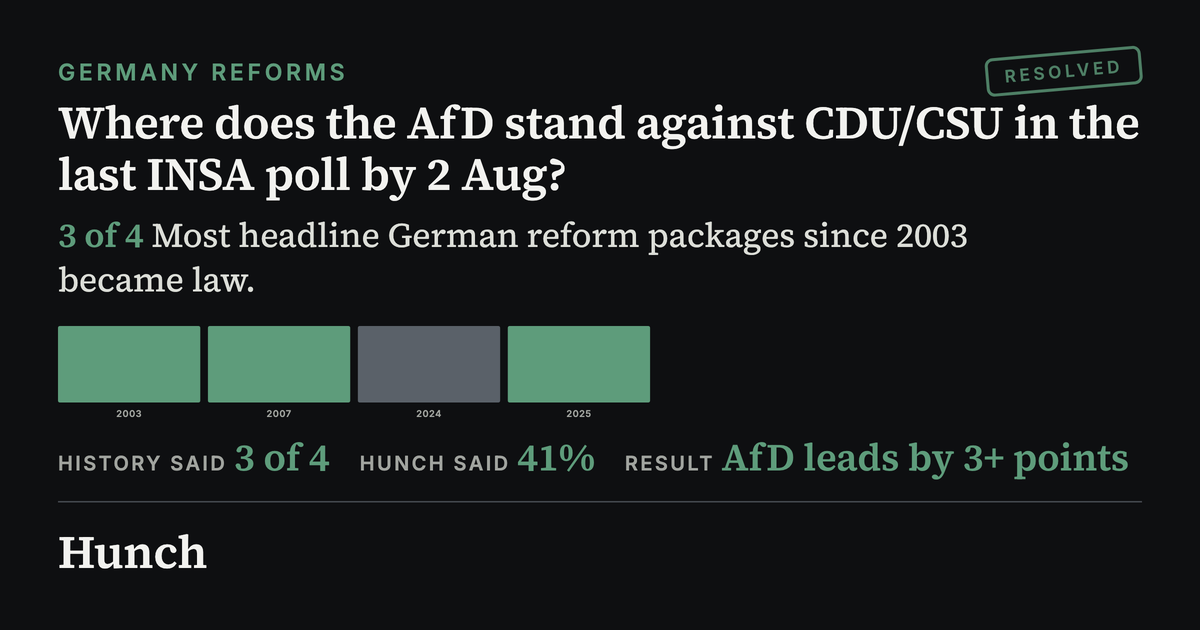
We looked for the big reform packages that German federal governments announced since 2003, and checked whether they became law. We found four. Three did, in 2003, 2007 and 2025. The one that failed is the most recent: Olaf Scholz’s 49 measures of 2024, most of which never became law after his coalition collapsed that November.
Show the other 2 cases
The Read
History leans towards the package becoming law. Three of the four big packages since 2003 did. This coalition has also moved fast when under pressure. In 2025 the €500bn fund went from announcement to a change in the constitution in under a month. The money for the tax cuts is settled and they are easy to sell to voters. That is the kind of law a government pushes through before an autumn of elections.
The weak spots are real. German law-making slows in summer, and cabinet business thins sharply from mid-July. The hardest measures, the retirement age and the sick-note rules, are the ones SPD members will fight at every stage of drafting. The closest case is also the most recent. In a coalition under pressure from the far right announced 49 measures, and by November that coalition was gone.
Disclaimer
Hunch works only from sources that are publicly available, and publishes on the basis of analysis of that material. We do not form an editorial opinion or take sides, we give a simpler and wider view of news that already exists. If information in a source we used was inaccurate, distorted, or later disputed but had already entered our analysis, Hunch accepts no liability for that. Predictions are not advice. Phase 1 markets use Hunch Points, not money.
Published by Hunch under the Editorial Code. Complaints and corrections: /contact/.