London police plan fixed face-scan cameras. Most such plans went ahead unchanged.
Met Police chief Sir Mark Rowley announced fixed facial recognition cameras on London's streets and police drone cover of every borough by June 2027.
What happened
Rowley announced static LFR cameras on street infrastructure and drone coverage of all London boroughs by , warning that crime is “evolving at speed”.
Sir Mark Rowley, head of London’s Metropolitan Police, set out the plan in a speech on . The new live facial recognition (LFR) cameras will be fixed on the street and watched remotely. They can be moved to areas with more crime, and the rollout continues into next year.
Rowley said LFR has led to more than 2,000 arrests since 2024. He also wants police drones to cover all 32 London boroughs by , as part of a city-wide emergency drone network built with London’s other emergency services.
Rowley argued that criminals are going digital. He asked for lighter rules before new tools are used, and warned that police could be outwitted by criminals using AI.
Big Brother Watch, a privacy campaign group, called facial recognition intrusive, discriminatory and undemocratic, and said its use was spiralling out of control. Its director, Silkie Carlo, said police drones watching how people behave in public were excessive and counterproductive.
No law is written just for LFR. The fight over the rollout now moves to the London mayor’s office at City Hall, to the government and possibly to the courts.
Sources: Metropolitan Police
The Pattern
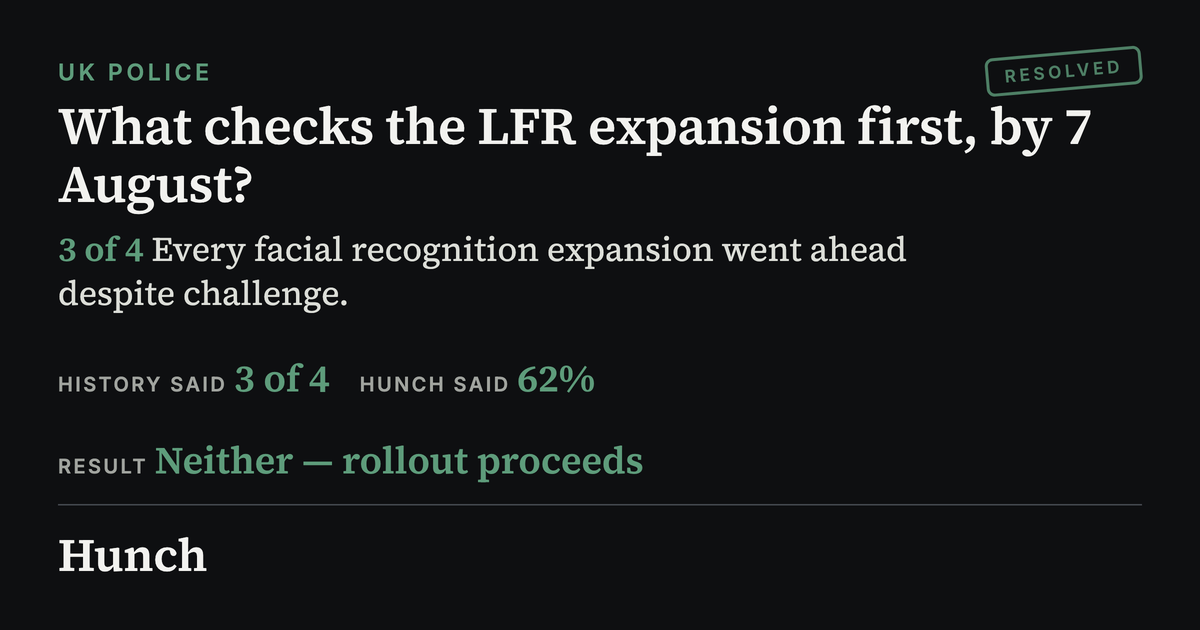
We looked at the big steps in UK police use of facial recognition since 2016 that met public or legal objections, and checked whether each went ahead unchanged. We found four. Three did. The exception was South Wales Police, after the Court of Appeal ruled its use unlawful in 2020. The force paused, rewrote its rules and started again.
Show the other 2 cases
The Read
History favours the rollout going ahead through the summer untouched. Objections have never stopped a UK facial recognition rollout, and the politics are on the Met’s side. More than 2,000 arrests is a strong number, ministers want visible action on crime, and nobody in government is offering tighter rules. The 62% on ‘neither’ reflects ten years of that record.
The weak spot is that fixed cameras are a different matter in law from cameras on vans. A van is used for a short time in one place. A permanent network watching everyone who walks past is closer to the use that the court found unlawful for South Wales Police in 2020. Big Brother Watch has gone to court before, and its warning sounds like a group building a case. One claim filed before would change the answer, and 24% on a motivated campaign group with a new target is far from nothing.
Disclaimer
Hunch works only from sources that are publicly available, and publishes on the basis of analysis of that material. We do not form an editorial opinion or take sides, we give a simpler and wider view of news that already exists. If information in a source we used was inaccurate, distorted, or later disputed but had already entered our analysis, Hunch accepts no liability for that. Predictions are not advice. Phase 1 markets use Hunch Points, not money.
Published by Hunch under the Editorial Code. Complaints and corrections: /contact/.